Ad examples

Nail care ad examples: 8 ideas for polish and cuticle care

Nail polish ads sell on three things shown on real hands: the shade in normal light, the shine and a chip-free fifth day. Cuticle care sells on a routine simple enough to start tonight. Here are eight ideas for a fictional brand, Varnelle, across a gel-look polish and a cuticle serum, each with its hook, angle, format and why it works.

8 ads2 live templates15 hooks

The swipe file

Each ad with its angle, its hook and why it works. Every brand is fictional. The ads were made with AI to show the idea.

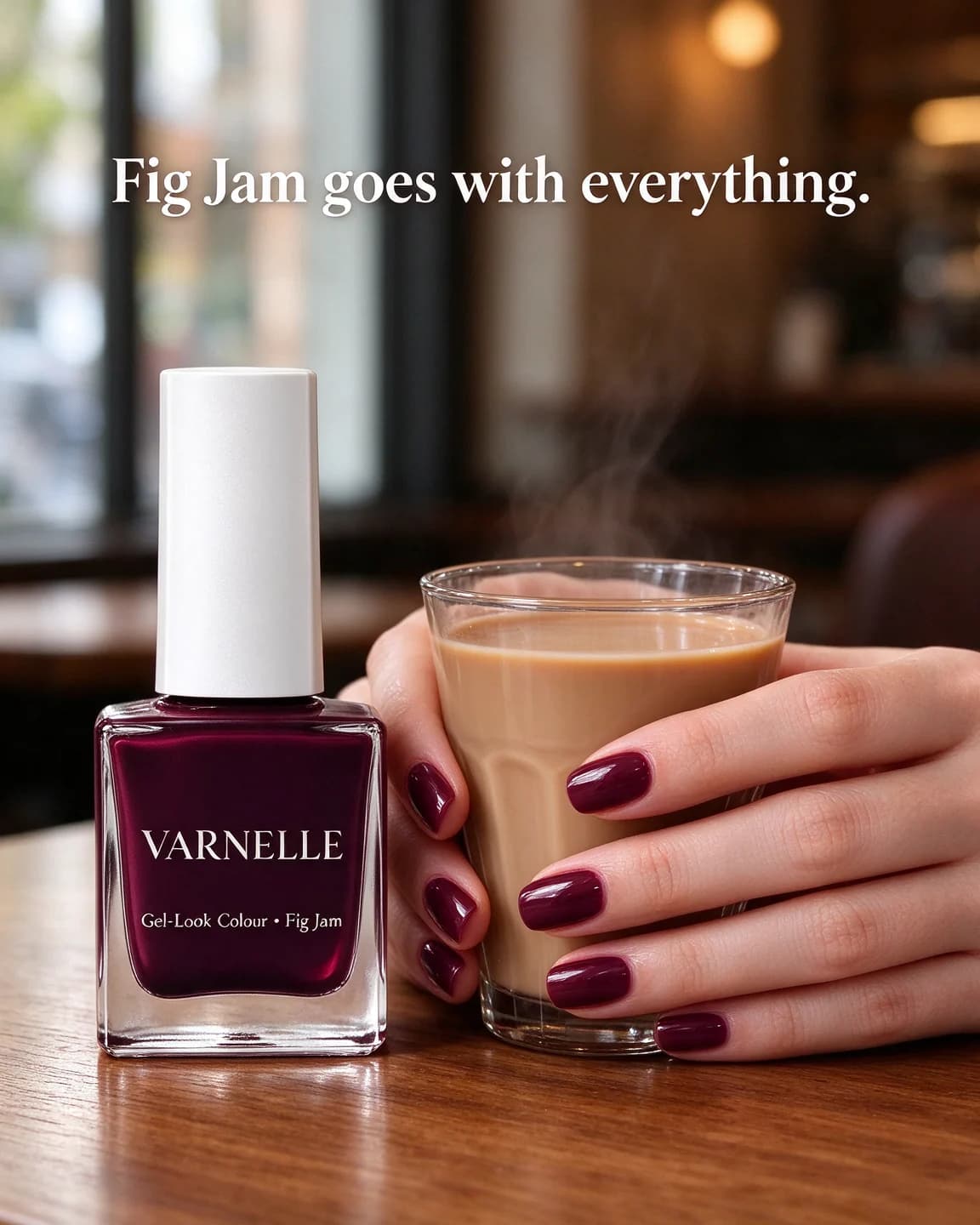
Two hands with glossy plum nails around a glass of chai on a café table beside a Varnelle Gel-Look Colour bottle in Fig Jam, headline "Fig Jam goes with everything."

VarnelleColour in contextFeed · 4:5 image

“Fig Jam goes with everything.”

Hands around a cup are how people see their own nails all day, so the shade appears in the light and setting it will be worn in. The nails here are AI-made, so the live version should use a real photo of Fig Jam on a real nail.

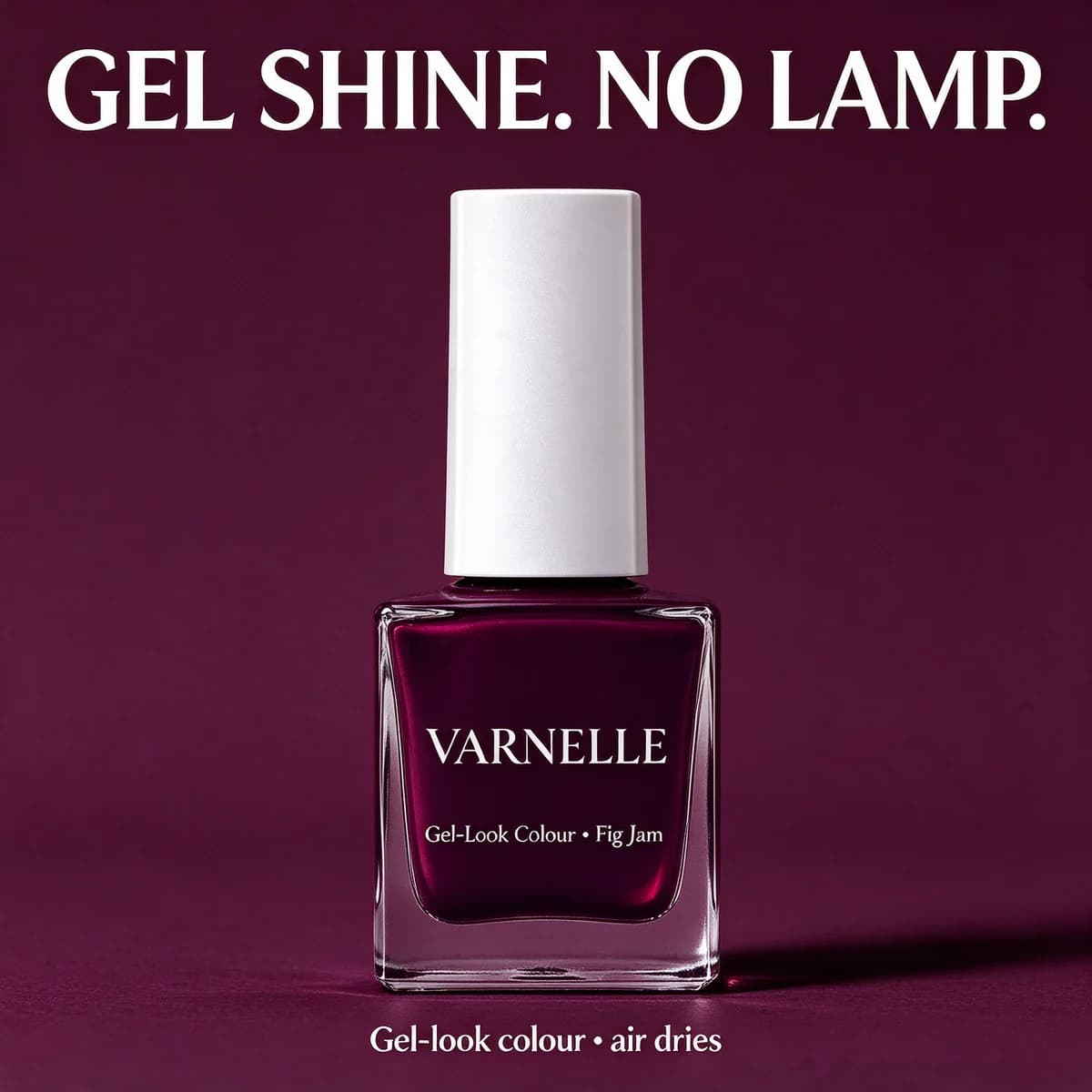
A Varnelle Gel-Look Colour bottle centred on a flat deep plum background with a hard shadow, giant headline "GEL SHINE. NO LAMP." and the line "Gel-look colour · air dries"

VarnelleObjection killerFeed · 1:1 image

“Gel shine. No lamp.”

It names what gel fans want, the shine, and what they don't, the lamp and the salon removal, in four words. 'Gel shine' is a comparison, so check the finish side by side with a real gel manicure before you print it.

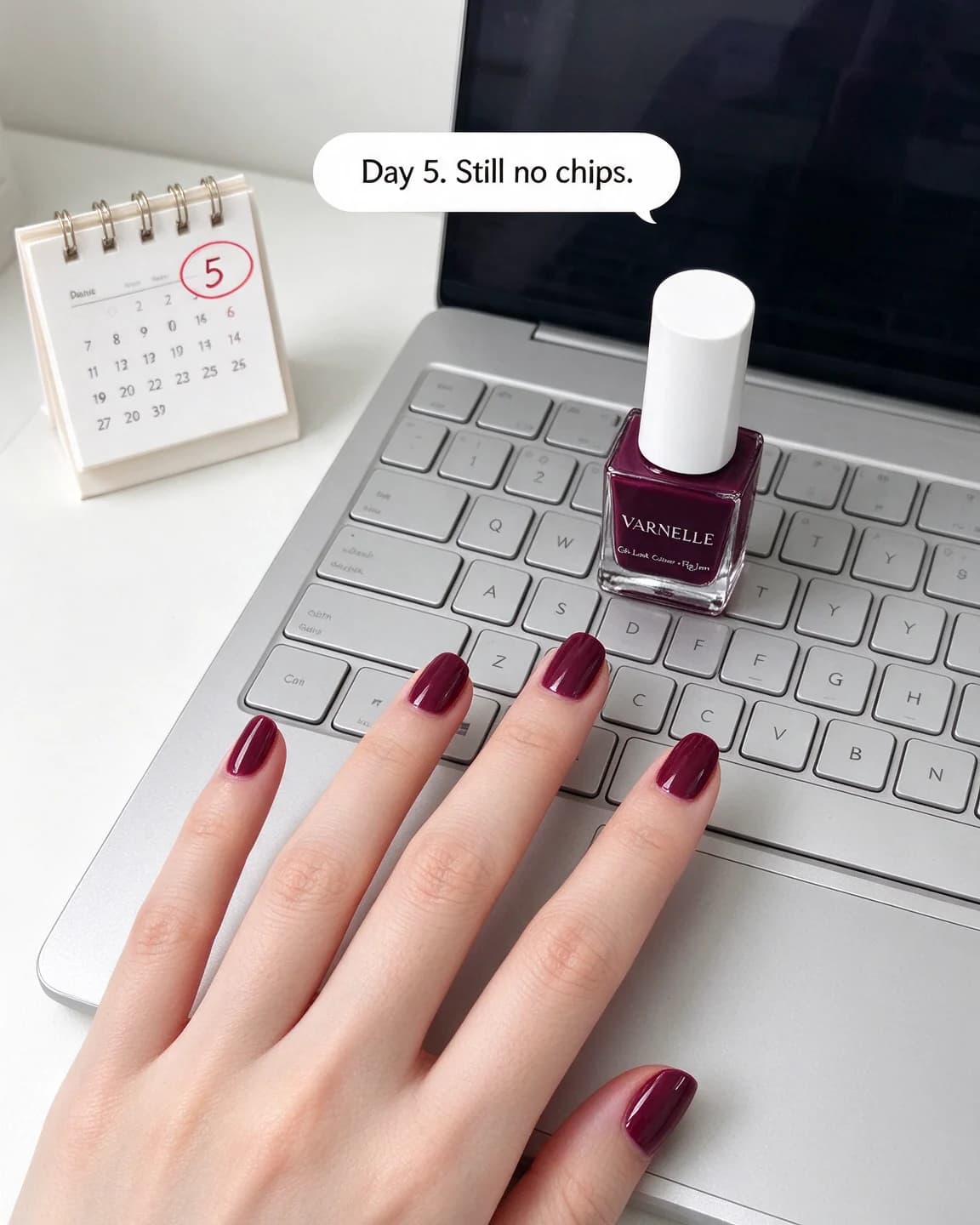
A hand with glossy plum nails on a laptop keyboard beside a Varnelle polish bottle and a desk calendar with the 5 circled, with a speech bubble reading "Day 5. Still no chips."

VarnelleWear proofFeed · 4:5 image

“Day 5. Still no chips.”

A dated wear check is the proof nail buyers look for in reviews, and the keyboard shows the daily wear that causes chips. Shoot real day-five nails before running it, because edited nails in a wear ad are exactly what regulators rule against.

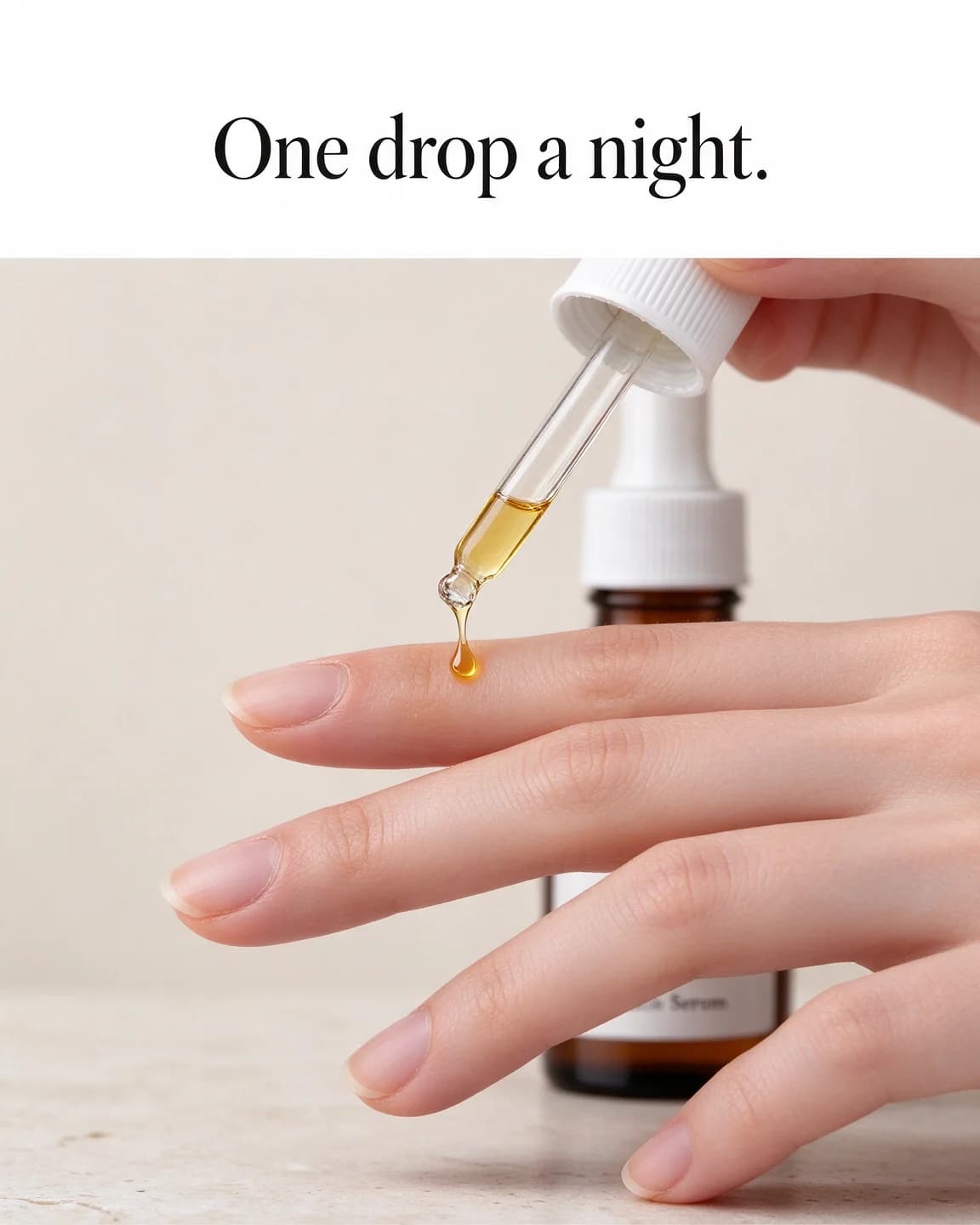
Macro shot of a glass dropper releasing one golden drop of Varnelle Cuticle Serum onto the cuticle of a bare nail, the amber bottle blurred behind, headline "One drop a night."

VarnelleCare ritualFeed · 4:5 image

“One drop a night.”

Showing the dose, one drop on the cuticle, turns a vague care product into a ten-second habit. It talks about the routine rather than promising stronger nails, which is easier to believe and to substantiate.

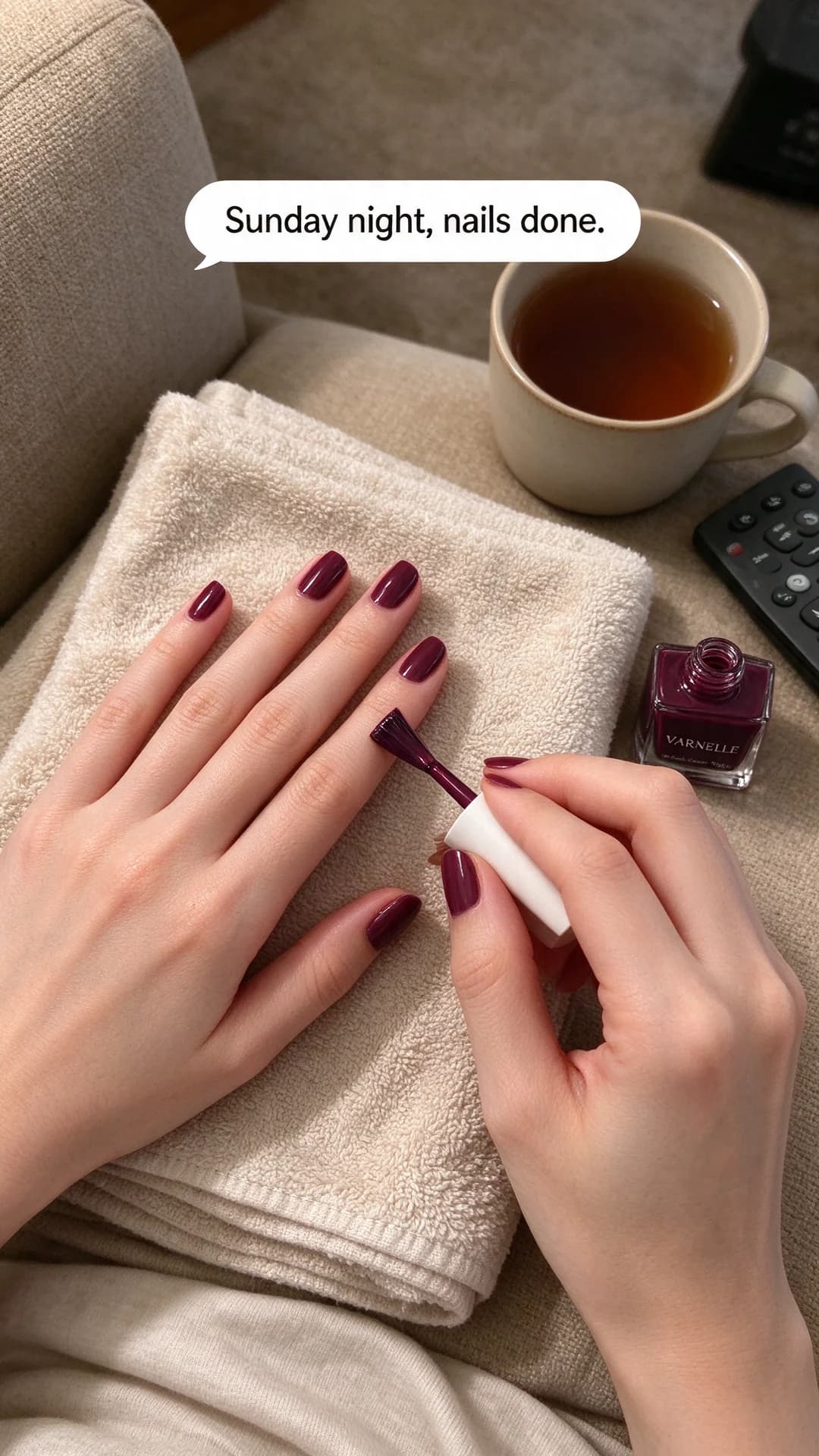
Overhead phone photo of a hand painting nails plum on a towel on a sofa beside an open Varnelle bottle and a mug of tea, with a speech bubble reading "Sunday night, nails done."

VarnelleUGC ritualStories · 9:16 image

“Sunday night, nails done.”

A weekly at-home manicure is a ritual many people already keep, and the caption names it in four words. The overhead phone-photo look reads like a friend's Story, with the open bottle right beside the hands.

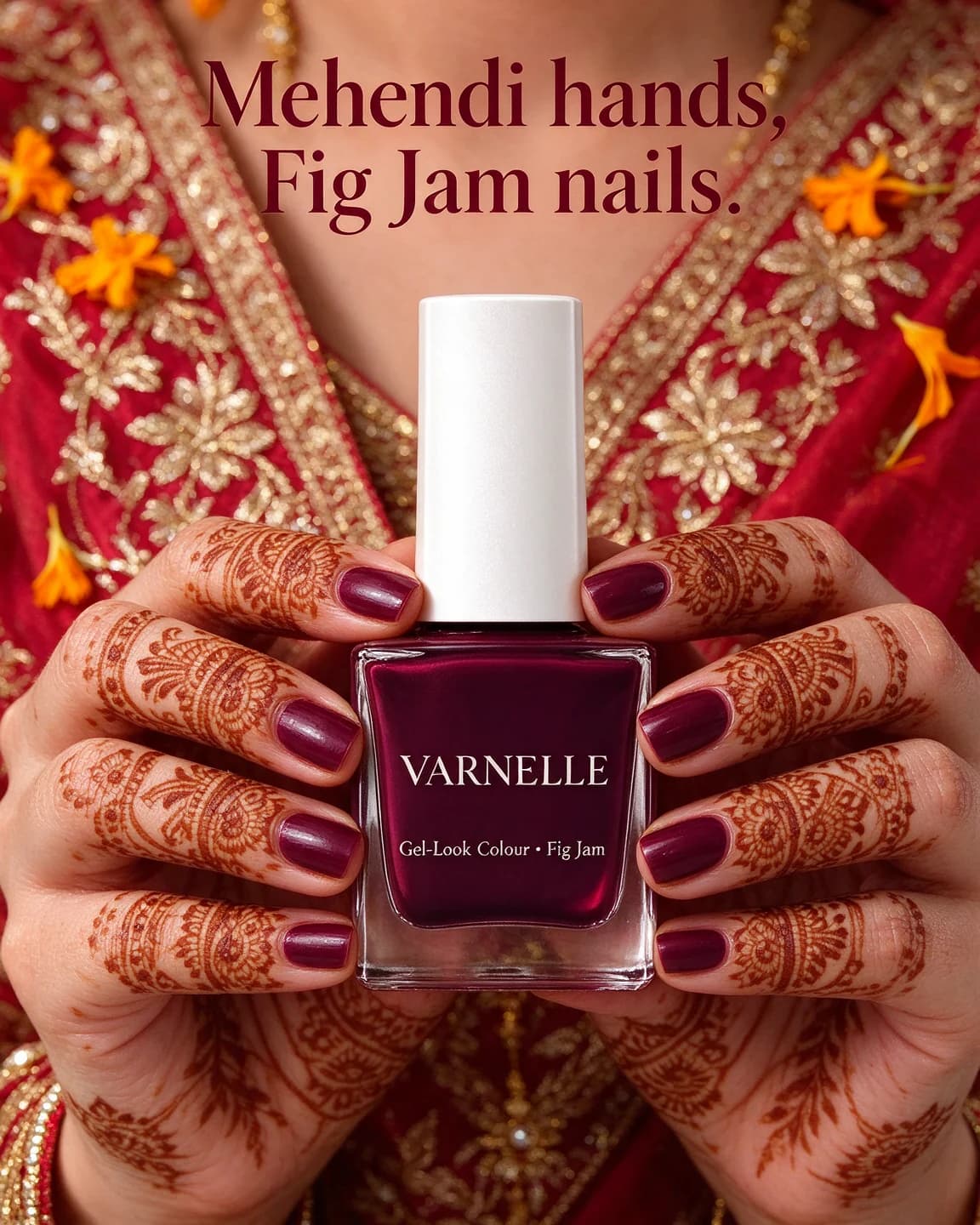
Two hands with fresh mehendi designs and glossy plum nails holding a Varnelle Fig Jam bottle against a gold-embroidered red dupatta, headline "Mehendi hands, Fig Jam nails."

VarnelleOccasionFeed · 4:5 image

“Mehendi hands, Fig Jam nails.”

Mehendi and fresh nail colour go together at many Indian weddings, so the ad sells a shade for a specific event rather than a vague season. The red and gold styling makes the plum look deliberate, and the date of the function gives a reason to order now.

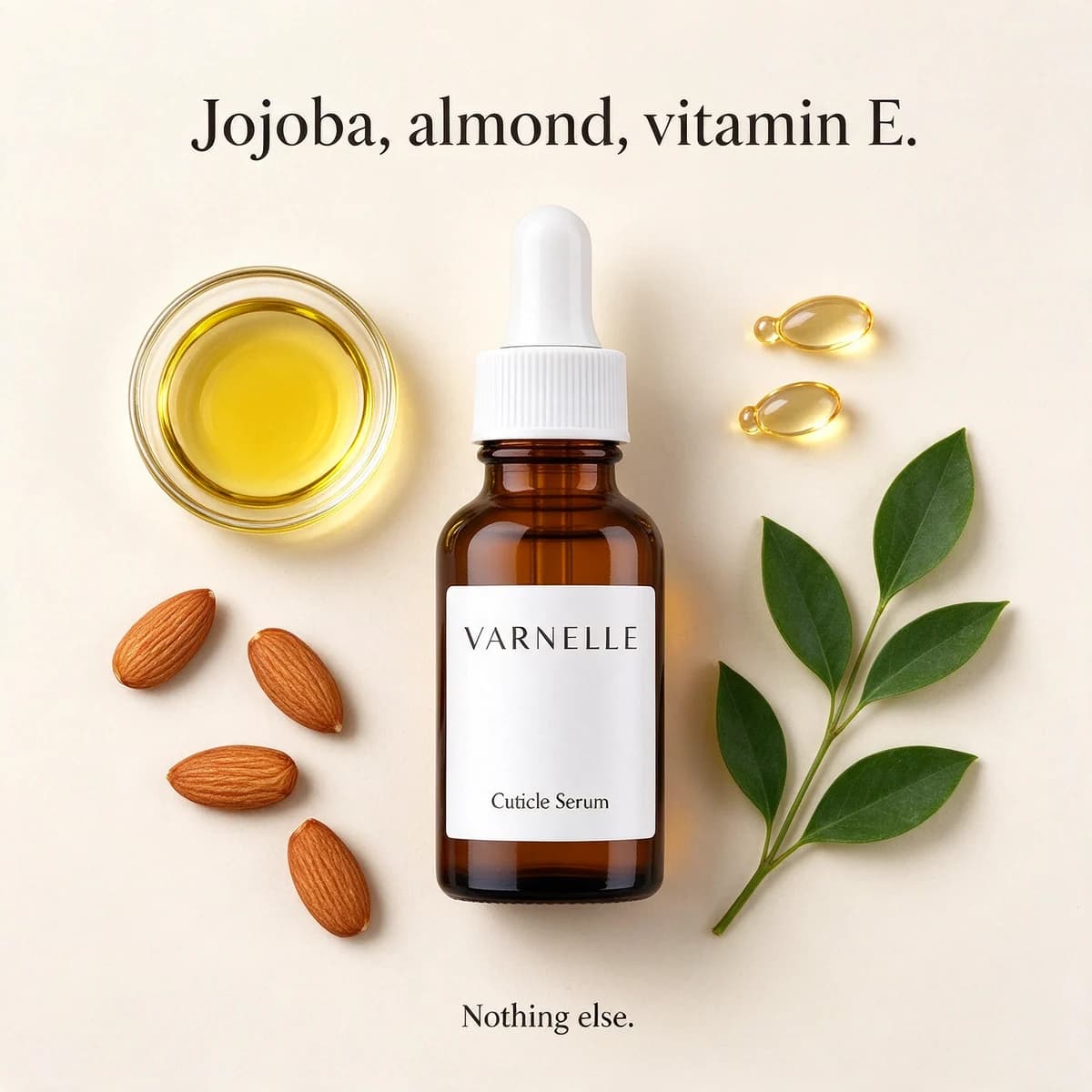
Top-down flat lay of a Varnelle Cuticle Serum bottle with a dish of golden oil, almonds and vitamin E capsules on cream, headline "Jojoba, almond, vitamin E." and the line "Nothing else."

VarnelleIngredient storyFeed · 1:1 image

“Jojoba, almond, vitamin E. Nothing else.”

A three-ingredient list is short enough to read on a thumbnail and specific enough to compare with other cuticle oils. 'Nothing else' only works if the label agrees, so check it against the full ingredient list first.

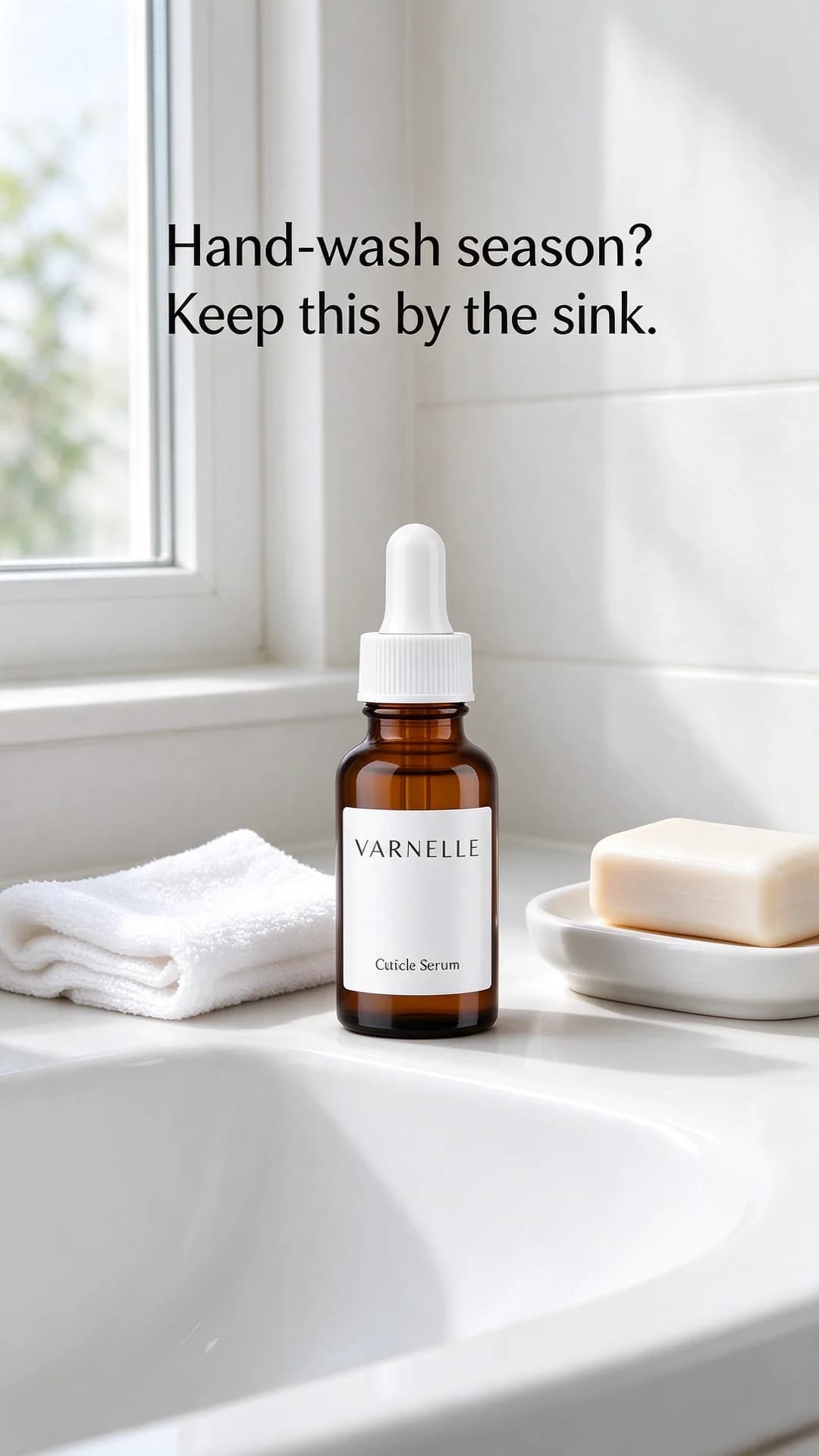
A Varnelle Cuticle Serum bottle on the edge of a white bathroom sink beside a bar of soap and a hand towel, headline "Hand-wash season? Keep this by the sink."

VarnelleSituation, not skinStories · 9:16 image

“Hand-wash season? Keep this by the sink.”

It names a situation, frequent hand-washing, instead of criticising the viewer's hands, which keeps it on the right side of Meta's appearance rules. Putting the bottle by the sink also tells people where to keep it, so the habit sticks.

Two more ways to try

  • VVarnelleSponsored

    What's in one drop

    VARNELLESERUM
    Jojoba oilSweet almond oilVitamin ENo added fragrance
    Cuticle SerumShop the serum

    Ingredient breakdown ad

    Four short labels around the bottle answer the ingredient question at a glance, and 'no added fragrance' covers the first thing many care shoppers check.

    Edit this template
  • VVarnelleSponsored
    The problem

    Hand-wash season dries out cuticles.

    The fix

    One drop of Cuticle Serum each night, massaged in.

    VARNELLESERUM
    Cuticle SerumShop the serum

    Problem–solution ad

    The problem is a situation everyone recognises rather than a flaw in the viewer's hands, and the fix is one specific step they can picture doing tonight.

    Edit this template

Angles to test first

  1. 1

    The shade in real life

    Nails around a cup, on a keyboard, on a steering wheel. Everyday settings show the colour in normal light and help people picture it on their own hands.

  2. 2

    Objections about gel

    Many polish buyers compare everything with salon gel: the shine, the lamp, the soak-off. Answer those directly, and say plainly what your formula is.

  3. 3

    Wear proof

    Day-five photos, a chip check after the washing-up, a week of typing. Real wear photos are the strongest proof in the category and the easiest claim to get wrong.

  4. 4

    Ritual and self-care

    The Sunday-night manicure, a drop of oil before bed. Routines sell care products without promising results you'd have to prove.

  5. 5

    Occasions

    Weddings, mehendi nights, festivals and holidays each come with a shade and a deadline, and the date gives the viewer a reason to buy now.

  6. 6

    Short ingredient lists

    For oils and treatments, three or four named ingredients are easier to trust than a count of what's been left out.

15 hooks for nail care ads

  • [Shade] goes with everything.
  • Gel shine. No lamp.
  • Day [5]. Still no chips.
  • One drop a night.
  • Sunday night, nails done.
  • Mehendi hands, [shade] nails.
  • [Oil], [oil], [ingredient]. Nothing else.
  • Hand-wash season? Keep this by the sink.
  • Dry to the touch in [the time you've tested].
  • No soak-off. Just ordinary remover.
  • The [plum] that doesn't turn [brown] under office lights.
  • Three shades for [wedding season].
  • Your [salon] shade, at [home].
  • What [five days of typing] does to a manicure.
  • [Two] coats or one? We tested both.

Moments to plan for

  • Wedding season (Nov–Feb in India)

    Mehendi-and-nails pairings and bridesmaid shade sets, with the last order date for delivery before the function.

  • Karva Chauth and Diwali (Oct–Nov)

    Festive reds and plums shot with diyas and gold fabric, with the shade name on the image.

  • Monsoon (Jun–Sep)

    Chip resistance shown with wet umbrellas and rainy commutes, if your wear tests support it.

  • Winter (Dec–Feb)

    Cuticle serum by the sink and the bed, for dry air and frequent hand-washing.

  • Summer holidays (Apr–Jun)

    Bright shades and pedicure framing for beach and travel, with travel sizes if you sell them.

  • New Year's Eve (Dec)

    Glossy deep shades and a quick top coat for party nights, shot under warm evening light.

Watch out for

  • Don't let editing, or AI, improve the nails. The ASA's guidance on production techniques in cosmetics ads (AdviceOnline, dated 18 August 2025) describes a ruling against an electric nail buffer ad whose edited images brightened the nail colour, whitened the tips and tidied the nail bed. AI-made nails are edited by definition, so use real photos for shine, wear and condition claims.
  • If you say 'formaldehyde-free', mean the whole family. The US FDA's nail care products page (content current as of October 2024) notes that formaldehyde can appear on labels as formalin or methylene glycol, so check for those names too, and list what you leave out by name rather than as a '10-free' count.
  • Selling gel polish in the EU? TPO, a photoinitiator long used in gel formulas, has been banned in cosmetics there since 1 September 2025 under Regulation (EU) 2025/877, including for salon use and with no sell-through period, according to the European Commission's questions and answers on TPO in nail products (dated 7 August 2025). Don't advertise stock that contains it.
  • Keep uncured gel and acrylics off the skin in tutorials. The FDA's nail care page says traces of reactive monomers left in artificial nails can cause redness, swelling and pain in the nail bed, and that avoiding skin contact cuts the chance of an allergic reaction, so a how-to ad that floods the cuticle teaches the wrong habit.
  • Talk about situations, not 'ugly' hands. As of October 2026, Meta's Health and Wellness ad standard (revised 22 July 2026) rules out negative terms, descriptions or questions that attack a person's appearance or body parts, so 'Embarrassed by your nails?' is out, and a situation such as 'Hand-wash season?' is the safer framing.

Practical pointers, not legal advice. Check Meta’s Advertising Standards and your local rules.

What nail ads have to show

Nail colour sells on three things: the shade in real light, the finish, and how long it lasts before it chips. Nail care (oils, serums and strengtheners) sells on a routine. Both are shown on hands, and hands are a well-known weak spot for AI images: an extra finger, a thumb on the wrong side, nails that change shape from one finger to the next. Check every hand in every image before it goes anywhere, and zoom in, because a phone screen hides problems a buyer will spot on a second look.

The safest split is the one the ads above use. AI scenes carry the bottle, the setting and the mood. Real photos carry the claims: the colour on a nail, the shine, the fifth-day wear.

Light, skin and the shade

People judge nail colour against their own skin, so show more than one skin tone across a batch and keep the light neutral. Warm bulbs push plum towards brown and blue towards grey. Cool office light flattens reds. A shade that looks right in one ad and wrong in the next will cost you more in returns and complaints than it wins in clicks.

Shoot colour where people see their own nails: around a cup, on a keyboard, holding a phone, on a steering wheel. These settings are dull on purpose. They're the light the polish will actually be seen in, and they make the ad look less like an ad.

The nail shot list

Shot Use it for How to make it
Bottle on a flat colour Bold claims and offers AI scene from the packshot
Hands around a cup or on a keyboard The shade in daily life Real photo for the nails, AI for concepts
The brush leaving the bottle Texture and formula Real close-up
Day-five wear check Long-wear claims Real photo, dated
A drop of serum on a cuticle The care routine Real photo or AI concept
Mehendi hands with colour Weddings and festivals Real photo, with the person's consent

Gel-look polish isn't gel

Say what the product is. If it air-dries and comes off with ordinary remover, that's a selling point, so put it on the image: "Gel shine. No lamp." Calling a lamp-free polish "gel" sets an expectation of salon-gel wear, and buyers will judge every chip against it.

If you do sell gel, your ads have more to get right. Show the lamp step honestly, keep uncured product off the skin in any how-to, and check that every formula you advertise is allowed in the markets you sell in. The watch-outs on this page cover the EU rule that changed in 2025.

Test polish and care apart

Polish and care sell in different ways, so test them separately.

For polish, start with one hero shade across five angles: the shade in a daily setting, the objection to salon gel, a real wear check, a weekly-ritual UGC still and an occasion such as a wedding. Two versions of each gives ten ads.

For the serum, test the routine (one drop a night), the ingredients (three oils, named) and a situation (hand-washing season). Care products rarely win on a bold claim, and the claims that would work best, faster growth or stronger nails, are the ones you most need evidence for.

Shade sets give you an offer that's easy to show. As a worked example, if one bottle is $4.10, three bought separately cost $12. A wedding-season trio at $10 saves $2.05, which fits in the primary text, while the image shows the three bottles and the occasion. The guide to iterating on a winning ad covers what to change once one of these angles pulls ahead.

How BulkAds makes nail ads from one bottle photo

Take the packshot with the cap on, the label facing the camera and the shade visible through the glass. A dark polish can read as black in a dim photo, so light it evenly and check the colour against the real bottle. In your brand kit, add the shade names, the formula facts you can back up ("air-dries", "no lamp needed") and the ingredients you leave out, named rather than counted.

A batch places the real bottle into new scenes (a café table, a desk, a sofa, a festive dupatta), with up to 12 ads in 1:1, 4:5 or 9:16. The product-match check compares every ad with your photo, which matters here because bottles are small and AI models like to stretch caps and shift colours. The visual-quality check looks for artefacts, but give every hand your own look as well.

For proof, upload your real photos of nails, wear checks and swatches as they are. Add the headline and primary text for each one, which BulkAds can rewrite, and launch them alongside the AI scenes. When a still wins, a short video ad with light moving across the gloss of the bottle is an easy next format to test. Product photo ads explains the whole flow.

From one winning shade to a seasonal drop

Nail brands live on new shades, which makes winners easy to reuse:

  • Same layout, new shade. The chai-cup scene in Fig Jam becomes the same scene in a coral for summer.
  • Same scene, new season. Mehendi hands for wedding season, a rainy commute for the monsoon.
  • Same scene, other product. The Sunday-sofa still works for the serum too, with the bottle open beside freshly oiled cuticles instead of wet polish.

Launch through the bulk ad launcher with everything paused, or let Autopilot run the test itself and draft fresh variants of the ads that sell. The makeup examples apply the same swatch rules to lipstick and tint.

Questions people ask

Should nail polish ads use real hands or AI hands?

Use real hands for anything about the colour, finish or wear, because those are claims. AI scenes are useful for the bottle and the setting, but count every finger and check every thumb before an AI image goes anywhere.

What's the best first ad for a nail polish brand?

Show your best-selling shade in a daily setting, such as hands around a cup, and pair it with an ad that answers the biggest objection, often the comparison with salon gel. Together they tell you whether this audience buys on colour or on convenience.

Can I call my polish 'gel' if it doesn't need a lamp?

Call it what it is. 'Gel-look' or 'gel shine' with 'no lamp needed' is clear. Calling a lamp-free polish 'gel' sets an expectation of salon-gel wear that buyers will judge you on.

How do I advertise a cuticle oil without making claims I can't back up?

Sell the routine and the ingredients: one drop at night, three named oils, a bottle by the sink. Avoid promising faster growth or repaired nails unless you have evidence for it.

Is Varnelle a real brand?

No. Varnelle is fictional, and every ad on this page was made with AI for illustration.

Keep going

Every brand on this page is fictional and every ad was made with AI for illustration — they’re examples, not case studies.

BulkAds AI is an independent product and is not affiliated with, endorsed or sponsored by Meta Platforms, Inc. Facebook and Instagram are trademarks of Meta Platforms, Inc.

More ad examples

Your next fifty ads are one link away.

Paste your website, meet your brand kit and see your first batch in minutes. 7 days for $9.99 — cancel anytime.

yourbrand.comMake my ads

See pricingExplore featuresBrowse the library