Ad examples

Makeup ad examples: 8 ideas that sell a shade without faking it

Good makeup ads sell one shade and one use at a time, and prove the colour with real photos, never AI swatches, because a colour on skin is what people buy. Here are eight ad ideas for a fictional brand, Tintory, across a lip and cheek tint, a matte lipstick and a festive set, each with its hook, angle and why it works.

8 ads2 live templates15 hooks

The swipe file

Each ad with its angle, its hook and why it works. Every brand is fictional. The ads were made with AI to show the idea.

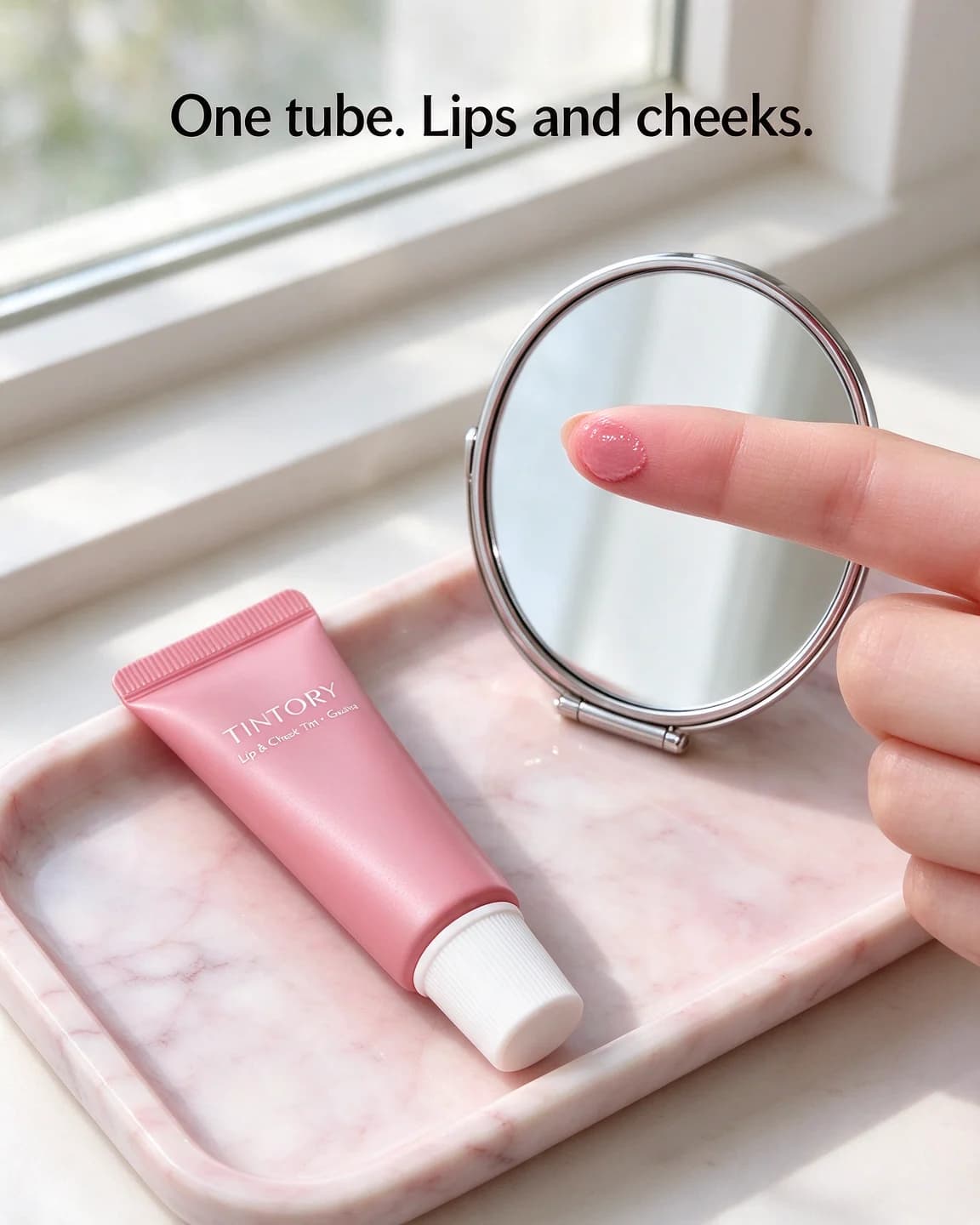
A Tintory Lip & Cheek Tint tube on a pink marble vanity tray beside a small mirror and a fingertip holding a dab of guava tint, headline "One tube. Lips and cheeks."

TintoryMulti-use valueFeed · 4:5 image

“One tube. Lips and cheeks.”

Two jobs from one product is the clearest value message in makeup, and it answers the shopper's real doubt, whether they'll actually use it, before the price comes up. The dab on a fingertip shows texture and colour without saying anything about anyone's face.

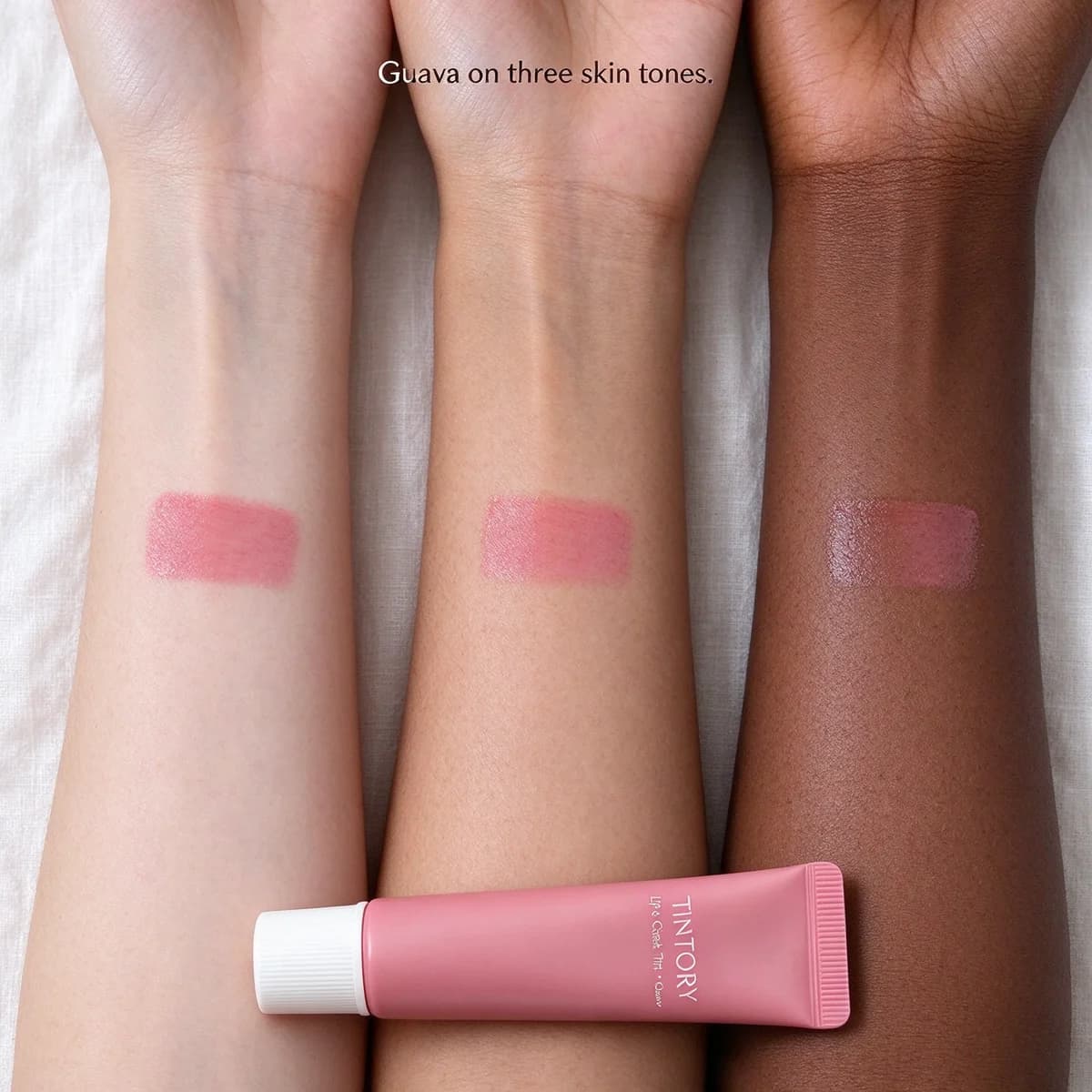
Three forearms in fair, medium and deep skin tones, each with a stripe of Tintory Guava tint, the tube lying across the bottom and the headline "Guava on three skin tones."

TintoryShade proofFeed · 1:1 image

“Guava on three skin tones.”

People want to see a shade on skin like theirs, and three tones in one frame answers that faster than any shade chart. This version is AI-made for illustration, so the live ad should use photographed swatches, because an AI swatch is a picture of a colour, not proof of one.

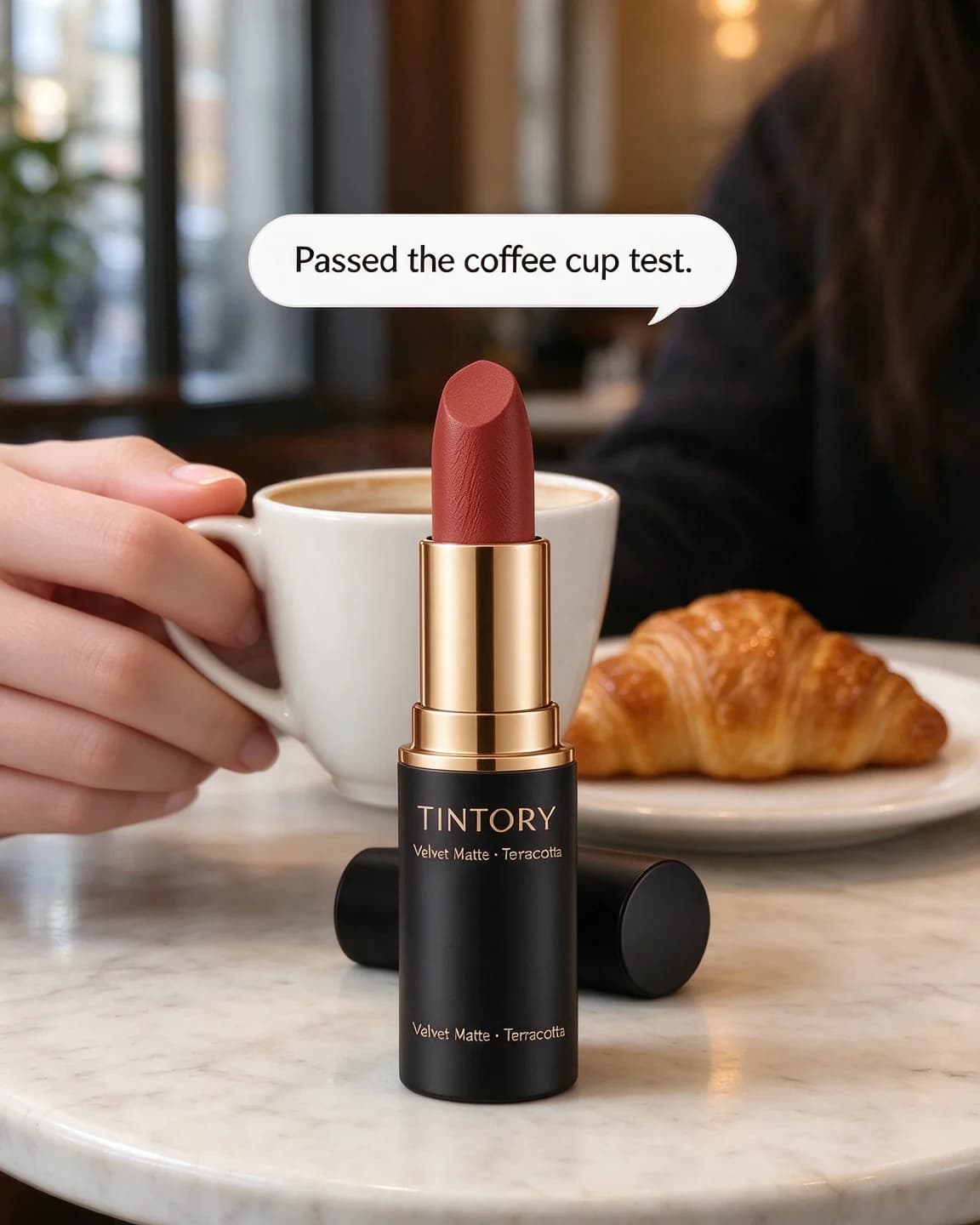
An open Tintory Velvet Matte lipstick in Terracotta beside a white coffee cup with a clean rim on a café table, with a speech bubble reading "Passed the coffee cup test."

TintoryWear testFeed · 4:5 image

“Passed the coffee cup test.”

A clean cup rim is a wear claim people can picture, and it borrows a check many lipstick wearers already run on themselves. Run it only once your own testing shows the formula doesn't transfer, and shoot the real cup rather than relying on this AI concept.

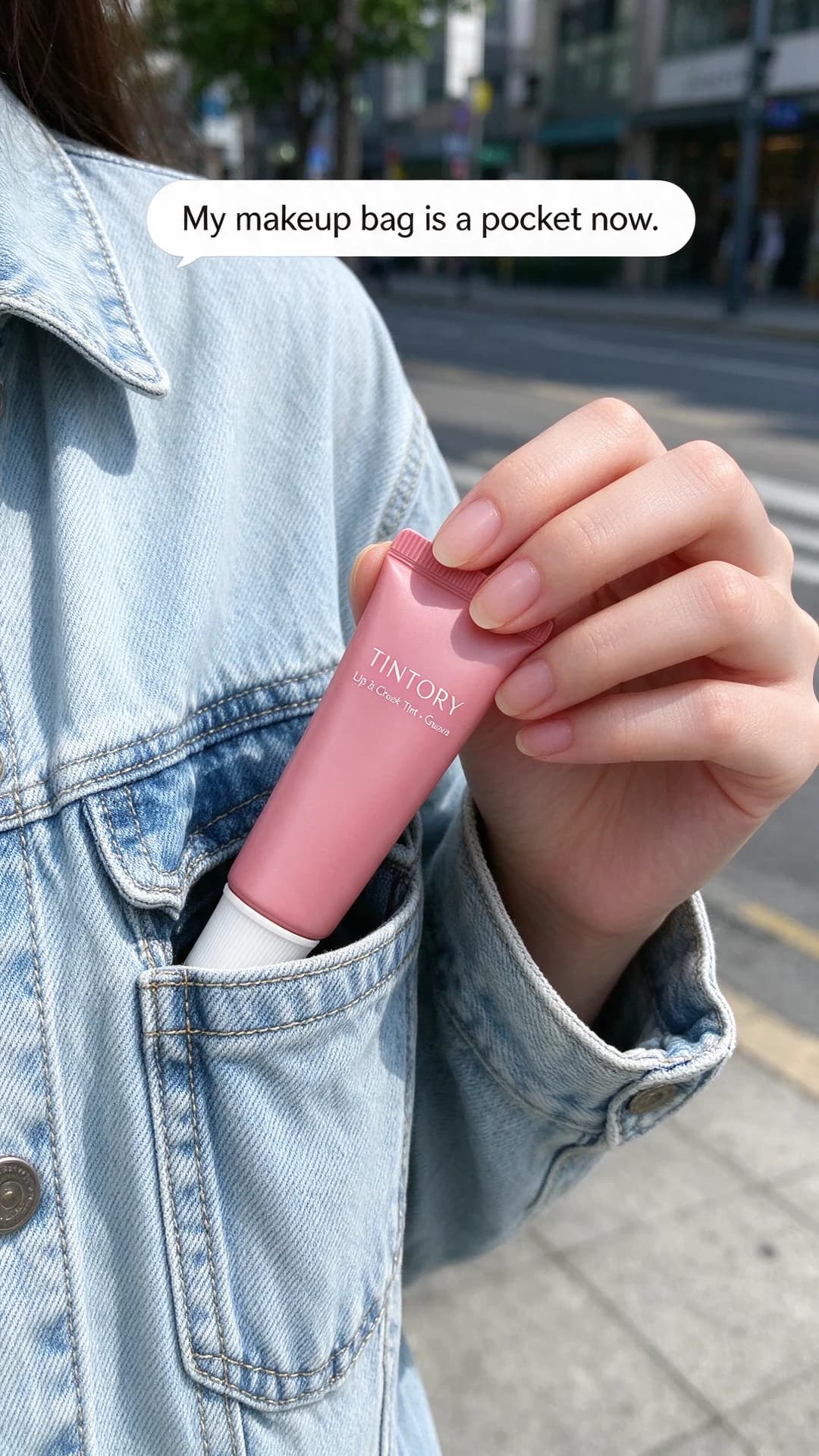
A hand pulling a Tintory Lip & Cheek Tint tube from a denim jacket pocket on a sunny street, with a speech bubble reading "My makeup bag is a pocket now."

TintoryUGC convenienceStories · 9:16 image

“My makeup bag is a pocket now.”

It sells size and convenience as a small, everyday moment, which suits full-screen Stories better than a studio shot. The caption sounds like something a buyer would say, so use it only when your reviews say it too.

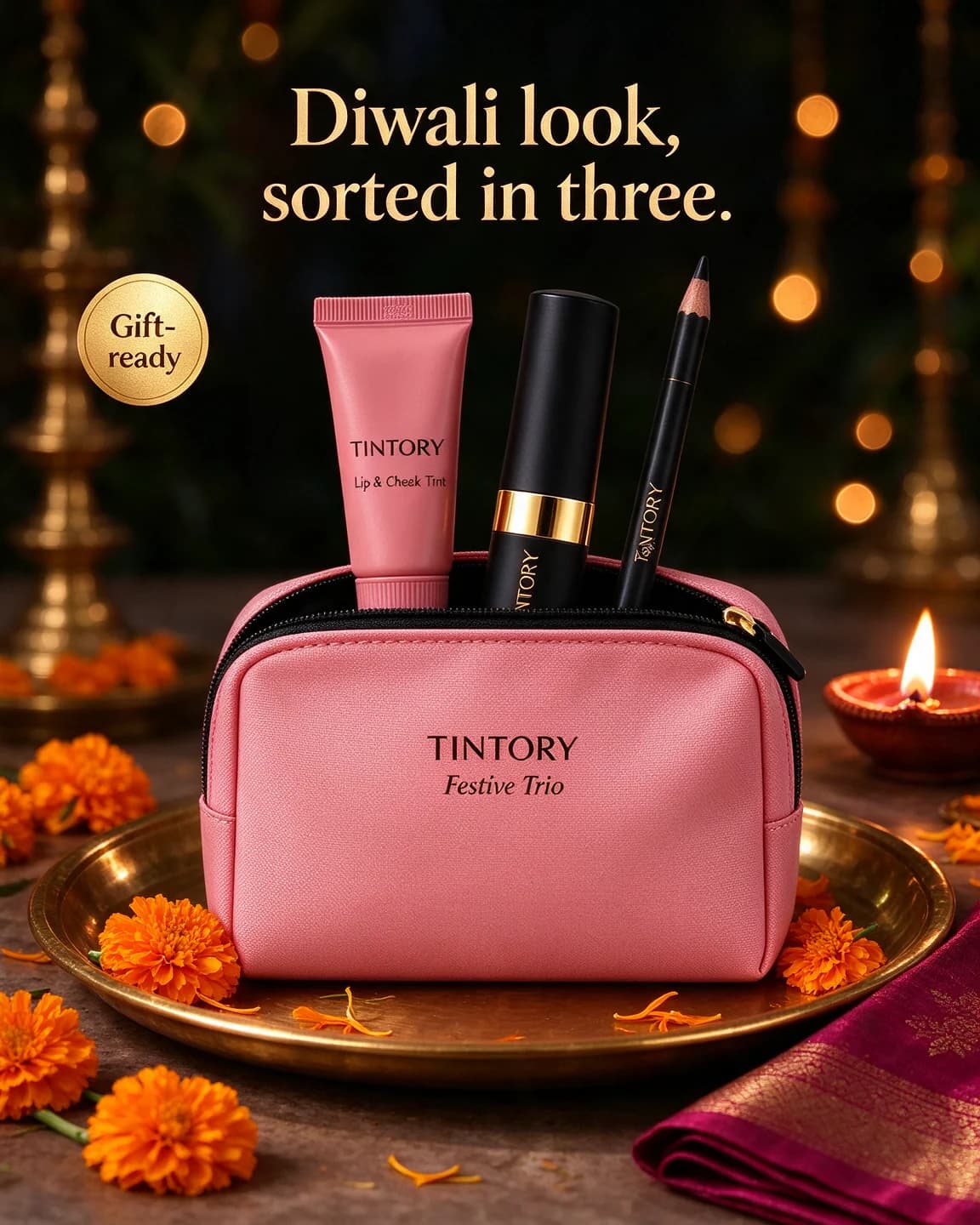
The Tintory Festive Trio pouch with tint, lipstick and kajal on a brass plate with marigolds and a lit diya, headline "Diwali look, sorted in three." and a "Gift-ready" sticker

TintoryFestive setFeed · 4:5 image

“Diwali look, sorted in three.”

A set solves the gift-giver's hardest problem, picking shades for someone else, and the brass plate and diya place it in the week people are buying. The 'Gift-ready' sticker removes the last chore, wrapping, without putting a discount on the image.

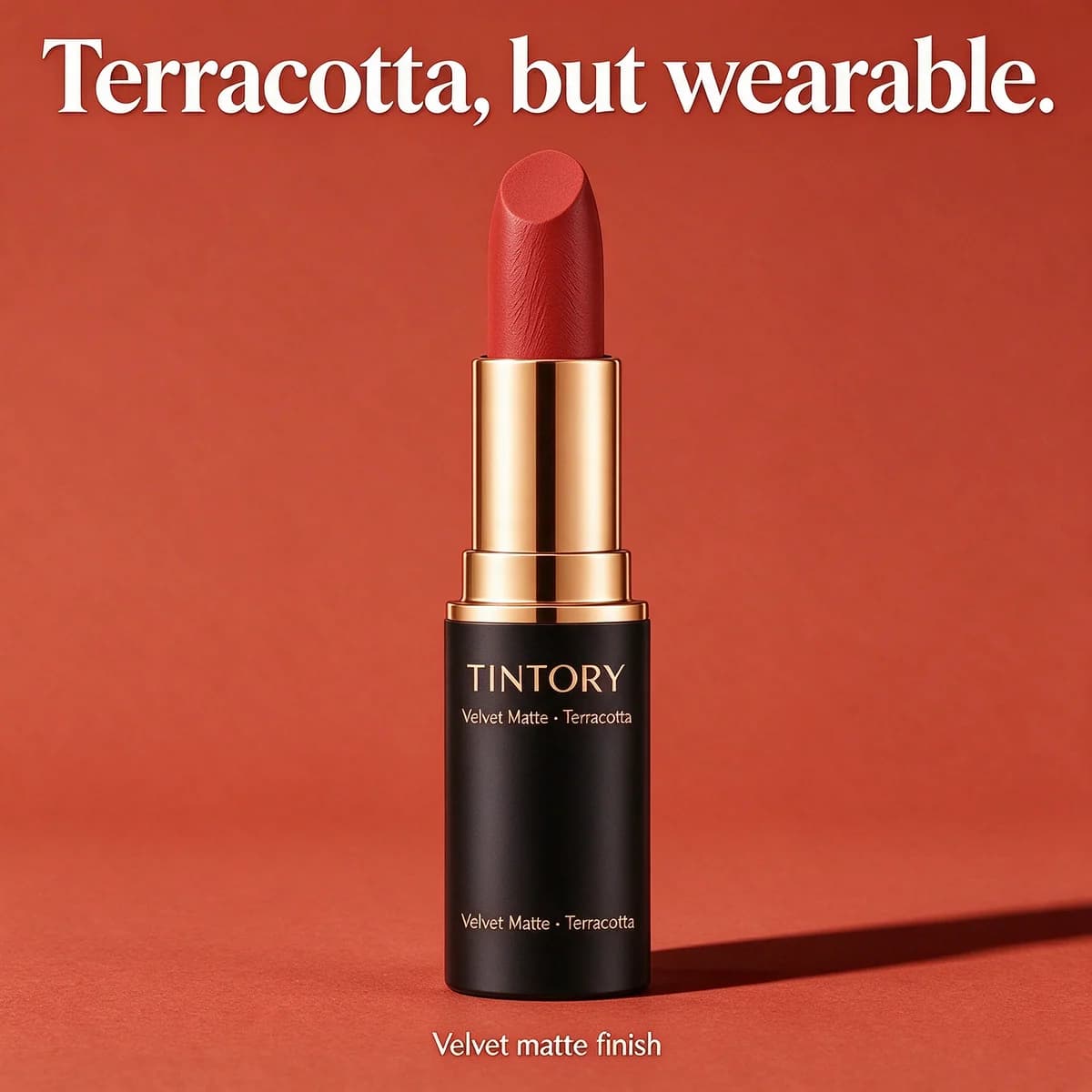
A Tintory Velvet Matte lipstick in Terracotta on a flat background of the same colour with a hard shadow, headline "Terracotta, but wearable." and the line "Velvet matte finish"

TintoryBold shade blockFeed · 1:1 image

“Terracotta, but wearable.”

A background in the bullet's own colour makes the shade the entire ad, and colour is the first thing anyone notices in a fast scroll. 'But wearable' answers the fear that stops people buying a bold shade, so the headline handles an objection in two words.

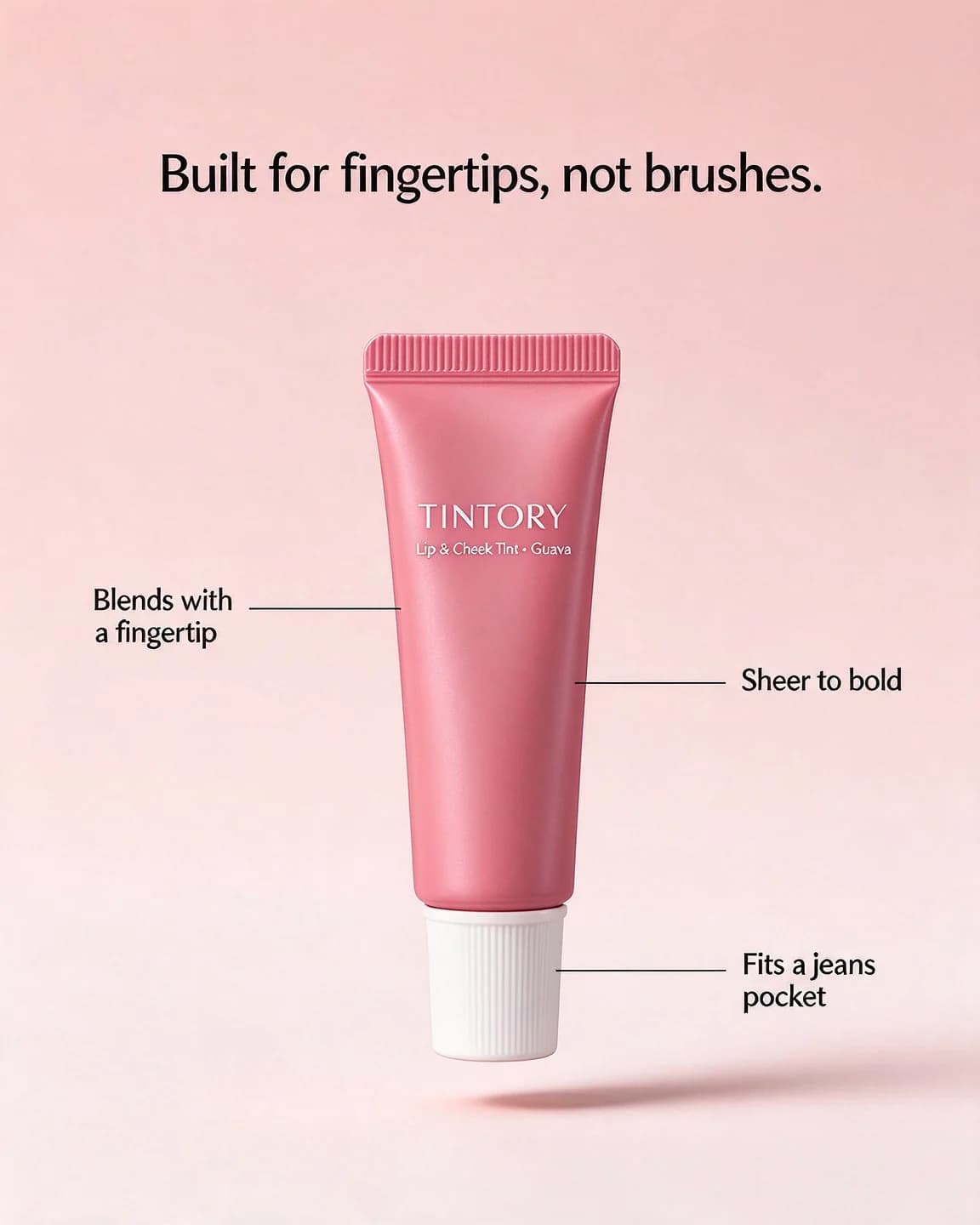
A Tintory Lip & Cheek Tint tube on a pale blush background with three labels, "Blends with a fingertip", "Sheer to bold" and "Fits a jeans pocket", under the headline "Built for fingertips, not brushes."

TintoryFeature calloutFeed · 4:5 image

“Built for fingertips, not brushes.”

Leader lines let three facts share one image without a paragraph, and each is something a buyer can check on first use. 'Not brushes' sets the tint against tools that need washing, which is a comparison without a competitor.

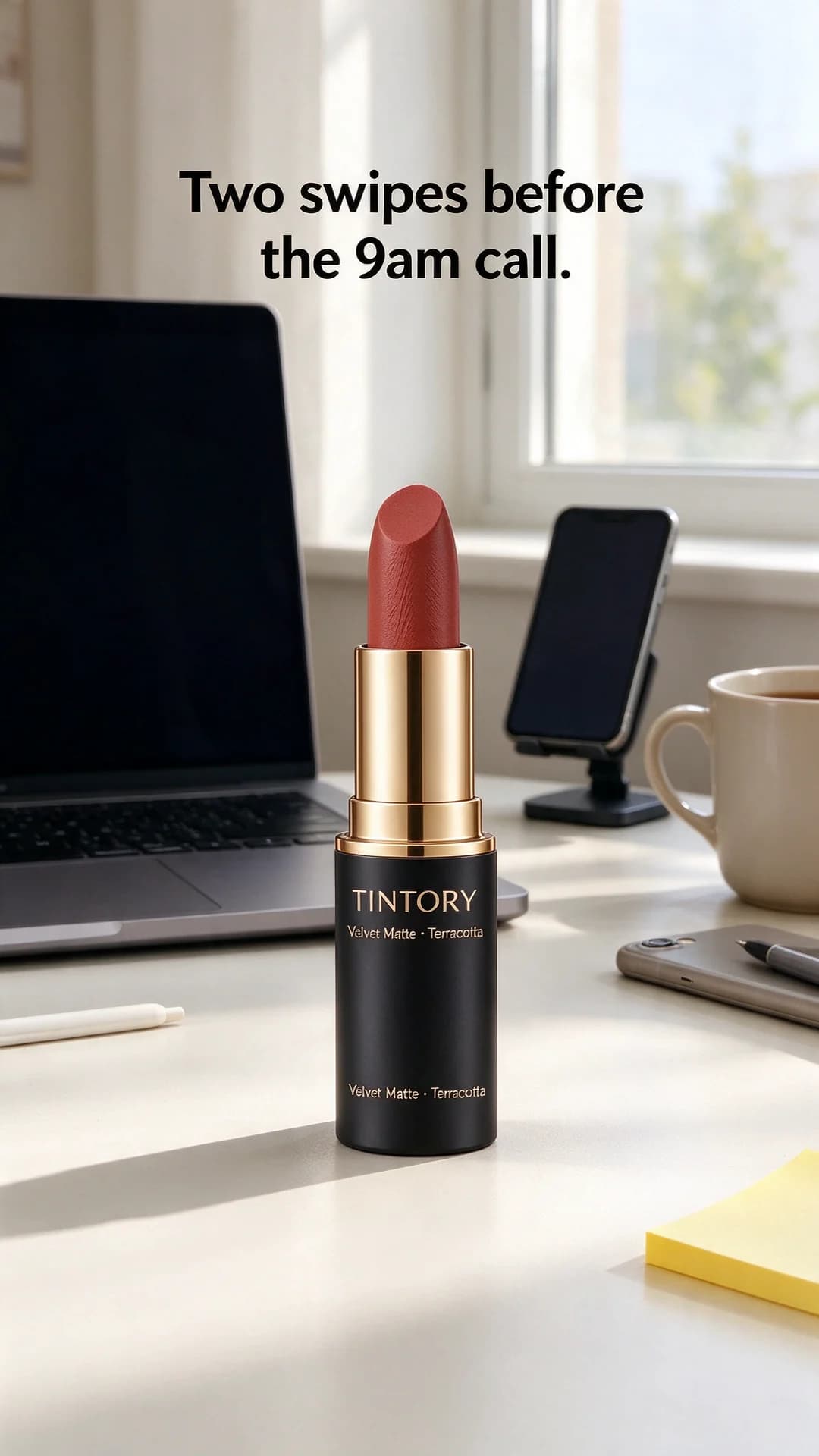
An open Tintory Velvet Matte lipstick on a tidy home desk beside a laptop, a phone on a stand and a coffee mug, headline "Two swipes before the 9am call."

TintoryMoment of useStories · 9:16 image

“Two swipes before the 9am call.”

It ties the lipstick to a daily moment many people now share, the camera-on morning meeting, and the empty desk lets viewers picture their own. 'Two swipes' promises speed with a number that's easy to believe, which is safer than a timed claim like 'ready in 30 seconds'.

Two more ways to try

  • TTintorySponsored

    One tube or a full kit?

    Tintory
    TINTORY
    • Lips and cheeks from one tube
    • Blends with a fingertip
    • Fits a jeans pocket
    The usual
    ?
    • A lipstick and a blush
    • Brushes to wash
    • A bag to carry them
    Lip & Cheek TintShop Guava

    Us vs them ad

    Comparing the product with the routine it replaces names no rival brand, and every row is something a buyer can test on the first morning.

    Edit this template
  • TTintorySponsored

    3 ways to wear Guava

    1. 1Dab on lips for a soft stain
    2. 2Tap onto cheeks and blend up
    3. 3Layer twice for evening
    TINTORY
    Lip & Cheek TintFind your shade

    How-to demo ad

    Teaching the multi-use idea step by step sells it better than claiming it, and a short how-to is the kind of ad people save to try later.

    Edit this template

Angles to test first

  1. 1

    Multi-use value

    One product, two or three jobs: lips and cheeks, liner and smudge, day and evening. It answers 'will I actually use it?' and makes the price feel shared across tasks.

  2. 2

    Shade proof

    The same shade on several skin tones, photographed in daylight and labelled with the shade name. It's the question every makeup buyer has, and the honest answer is a real photo.

  3. 3

    Wear tests

    A coffee cup, a long lunch, a check at 6pm. Wear tests turn a pack claim into a scene, but each one needs your own testing behind it before it runs.

  4. 4

    Daily moments

    The 9am call, the commute, the school run, the wedding lunch. Tie the product to a moment and the viewer pictures their own version of it.

  5. 5

    Sets and gifting

    Festive trios, wedding-guest kits and Valentine's duos take away the gift-giver's shade anxiety. Show the set together and let the copy explain what's inside.

  6. 6

    The bold shade

    A bright or deep shade on a background of its own colour stops the scroll even for people who'd buy the neutral. Use it to win attention, then follow up with the shade most people buy.

15 hooks for makeup ads

  • One [tube]. [Lips] and [cheeks].
  • [Shade] on [three] skin tones.
  • Passed the [coffee cup] test.
  • My makeup bag is a [pocket] now.
  • [Shade], but wearable.
  • Two [swipes] before the [9am call].
  • [Festival] look, sorted in [three].
  • Swatched in [daylight], not [studio light].
  • Built for [fingertips], not [brushes].
  • What [shade] looks like at [6pm].
  • The [lipstick] that sat through [a wedding lunch].
  • From [sheer] to [bold] in [two] layers.
  • Warm, cool or neutral? Start with [shade].
  • [Number] shades, named after [what inspired them].
  • Your [handbag] edit: [product], [product], [product].

Moments to plan for

  • Wedding season (Nov–Feb in India)

    Long-wear lipstick shown at a lunch buffet or a sangeet, with real wear-check photos and shade picks for guests.

  • Diwali (Oct–Nov)

    A gift-ready trio on a brass plate with diyas, with the saving worked out in the primary text.

  • Valentine's Day (Feb)

    Two-shade lip duos framed as 'one for you, one for them', or a red shade on a flat colour block.

  • Monsoon (Jun–Sep)

    Pocket-size tints for humid commutes and rainy-day bags, with any humidity claim tested before it appears.

  • Back to college and office (Jun–Jul)

    Five-minute routines with one or two products, shot on a desk, a hostel shelf or a metro seat.

  • Party season (Dec)

    A bold-shade spotlight and an 'evening layer' how-to, built from the same tint used in the daytime ads.

Watch out for

  • Don't let an AI image stand in for the shade on skin. The UK advertising regulator's guidance on production techniques in cosmetics ads (ASA AdviceOnline, dated 18 August 2025) says ads must not exaggerate what a product can achieve, and it cites rulings against mascara ads whose lashes were retouched or looked fuller than the mascara alone could make them. An AI-made swatch is retouching from scratch, so use real photos for colour, coverage and wear.
  • Keep beauty filters out of creator content about the product. In two rulings dated 3 February 2021, the ASA found that Instagram Stories in which influencers promoted tanning products through a filter that changed their skin tone were misleading, because the filter did the very thing the product claims to do. Both rulings named the brand alongside the influencer, so a brand can't leave this to its creators.
  • Write about the product, never about the viewer's looks. As of October 2026, Meta's Health and Wellness ad standard (change log dated 22 July 2026) doesn't allow cosmetic ads with statements of inferiority about physical appearance, so lines like 'Hide your thin lips' or 'Tired of looking tired?' are out. The same standard bars ads for skin whitening or bleaching products that permanently change skin colour, so keep shade copy about the colour on skin, never about making skin fairer.
  • Test every wear claim before it reaches an image. 'Transfer-proof', '16-hour', 'waterproof' and 'smudge-proof' are performance claims, and a coffee cup or a 6pm photo in the ad turns each one into something viewers will check for themselves.
  • Say what 'cruelty-free' means for your brand. The US FDA says there are no legal definitions for 'cruelty-free' or 'not tested on animals', and notes that companies may rely on raw material suppliers for any animal testing (FDA page, content current as of 25 February 2022). Name the certification you hold or the testing policy you follow, and check that it covers your suppliers too.

Practical pointers, not legal advice. Check Meta’s Advertising Standards and your local rules.

The swatch problem

Makeup is bought for a colour on skin, and that's exactly what an ad struggles to show truthfully. Phone screens warm some shades and cool others. Studio light flatters every finish. And an AI image model will paint a perfect stripe of colour on an arm that has never touched the product.

A picture like that looks like proof, but it's an illustration. So split every makeup ad into two jobs:

  • The product. The tube, the bullet, the set, where it lives and how it's carried. AI scenes are useful here: your real packshot can sit on a vanity tray, in a jacket pocket or on a festive brass plate without a shoot.
  • The performance. The shade on skin, the finish, how it looks at 6pm. This needs a camera, a real person or a real arm, and honest light.

The ads above follow that split. The swatch and coffee-cup ads are flagged in their notes as concepts, because those are the two claims a buyer will hold you to.

The photo library a makeup brand needs

Before the first batch, spend an afternoon by a window with a phone and build a small library. Most of it never changes, and every future ad draws on it.

Shot What it proves How to make it
Clean packshot of each hero shade What arrives in the box Camera, plain background
The product open Texture, bullet shape, the colour in the pan Camera, or an AI scene from the packshot
Swatches on at least three skin tones How the shade reads on skin like the viewer's Camera only, daylight, shade names visible
A wear check late in the day That the pack claim holds Camera only
Bag, vanity and desk scenes Where the product lives AI scene from the packshot
The set together What a gift contains Camera, photographed as one product

Photograph swatches beside a white card in daylight and you'll have a reference for checking colour on your own screen. If the swatch in the ad looks redder than the lipstick in your hand, fix the photo before you touch the headline.

What to test first

Lead with the product's most useful truth, not its prettiest shade. For a multi-use tint that's "one tube, two jobs". For a lipstick it's usually the shade itself, or how it wears. A first round for one hero product could look like this:

  1. Multi-use: one tube for lips and cheeks.
  2. Shade proof: the same shade on three skin tones, from real swatch photos.
  3. Wear test: the coffee cup, the long lunch, the late check.
  4. Moment: the 9am call, the commute, the wedding lunch.
  5. Bold colour block: the bullet on a background of its own colour.

Two versions of each gives ten ads, a sensible first batch. The guide on how many ad creatives to test covers scaling that up or down, and concept versus iteration testing explains why the five angles come before the ten shades.

Treat shades the way you treat angles. Run one ad per hero shade rather than a dozen at once: your best seller, a safe neutral and one bold shade. If the bold shade wins attention while the neutral wins the sales, that isn't a contradiction. You've found a scroll-stopper and a product, and the next batch can use both.

Sets, bundles and the sum shoppers do in their heads

Festive sets sell on two things, the ready-made gift and the saving, and both should be easy to check. As a worked example, if the tint sells for $5.65, the lipstick for $6.70 and the kajal for $3.60, the three bought separately come to $16. A set at $12 saves $3.60. Put that sum in the primary text and keep the image for the moment: "Diwali look, sorted in three."

Photograph the set together, in its pouch or box, and use that photo as the packshot for every bundle ad. An AI scene built from a single tube has to invent the other two products, and invented products are exactly the drift a gift ad can't afford.

How BulkAds makes makeup ads from one product photo

Start with a sharp packshot of each hero shade on a plain background, cap on and label facing the camera. In your brand kit, add the shade names and only the claims you can support, so "transfer-resistant" appears in ads only if your testing backs it. Then ask for a batch.

BulkAds places your real packshot into new scenes and layouts (a vanity tray, a jacket pocket, a flat colour block, a festive plate), with up to 12 ads in one batch in 1:1, 4:5 or 9:16. Each ad arrives with a pre-flight report. The product-match check compares it with your original photo, and in makeup that catches the small things that drift: a gold band that turns silver, a cap in the wrong colour, a shade name spelled differently from the pack. When one element is off, regenerate that element rather than the whole ad. At 2 credits per image ad, a batch of 12 uses 24 credits.

For the shots that prove performance, the swatches, the wear checks, a real customer wearing the shade, upload your own photo as it is with Upload ad. Add its headline and primary text, which BulkAds can rewrite, and launch it beside the AI-made scenes, so your campaign compares honest proof with mood, not one AI picture with another. Product photo ads explains the process, and the guide to product photos for AI ads covers lighting for glossy cases and metallic bands.

Once a still is selling, turn it into a short video ad: a slow push-in on the bullet, or light moving across the tube. It keeps the hook and changes only the format.

Turning a winner into a shade series

When a layout sells, it becomes the template for the range:

  • Same layout, next shade. The terracotta colour block becomes a plum one and a coral one.
  • Same hook, other product. "One tube. Lips and cheeks." becomes "One pencil. Liner and smudge." for the kajal.
  • Same angle, new moment. The wedding lunch becomes the office party.
  • Same idea, full screen. Rebuild it in 9:16 with the text inside the safe zone.

Launch the batch paused with the bulk ad launcher, or let Autopilot launch it as its own test, where it stops ads that spend without selling and drafts fresh variants of the ones that do, inside the caps you set. If you also sell polish, the nail care examples use the same split between AI scenes and real proof.

Questions people ask

Should makeup ads show the product on a face?

A real person wearing the real shade is strong proof, so use those photos when you have them, with the shade name visible. The examples here use hands, arms and products only because they're AI-made illustrations, and an AI face wearing your shade wouldn't prove anything about it.

Can makeup ads use before-and-after photos?

As of October 2026, Meta's Health and Wellness ad standard (last revised 22 July 2026) lists before-and-after transformations for general cosmetic products among the things ads may show when they target people aged 18 and over. The same page says its age rules don't apply to non-permanent beauty products such as makeup, so read the live page to see how the two lines apply to your ad. Whatever Meta allows, the UK ASA treats an 'after' image as an objective claim that must show what customers can generally get from the product (AdviceOnline, 18 August 2025). That means an honest photo of your real product, never an AI-made transformation.

Which makeup ad should I make first?

Start with the product's most useful truth. For a multi-use product that's the 'one tube, two jobs' ad, and for a lipstick it's usually the shade on a colour-matched background. Add real swatches next, because doubt about the shade stops more sales than any other question.

How many shades should one makeup ad show?

One hero shade per ad in most cases, so the colour reads at a glance. Use a swatch line-up when the ad's job is to show the range, and keep every shade name readable at thumbnail size.

Is Tintory a real brand?

No. Tintory is fictional, and every ad on this page was made with AI for illustration.

Keep going

Every brand on this page is fictional and every ad was made with AI for illustration — they’re examples, not case studies.

BulkAds AI is an independent product and is not affiliated with, endorsed or sponsored by Meta Platforms, Inc. Facebook and Instagram are trademarks of Meta Platforms, Inc.

More ad examples

Your next fifty ads are one link away.

Paste your website, meet your brand kit and see your first batch in minutes. 7 days for $9.99 — cancel anytime.

yourbrand.comMake my ads

See pricingExplore featuresBrowse the library