Why problem–solution ads work
Most purchases start with a small irritation: the afternoon craving, the sunscreen that leaves a white cast, the treats that crumble into the sofa. A problem–solution ad starts there too. It names a problem the viewer recognises, then presents the product as the answer — in that order, in about two seconds.
Naming the problem first does two jobs. It filters: people who don't have the problem scroll on, and people who do feel seen, which is exactly the audience you want. And it creates a small tension that the ad then resolves. A question like "Craving soda, not the sugar?" is hard to read without mentally answering it, and the answer is sitting right there in the product line.
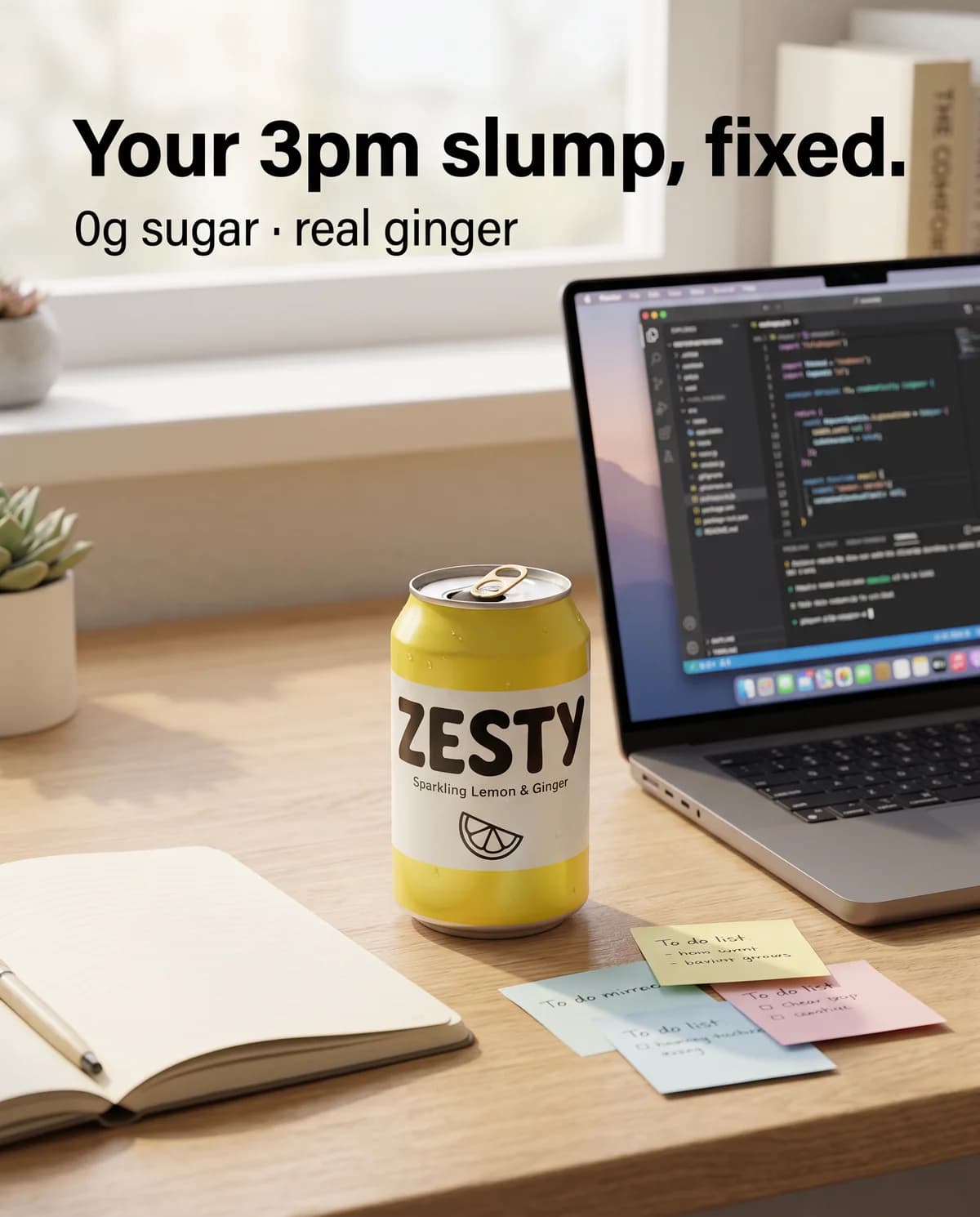
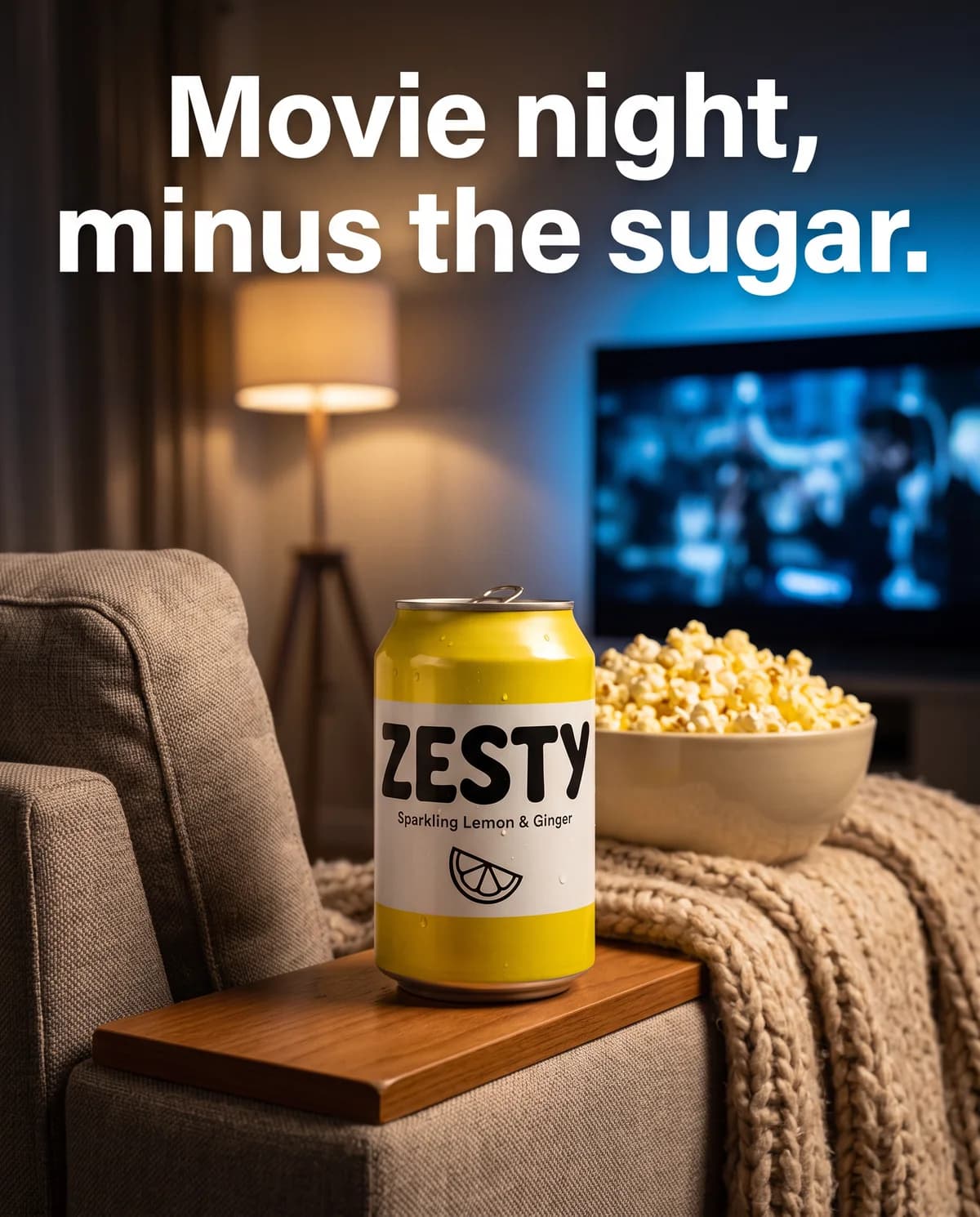
It's one of the oldest structures in advertising, and on a static ad it comes down to layout: the problem sits at the top where the eye lands first, the product and the fix sit below it. If the problem needs more words, put them in the primary text and keep the image to two lines.
Naming the problem without breaking Meta's rules
The problem has to be about a situation or a product experience, never about the viewer's body, health, money or identity. Meta's advertising standards don't allow ads that assert or imply personal attributes — including health, financial status, age and religion — so "Are you overweight?" or "Struggling with debt?" will be rejected, however helpful the product.
The fix is usually easy: move the problem from the person to the moment or the product.
| Avoid | Try instead |
|---|---|
| "Struggling with sugar cravings?" | "Craving soda, not the sugar?" |
| "Is your skin looking dull?" | "Sunscreen that sits white and sticky?" |
| "Can't concentrate at work?" | "Open-plan office noise, all day?" |
| "Tired of feeling bloated?" | Leave digestion out of the ad entirely |
A quick check: read the problem line aloud to a friend. If it sounds like a comment about them rather than about their soda, sunscreen or sofa, rewrite it.
Meta's wording changes over time, so check its current Advertising Standards if a line feels close. BulkAds' ad copy generator is written to avoid the phrasing Meta commonly flags, but read every line yourself before it runs.
How to make one, step by step
- List the problems your product solves. Write them the way customers say them. Reviews and DMs are the best source. "The white cast", "they crumble everywhere", "diet soda tastes of nothing".
- Pick one problem per ad. Different problems are different ads, and often different buyers.
- Write the problem as a short question or statement. Seven words or fewer, specific, about a moment or a product.
- Write the solution line. Ten words or fewer: the product name plus the one fact that solves it. "Zesty: sparkling lemon and real ginger, 0 g sugar."
- Show the product as the answer. Big and clear, straight after the problem. The eye should travel question, product, answer.
- Choose a small-step call to action. "Try it" suits a small problem better than "Buy now".
- Use the primary text for the agitation. One line on how the problem feels, one on the fix, then the offer if there is one.
Ten variations for one test
In this template each problem is a separate ad angle, and the angle is what you're really testing:
| # | What changes | Example |
|---|---|---|
| 1 | Problem | "Craving soda, not the sugar?" |
| 2 | Problem | "Diet soda tastes of nothing?" |
| 3 | Problem | "Same boring drinks at every party?" |
| 4 | Problem | "Movie night means a litre of cola?" |
| 5 | Problem | "Office fridge full of sugary cans?" |
| 6 | Form | The winning problem as a statement, not a question |
| 7 | Solution line | The same problem answered with a different fact |
| 8 | Visual | The product shown in the moment, not on flat colour |
| 9 | Proof | A line from a real review as the solution |
| 10 | Size | Rebuilt at 9:16 for Stories and Reels |
Problems 1–5 are genuinely different concepts, rows 6–10 refine the winner. The ad variation calculator shows how problems × solution lines × formats multiply, and what testing them would cost. For more problem-first openers, the hook bank has fill-in-the-blank lines by type.
How to test problem–solution ads
Run the problems together in one ad set, one ad per creative, with broad targeting, and give each ad enough spend to earn a verdict — often a couple of times your target cost per purchase. Judge on cost per purchase, not on how many people commented "so true".
The winning problem is the real finding. It tells you which pain your buyers feel most sharply, and that should shape everything else: your next before and after ad, your product page headline, even the order of your listicle points. If no problem wins clearly, that's a finding too. Perhaps your buyers aren't fixing a problem at all, and an ad about pleasure or an occasion will do better.
Once a problem wins, test the agitation separately. Keep the image and change only the primary text: one version with no agitation, one that describes the problem in a sentence, one that tells a tiny story of the moment. Sometimes the extra line lifts results, sometimes it just slows people down.
Common mistakes
- A problem nobody has. If you have to explain the problem, it's not the one to lead with.
- A vague problem. "Want a better drink?" is too broad to recognise. Name the moment.
- Blaming the viewer. "You're doing it wrong" makes people defensive. Blame the category instead: "It's not you, it's your sunscreen."
- An oversized promise. A small problem needs a proportionate fix. "Transform your afternoons" oversells a can of soda.
- A buried answer. If the solution line is tiny or tucked away, the ad raises a problem and walks off. The answer should be as easy to read as the question.
- Health and body problems. Even when your product genuinely helps, framing the ad around a condition is where Meta's personal attributes and health policies bite. Keep problems situational, and base every solution line on a real, provable fact.
Questions people ask
What is a problem–solution ad?
A problem–solution ad names a specific problem the viewer recognises, then presents the product as the answer. It's one of the oldest structures in advertising: on the image, the problem goes at the top and the product sits below it as the fix.
Can I ask “Are you…?” questions in Facebook ads?
Not about personal attributes such as health, finances, age or religion — Meta's policies don't allow ads that assert or imply them. Frame the problem around a situation or a product instead.
Should the problem be a question or a statement?
Both work: questions invite the reader to answer in their head, statements feel more confident. It's a cheap thing to test once you've found the winning problem.
How is this different from a before and after ad?
A problem–solution ad names the problem in words, a before and after ad shows it in a picture next to the improved version. They pair well, because a winning problem often makes a good “before”.
Keep going
- Features
Ad copy generator
Headlines and primary text in 95+ languages
- Ad templates
Before & after ad template
The same moment twice — once without you, once with you
- Ad templates
Us vs them ad template
Two matched columns, one obvious choice — against a category
- Ad templates
Listicle ad template
A numbered headline and three to five reasons, strongest first
- Hook bank
The hook bank
Fill-in-the-blank opening lines, sorted by what they do.
- Glossary
Ad angle
An ad angle is the specific reason to buy that an ad argues — convenience, price, taste, status, a problem solved — aimed at one kind of customer. Different angles sell the same product to different people.
Every brand, person and review in these mock-ups is fictional. In your own ads, use only real reviews, real numbers and claims you can back up.
BulkAds AI is an independent product and is not affiliated with, endorsed or sponsored by Meta Platforms, Inc. Facebook and Instagram are trademarks of Meta Platforms, Inc.