Ad examples

Drinkware ad examples: 8 ideas that prove what a bottle can do

Drinkware ads work when they prove something a listing can't: ice still in the bottle at 6pm, a dry desk under a cold tumbler, a lid that survives the school bag. These eight ideas for a fictional bottle brand show the shot, the hook and the angle for each, with the claims you need to test before any of them runs.

8 ads2 live templates15 hooks

The swipe file

Each ad with its angle, its hook and why it works. Every brand is fictional. The ads were made with AI to show the idea.

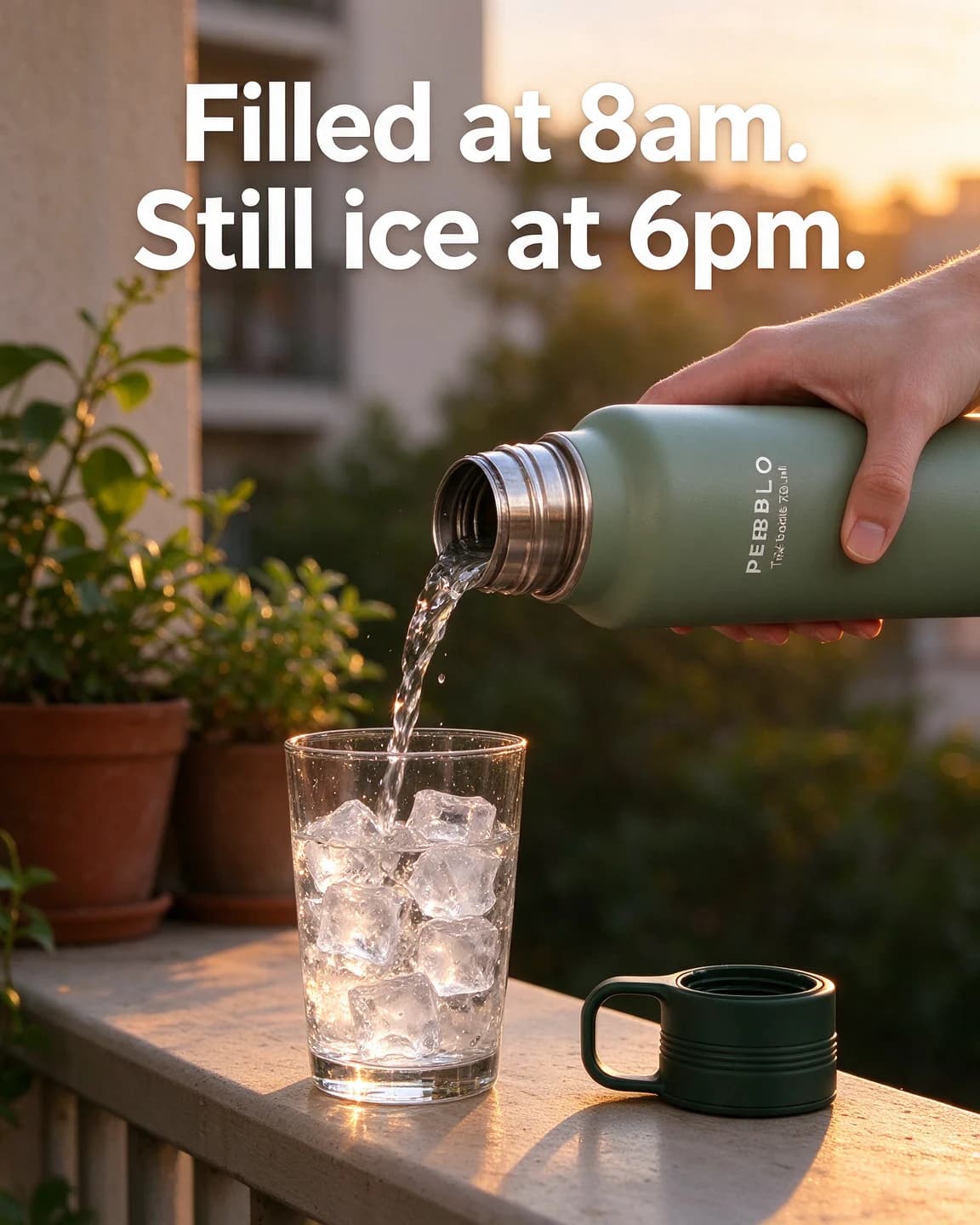
A hand pouring water and ice cubes from a sage-green Pebblo Trek Bottle into a glass on a sunny balcony ledge, headline "Filled at 8am. Still ice at 6pm."

PebbloProof you can seeFeed · 4:5 image

“Filled at 8am. Still ice at 6pm.”

Ice tumbling out at the end of the day shows the insulation instead of describing it, and the two times give the viewer a test they can picture. Run it only if your own test matched, and write the conditions you used in the primary text.

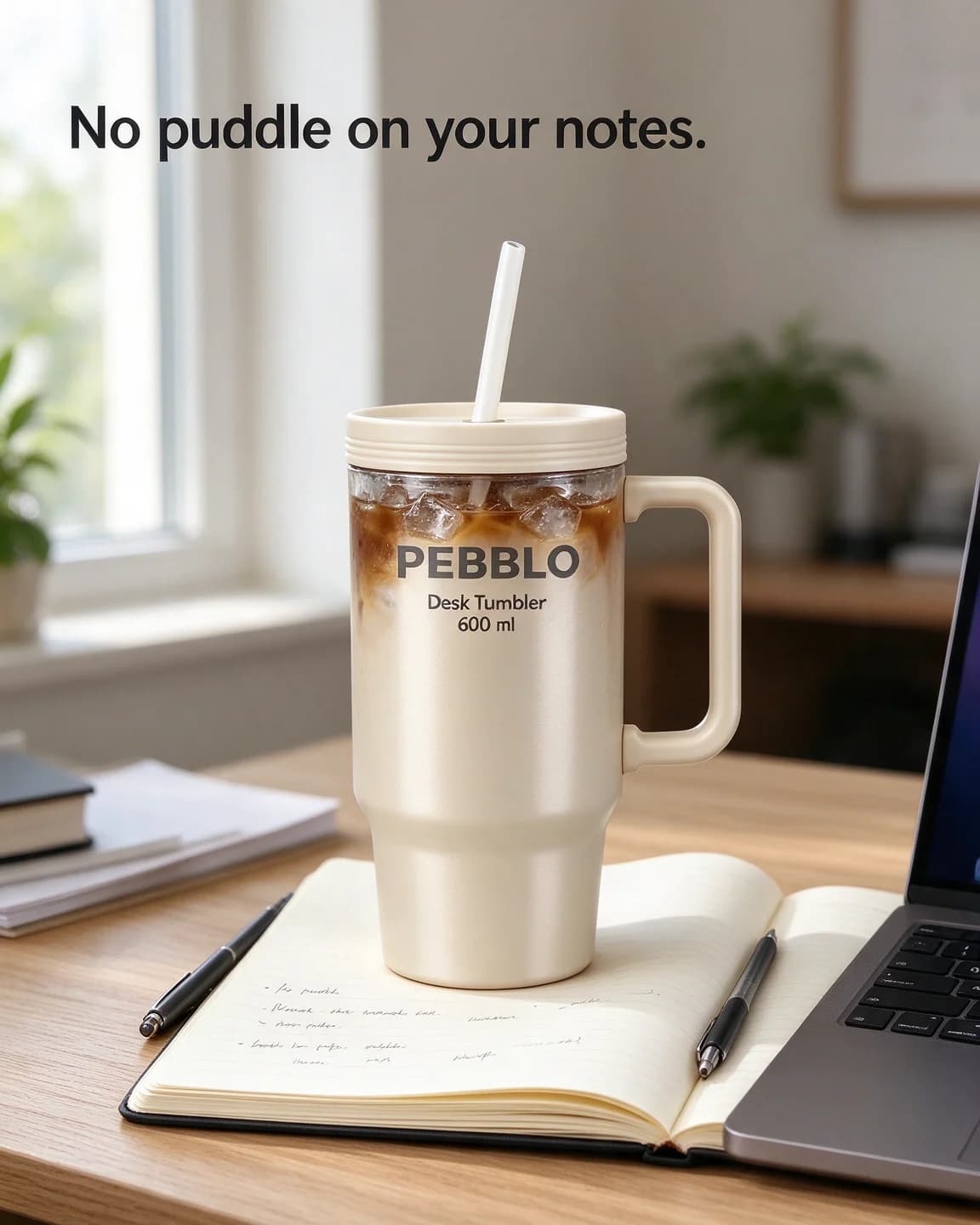
A cream Pebblo Desk Tumbler with a straw standing on an open paper notebook beside a laptop, the page completely dry, headline "No puddle on your notes."

PebbloSmall annoyance, solvedFeed · 4:5 image

“No puddle on your notes.”

Anyone who has set a cold glass on paperwork knows the wet ring, so a dry notebook page makes double-wall insulation visible without a diagram. The desk also tells the viewer who it is for: people who sip at a desk all day.

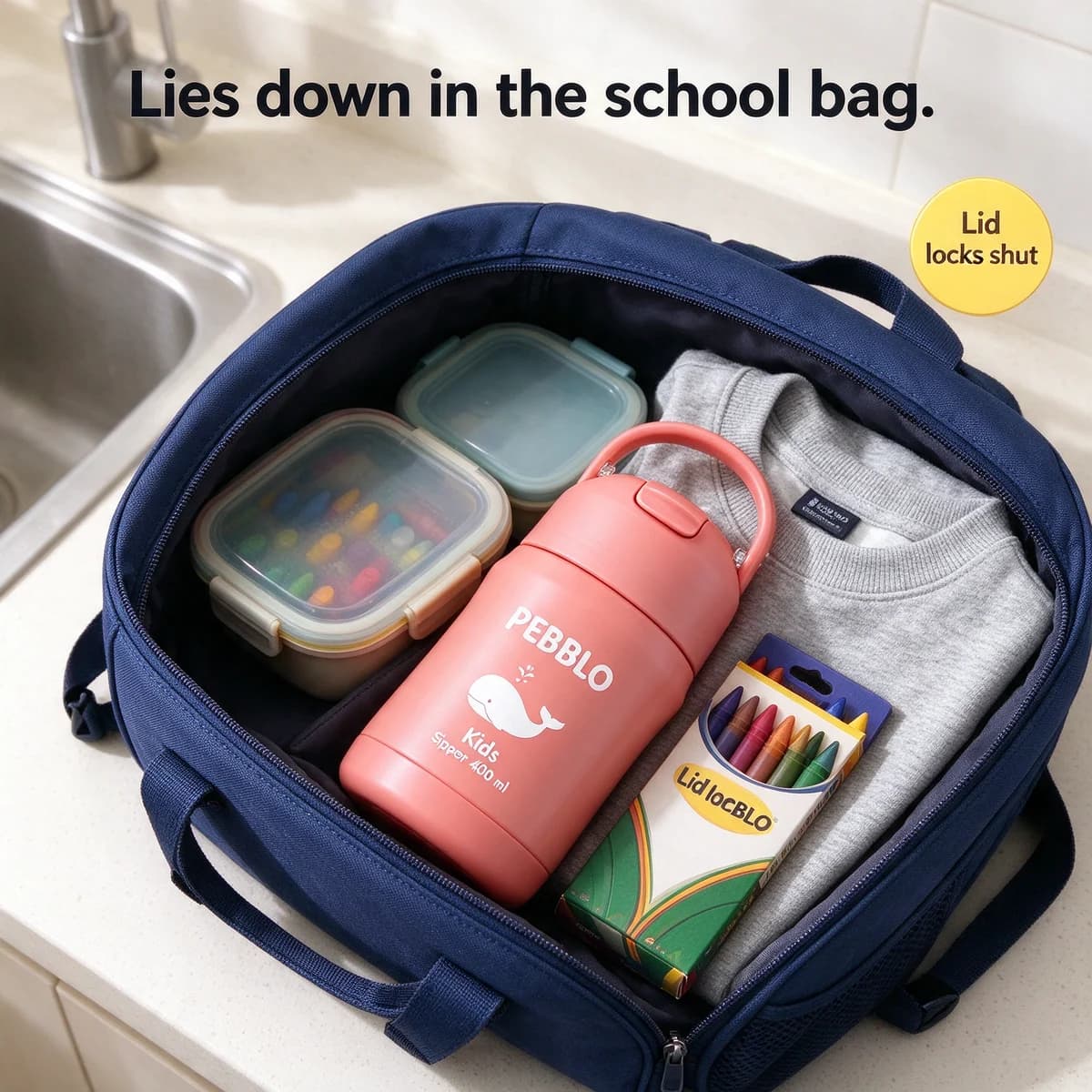
A coral Pebblo Kids Sipper lying on its side in an open school backpack with a lunchbox, crayons and a jumper, headline "Lies down in the school bag." and a "Lid locks shut" sticker

PebbloParent objection: leaksFeed · 1:1 image

“Lies down in the school bag.”

Parents worry about a soaked bag before they worry about temperature, so the bottle lies sideways among books and clothes that are visibly dry. Kids' straw lids are the ones most likely to weep, so leave this exact bottle on its side overnight on kitchen paper before you shoot, and drop the ad if the paper is damp.

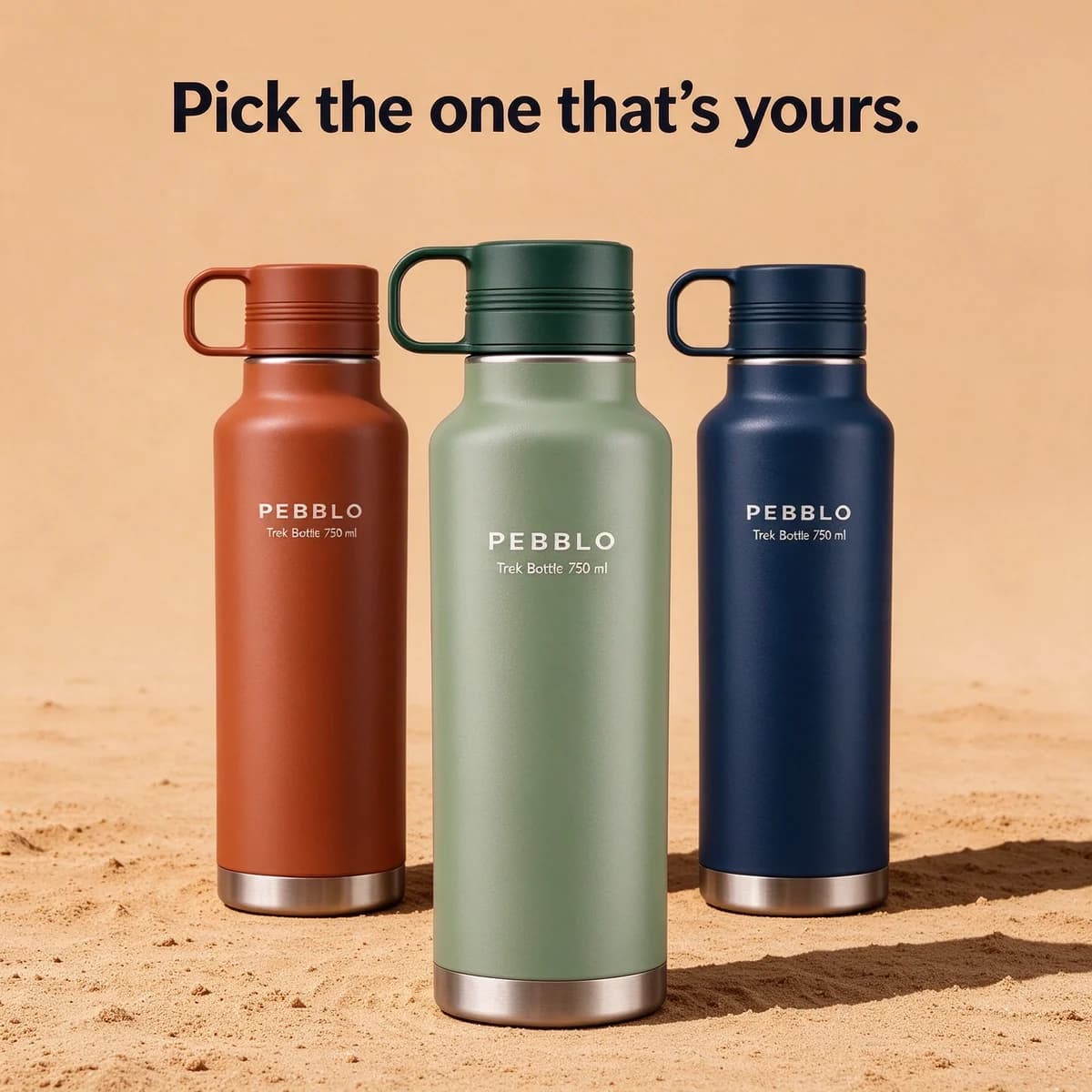
A sage-green Pebblo Trek Bottle in front of the same bottle in terracotta and navy on a flat sand-coloured background, headline "Pick the one that's yours."

PebbloColour and identityFeed · 1:1 image

“Pick the one that's yours.”

A bottle goes everywhere with its owner, so colour reads as a personal choice rather than a spec. Three shades in one frame also answers 'what else does it come in' before anyone taps through.

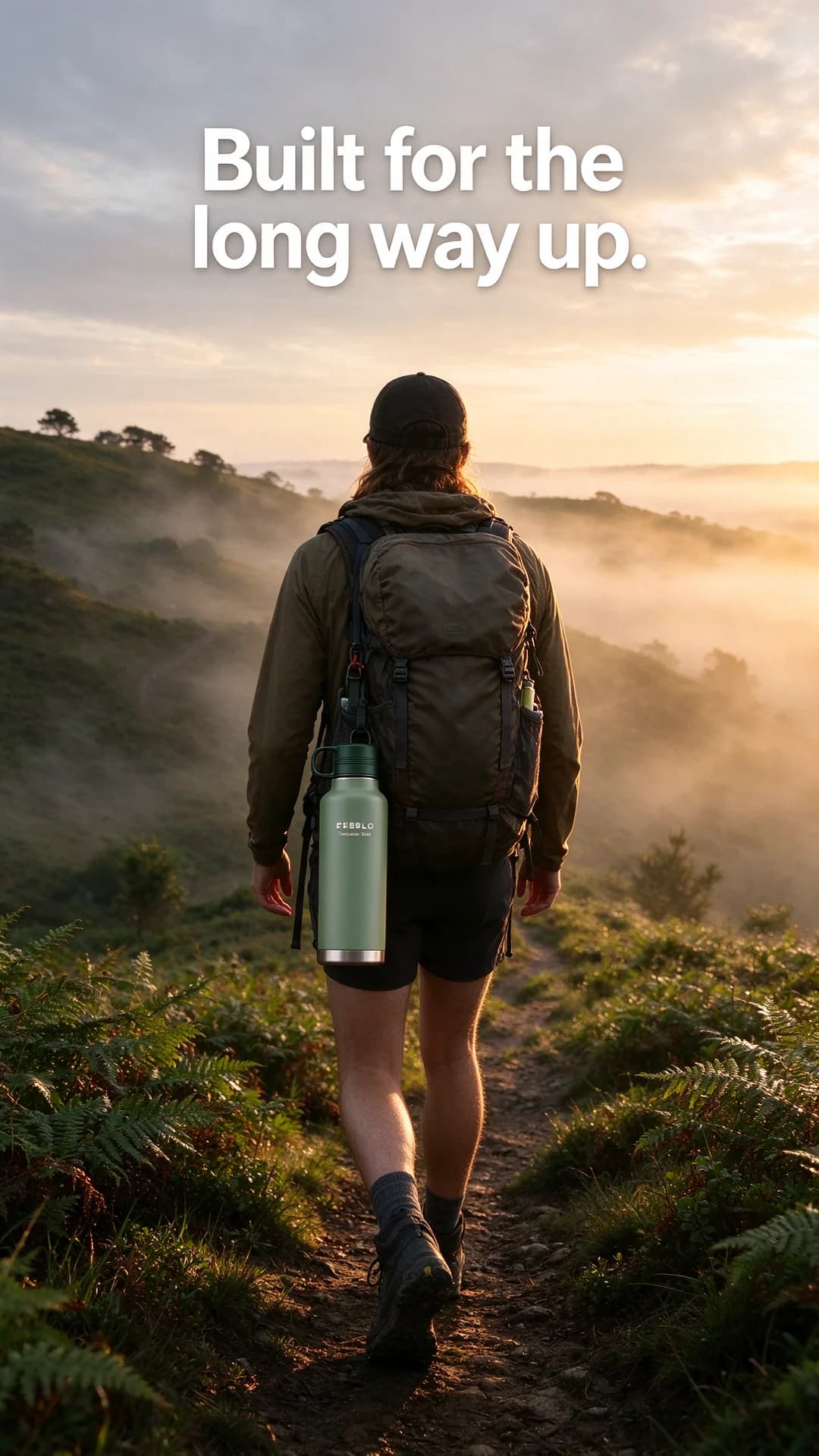
A sage-green Pebblo Trek Bottle clipped by its loop lid to the backpack of a hiker seen from behind on a misty trail at sunrise, headline "Built for the long way up."

PebbloMoment of useStories · 9:16 image

“Built for the long way up.”

The carry loop earns its place hanging from a pack strap, which a studio shot can never show. A full-screen vertical suits a scenic still, with the headline high in the frame, under the profile bar and well clear of the reply bar at the bottom.

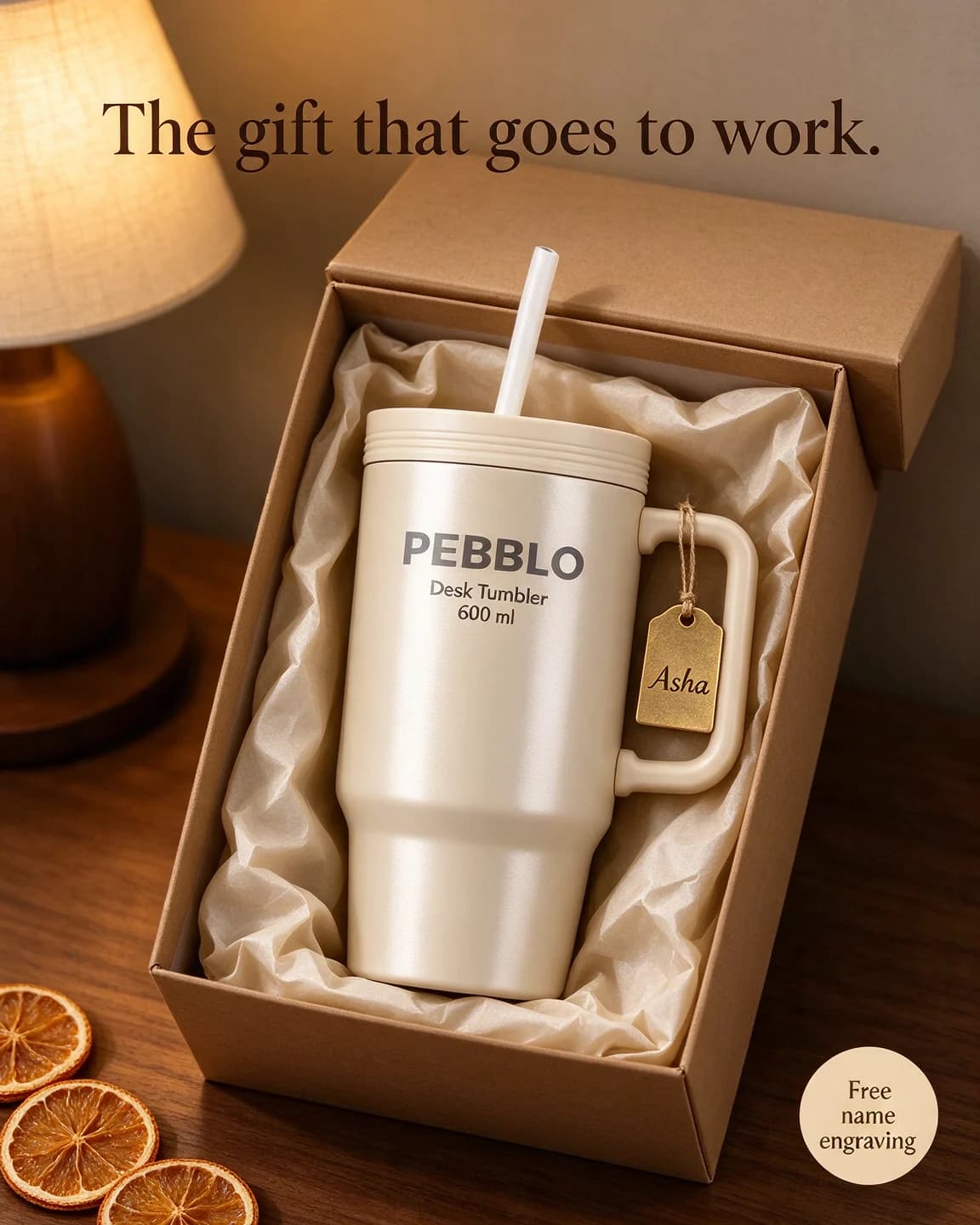
A cream Pebblo Desk Tumbler in an open kraft gift box with tissue paper and a small engraved name tag, headline "The gift that goes to work." and a "Free name engraving" sticker

PebbloGiftingFeed · 4:5 image

“The gift that goes to work.”

It frames the tumbler as a gift the person will use every working day, which answers the usual worry that a present ends up in a drawer. The engraving sticker adds something a supermarket bottle can't, and it suits teams ordering in bulk.

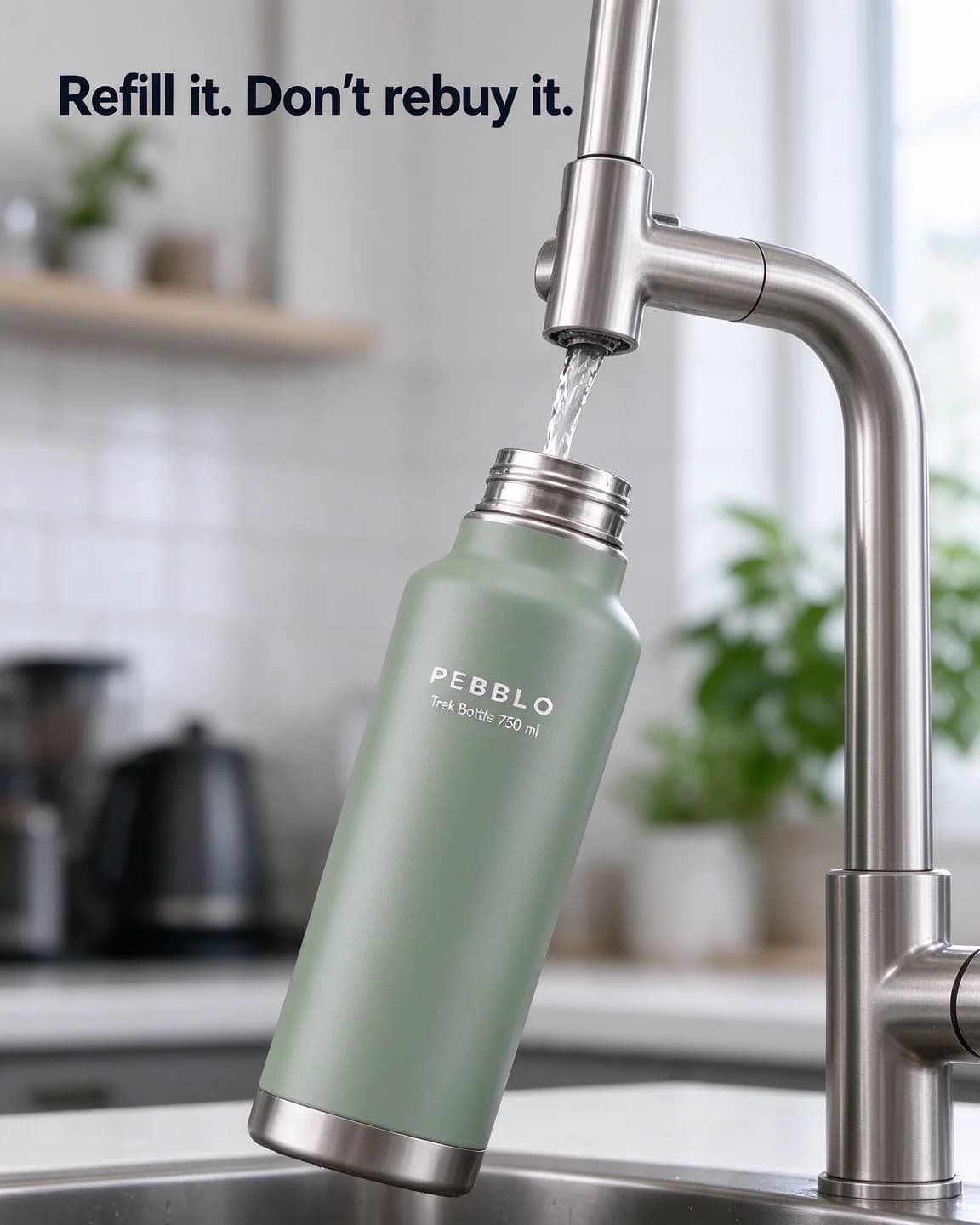
A sage-green Pebblo Trek Bottle being refilled under a stainless steel office water tap, headline "Refill it. Don't rebuy it."

PebbloHabit swapFeed · 4:5 image

“Refill it. Don't rebuy it.”

The habit is the message: one bottle topped up at a tap instead of a new one bought at a counter. It stays on the provable side of green marketing by naming a specific action instead of calling the bottle 'eco-friendly'.

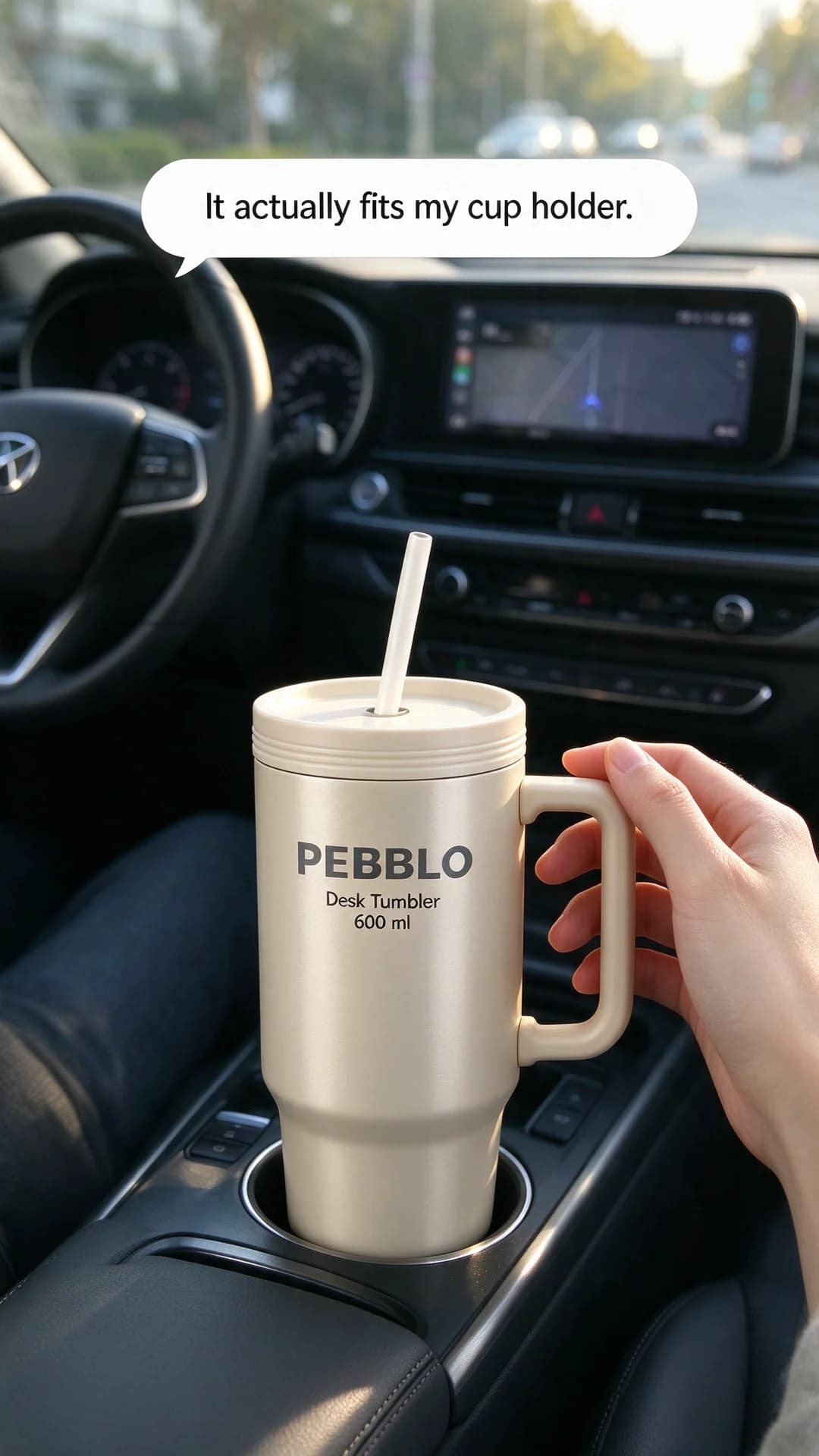
A cream Pebblo Desk Tumbler sitting in a car's cup holder as a hand reaches for its handle, with a speech-bubble caption "It actually fits my cup holder."

PebbloUGC fit checkReels · 9:16 image

“It actually fits my cup holder.”

Fit is the quiet objection with large tumblers, and a first-person caption in a real car answers it better than a base diameter in millimetres. Keep it honest by naming the base width in the copy, since cup holders vary from car to car.

Two more ways to try

  • PPebbloSponsored

    Pebblo vs the bottle in your bag

    Pebblo
    PEBBLO
    • Ice still there after lunch
    • Steel inside, no plastic taste
    • Dry outside, dry bag
    • Loop lid hangs off a strap
    The usual
    ?
    • Lukewarm by 11am
    • Tastes of last week's juice
    • Leaves a ring on everything
    • Rolls under the car seat
    Trek Bottle 750 mlShop Pebblo

    Us vs them ad

    Comparing against the bottle people already carry, not a named rival, keeps it fair and makes every line on the right something the viewer has lived through.

    Edit this template
  • PPebbloSponsored

    Made for the desk and the drive

    PEBBLO
    Tapered baseStraw lid clicks shutWide handleDry outside
    Desk Tumbler 600 mlShop the tumbler

    Feature callout ad

    Four short labels answer what tumbler shoppers check in reviews: will it fit the car, will it spill, can I carry it, will it sweat on my desk.

    Edit this template

Angles to test first

  1. 1

    Proof you can see

    Ice pouring out at dusk, a dry surface under a cold drink, a bottle shaken to hear the ice. Physical evidence beats a number on its own, and it gives the number something to stand on.

  2. 2

    Small annoyances, solved

    Wet rings, warm water by 11am, a metallic aftertaste, a lid that needs two hands. Name one irritation per ad and show it gone.

  3. 3

    Where it lives

    Desk, dashboard, gym floor, school bag, trail. Choose the place first, because the right claim follows from it: fit for the car, spill safety for the bag, a carry loop for the trail.

  4. 4

    Colour and identity

    People choose bottles the way they choose phone cases. Colour line-ups, new shades and a 'which one are you' frame sell the object as a personal accessory.

  5. 5

    Gifting and teams

    Engraving, a gift box and an order-by date turn a daily-use item into a considered present. Office and year-end gifting add bulk orders worth a separate ad.

  6. 6

    The refill habit

    Sell the behaviour, filling up instead of buying bottled water, with a concrete benefit you can prove. Avoid vague words like 'sustainable' that you can't back up.

15 hooks for drinkware ads

  • Filled at [8am]. Still [ice] at [6pm].
  • No puddle on your [notes].
  • Lies down in the [school bag]. Stays dry.
  • Pick the [colour] that's yours.
  • Built for the long way [up].
  • The gift that goes to [work].
  • Refill it. Don't rebuy it.
  • It actually fits my [cup holder].
  • Shake it at [3pm]. Hear the ice.
  • [Hot chai] at [7am]. Still warm at [noon].
  • No [metal] taste. Just [water].
  • One hand to open, one to [hold the lead].
  • Their name on it, so it comes home from [school].
  • [Two] refills before [lunch], one bottle all day.
  • Your [desk] drink, still cold by the [last meeting].

Moments to plan for

  • Summer heat (Apr–Jun in India)

    Lead with the cold-hours proof on commutes and school runs, shot in bright outdoor light so the heat is obvious.

  • School reopening (Apr–Jun in India, Aug–Sep in the US and UK)

    The kids' bottle on its side in a packed bag, with name labels or engraving as the reason to order before term starts.

  • New Year (Jan)

    Habit framing, such as 'two refills before lunch', kept to drinking more water and well away from weight-loss or detox promises.

  • Monsoon and trekking season (Jul–Sep)

    The loop lid clipped to a backpack on a wet trail, with the steel body shown shrugging off rain and mud.

  • Diwali and year-end gifting (Oct–Dec)

    Engraved tumblers in gift boxes for families and teams, with the last order date for delivery printed on the image.

  • A new job or a return to the office

    The desk tumbler beside a laptop and a lanyard, pitched as the small upgrade for a first week at a new desk.

Watch out for

  • Insulation hours are a test result, not a slogan. 'Cold for 24 hours' needs a test you ran, with the conditions (how full, how cold at the start, lid closed, room temperature) written in the primary text.
  • 'Leak-proof' is an absolute. Straw and sip lids often weep when tipped, so say 'spill-resistant' for those and only show a bottle on its side if its sealed lid truly holds.
  • Material claims need paperwork for every part that touches the drink, lid and straw included. 'Lead-free' became a live question in January 2024, when Stanley said the pellet sealing the vacuum in its cups 'includes some lead' under a steel layer (KTVU FOX 2, January 25, 2024).
  • Don't call a bottle 'eco-friendly' or 'sustainable' on its own. The US Federal Trade Commission's Green Guides say marketers should not make unqualified general environmental benefit claims, and their first example treats the brand name 'Eco-friendly' as deceptive (16 CFR 260.4, checked October 2026). Name the specific benefit you can prove instead.
  • Show true scale. A hand, a laptop or a cup holder in frame stops a 400 ml kids' bottle looking like a 1 litre jug, and keep hot drinks out of straw lids and kids' bottles that aren't made for them.

Practical pointers, not legal advice. Check Meta’s Advertising Standards and your local rules.

What a drinkware ad has to prove

On a white background, most insulated bottles look alike: a steel cylinder, a lid and a logo. The buyer can't feel the weight, hear the ice or check whether the lid leaks, so the ad has to stand in for all three. The best drinkware creative does that with evidence a phone screen can show. Ice tumbling out at the end of a day. A dry notebook page under a cold tumbler. A bottle lying on its side in a packed school bag.

That makes drinkware a forgiving category for honest ads. You rarely need a big promise. You need one physical test, shot well, and a headline that names what the viewer is looking at.

The shots that sell a bottle

Each of these answers a question shoppers ask before they pay for a bottle or a tumbler. Make at least one of each for your hero product before you try anything clever.

  • The ice pour. Ice tipped from the bottle into a glass late in the day. It is the most direct proof of insulation, and it moves well as a short video.
  • The dry surface. A cold tumbler on paper, wood or a laptop palm rest with no ring. It sells double-wall insulation without a cutaway diagram.
  • The bag test. The bottle on its side among books, clothes or a laptop. Shoot this only with lids that genuinely hold.
  • The fit check. A car cup holder, a bike cage, a backpack side pocket. Fit is the first practical question a big tumbler raises.
  • The hand. A hand wrapped around the bottle gives real scale. Without one, a 400 ml kids' bottle and a 1 litre jug can look identical.
  • The line-up. Every colour in one frame. It answers "what else does it come in" and turns colour into a personal choice.
  • The place it lives. Desk, dashboard, gym floor, trail. Pick the place first and the right claim usually follows.

Light matters more than usual with steel. Powder-coated finishes go flat under hard light and brushed steel catches every reflection, so soft window light or open shade keeps the colour true and the label readable. If you shoot your own packshot, a large white card opposite the window fills the shadow side without adding a hotspot.

A first batch of 12 for one bottle

Start with one product and four angles, three versions each, which fills a single batch of 12 ads. A sensible first set for an insulated bottle:

  1. Proof. The ice pour or the dry desk, with your tested hours in the headline.
  2. Annoyance solved. The puddle, the warm water or the plastic taste.
  3. Place of use. Desk, car or trail, whichever your reviews mention most.
  4. Gift or colour. The line-up, or a gift box when a gifting season is close.

Make each in 4:5 for feeds and 9:16 for Stories and Reels. The 9:16 versions need their headline high in the frame, under the profile bar and clear of the reply bar and buttons, and the safe zone checker shows exactly where those sit. How many versions to make, and when to cut, is covered in how many ad creatives to test.

Offers work best when they match how people buy. Bottles are often bought in twos, one for work and one for the gym, or one per child, so a pair price is easier to grasp than a percentage. As a worked example, if one Trek Bottle sells for $15, a pair at $26 saves the buyer $5.15, and that saving can sit on the image as a plain amount. Near Diwali or the year end, a gift set with engraving included does the same job, and the gift guide template shows a layout for it.

Run the ice test before you write the hours

Drinkware claims are easy to check, which means buyers check them. The "Watch out for" list above says what each claim needs. The step that gets skipped is the test itself, and a kitchen version is enough to tell you which number you can print:

  1. Take three bottles from different deliveries, not the sample the supplier sent first. The ad speaks for every bottle in the warehouse.
  2. Fill each to the shoulder with the same mix of ice and water, close the lids and leave them side by side in one room. Write the room temperature down.
  3. Check at fixed times with a food thermometer, or simply note when the last ice disappears, and photograph each check.
  4. Quote the worst bottle, not the best. If the weakest still had ice after ten hours, "Filled at 8am. Still ice at 6pm." is a fair headline. If one lasted 22 hours and another 18, the ad says 18.
  5. Write the conditions next to the number in the primary text, for example "full bottle of iced water, lid closed, room at 30°C". A number with conditions reads as a fact. "Cold all day" reads as a slogan.

Test hot drinks separately and print each result on its own, because hot and cold hours are rarely the same. Do the same for leaks: fill the bottle, close it, lay it on kitchen paper overnight and repeat with the straw lid. For "BPA-free", "lead-free" or "18/8 stainless steel", ask your supplier for a test report that names every part touching the drink, seal and straw included, and keep it with your test photos. They answer the first customer who writes in to say theirs went warm.

How BulkAds makes these from one bottle photo

BulkAds starts from your real packshot, so the bottle in every ad keeps its shape, lid and label. A clean photo on white works best: one bottle, centred, soft even light, label sharp. Reflective steel can hide label details, so shoot it in diffuse light, as the guide to product photos for AI ads explains.

From that one photo, a batch of up to 12 ads for the Trek Bottle can hold the ice pour, the refill, the trail and the comparison with the old bottle in your bag, each with its own headline, primary text and description in your brand voice. The colour line-up is the exception. Start it from a photo with every real shade in it, so no colour appears in an ad before it exists in your stock. Your brand kit holds the claims you can back up, like the hours from your own test or the steel grade, and the copy is told to stick to those. A batch of 12 image ads uses 24 credits.

Before you see the batch, a pre-flight check compares each ad with your original photo and flags any where the lid, colour or label drifted, along with spelling slips in on-image text. Drinkware also moves well: condensation running down the outside, light sliding across the steel, a slow push-in on the label. Turn the image that sells into a short video ad and test it beside its still.

Every ad launches to your own Meta ad account paused, so you can check it first. In the tests it launches itself, Autopilot stops ads that spend without selling and drafts four fresh variants of each winner, so a proven ice-pour idea can come back as a desk version, a trail version and a gift version.

Questions people ask

What should a water bottle ad show first?

Proof of the one thing a listing can't show: ice still in the bottle at the end of the day, a dry surface under a cold tumbler, or the bottle on its side in a packed bag. Pick the proof that matches your strongest tested claim and lead with it.

Can I say my bottle keeps drinks cold for 24 hours?

Only if your own test shows it, under conditions you state. Write them in the primary text, for example a full bottle of iced water with the lid closed at room temperature. If results vary between bottles, quote the lowest result you got, not the best one.

Are video ads worth making for drinkware?

Yes, once an image angle has proven itself. Bottles have natural motion, like condensation running down the outside, ice settling or a lid clicking shut, and a short video of a winning still tests the format without changing the message.

How do I make drinkware gift ads stand out?

Give the gift a reason to be this bottle: an engraved name, a gift box, a colour chosen for the person, and the last date to order for delivery. For team orders, show several engraved tumblers together rather than one.

Is Pebblo a real brand?

No. Pebblo is fictional, and every ad on this page was made with AI for illustration.

Keep going

Every brand on this page is fictional and every ad was made with AI for illustration — they’re examples, not case studies.

BulkAds AI is an independent product and is not affiliated with, endorsed or sponsored by Meta Platforms, Inc. Facebook and Instagram are trademarks of Meta Platforms, Inc.

More ad examples

Your next fifty ads are one link away.

Paste your website, meet your brand kit and see your first batch in minutes. 7 days for $9.99 — cancel anytime.

yourbrand.comMake my ads

See pricingExplore featuresBrowse the library