Ad examples

Skincare ad examples: 9 ideas that sell without overpromising

Skincare is the category where a good ad can still get rejected. These nine serum and sunscreen ideas for fictional brands show how to sell texture, routine and ingredients honestly, each with its hook, its angle and why it works.

7 ads2 live templates15 hooks

The swipe file

Each ad with its angle, its hook and why it works. Every brand is fictional. The ads were made with AI to show the idea.

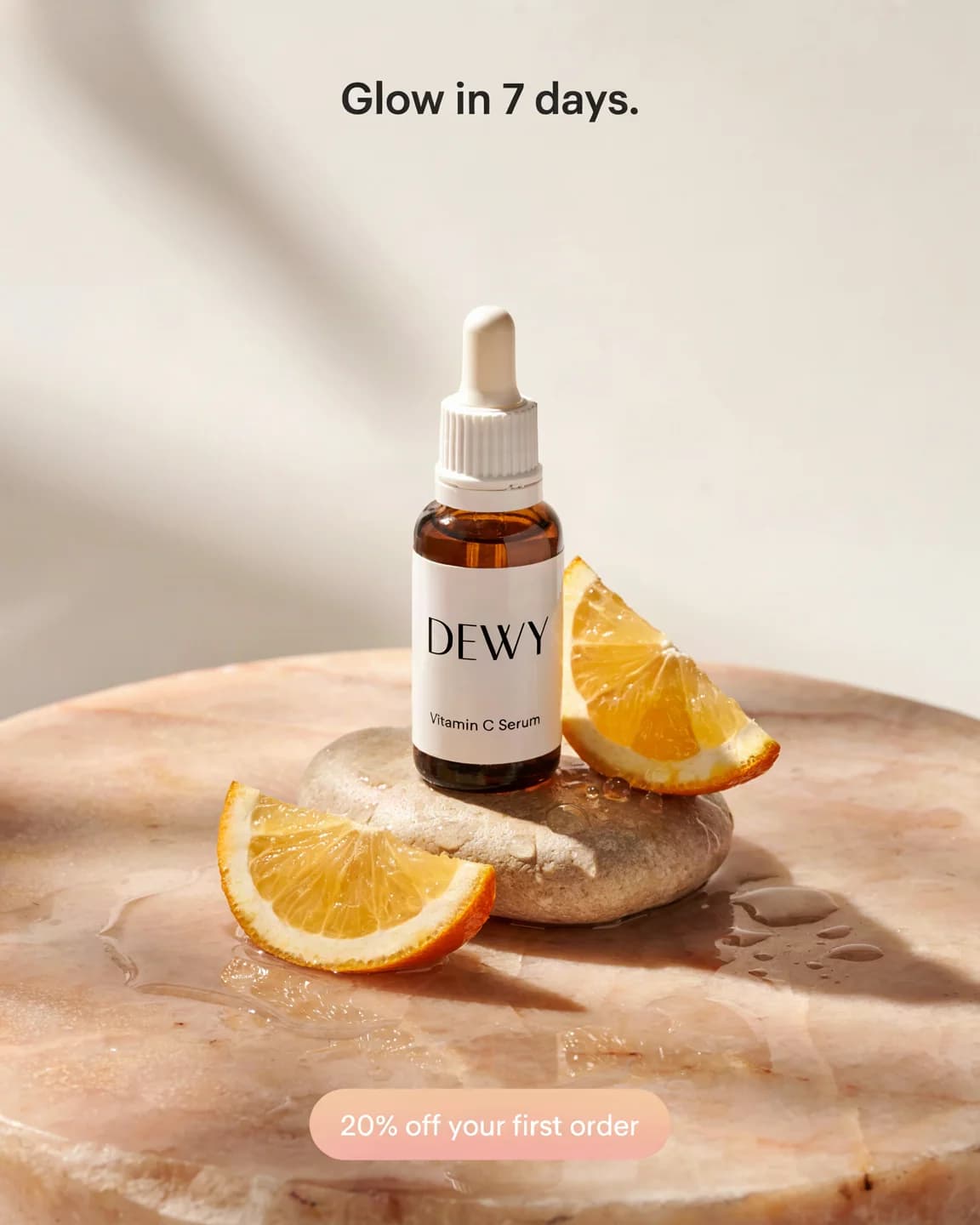
A Dewy Vitamin C Serum dropper bottle on a pale stone with orange wedges and water droplets, headline "Glow in 7 days." and a "20% off your first order" pill

DewyTimed promiseFeed · 4:5 image

“Glow in 7 days.”

A timeframe makes the promise concrete, and orange wedges on wet stone signal vitamin C and freshness without any science. It's a results claim, though — only run a line like this if you can back it up, and let the first-order pill do the persuading for new customers.

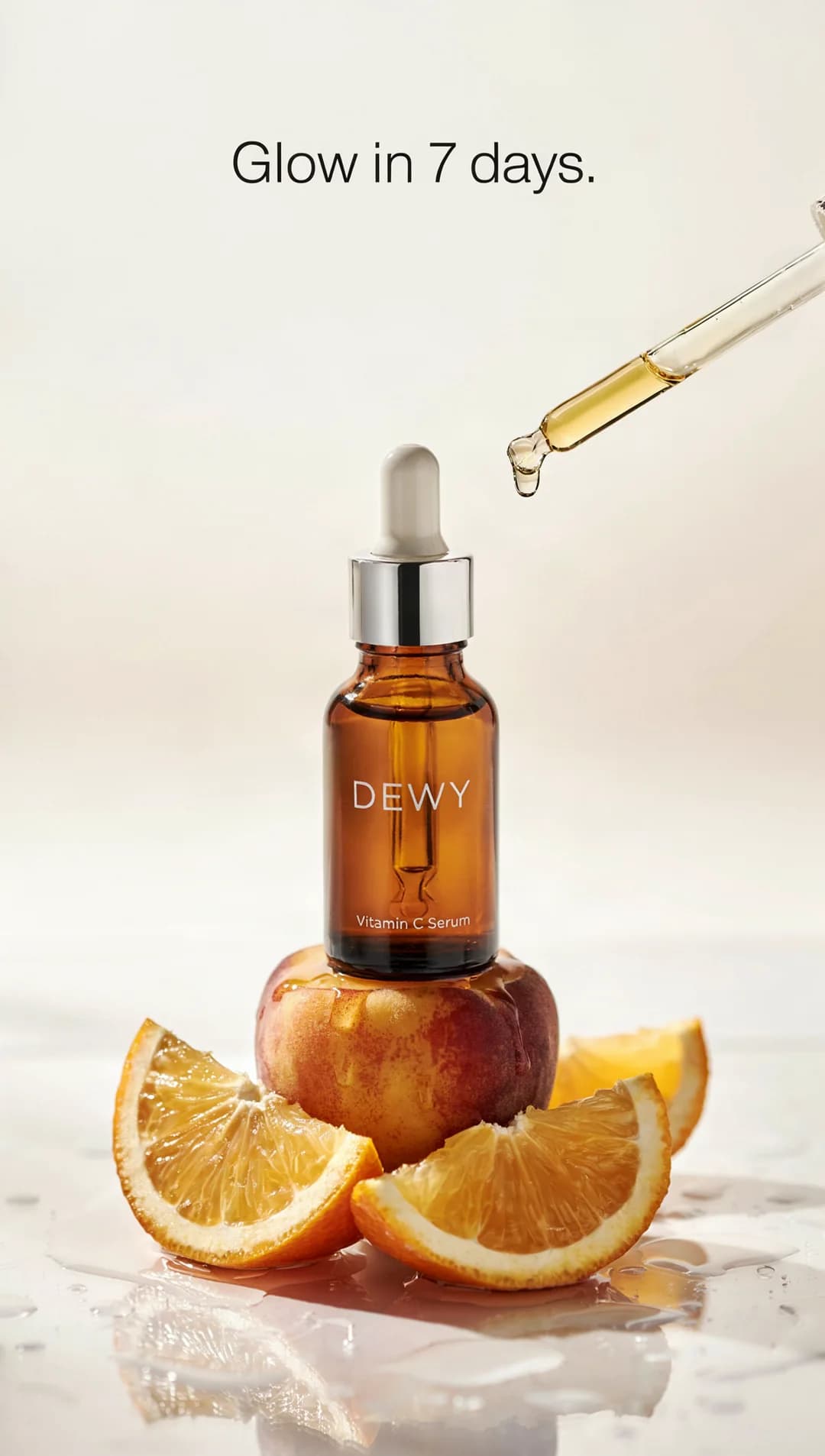
DewyTexture in motionReels · 6s video

“Glow in 7 days.”

A single drop falling from the pipette shows the texture — thin, clear, golden — which is what serum buyers want to see and a packshot can't show. The slow drip is made for Reels, where a moving product holds attention better than a still bottle.

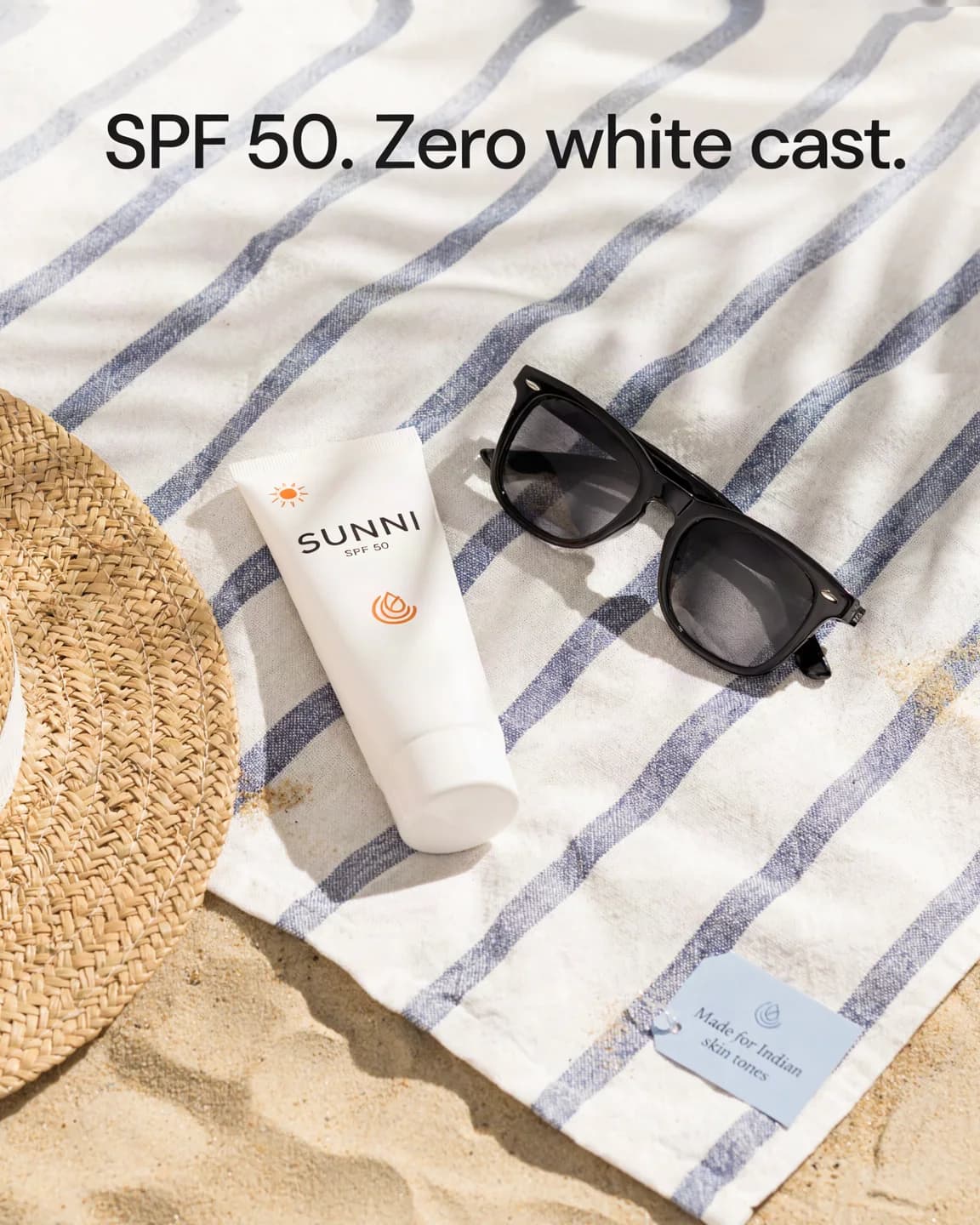
A Sunni SPF 50 sunscreen tube on a striped beach towel with sunglasses and a straw hat, headline "SPF 50. Zero white cast." and a tag reading "Made for Indian skin tones"

SunniObjection killerFeed · 4:5 image

“SPF 50. Zero white cast.”

It leads with the protection number, then removes the objection that stops many people wearing sunscreen daily: a chalky finish. The tag says who it's made for, which speaks directly to buyers who've been let down by white-cast formulas.

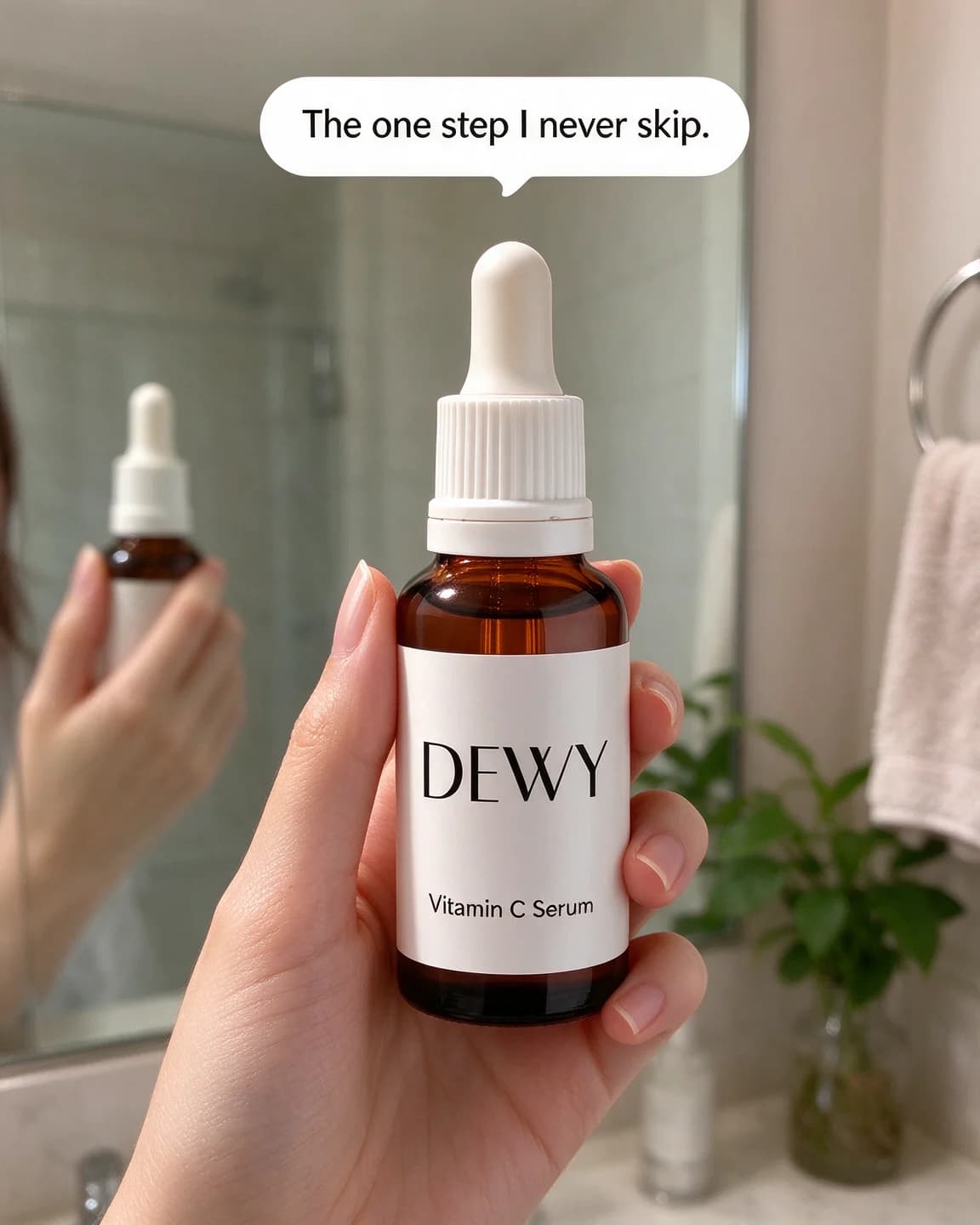
A hand holding a Dewy Vitamin C Serum bottle in front of a softly lit bathroom mirror, with a speech-bubble caption reading "The one step I never skip."

DewyUGC routineFeed · 4:5 image

“The one step I never skip.”

It sells a habit rather than a result, which is both more believable and safer than a promise about skin. The bathroom-mirror shot looks like a real morning routine, so it suits people building or simplifying their own.

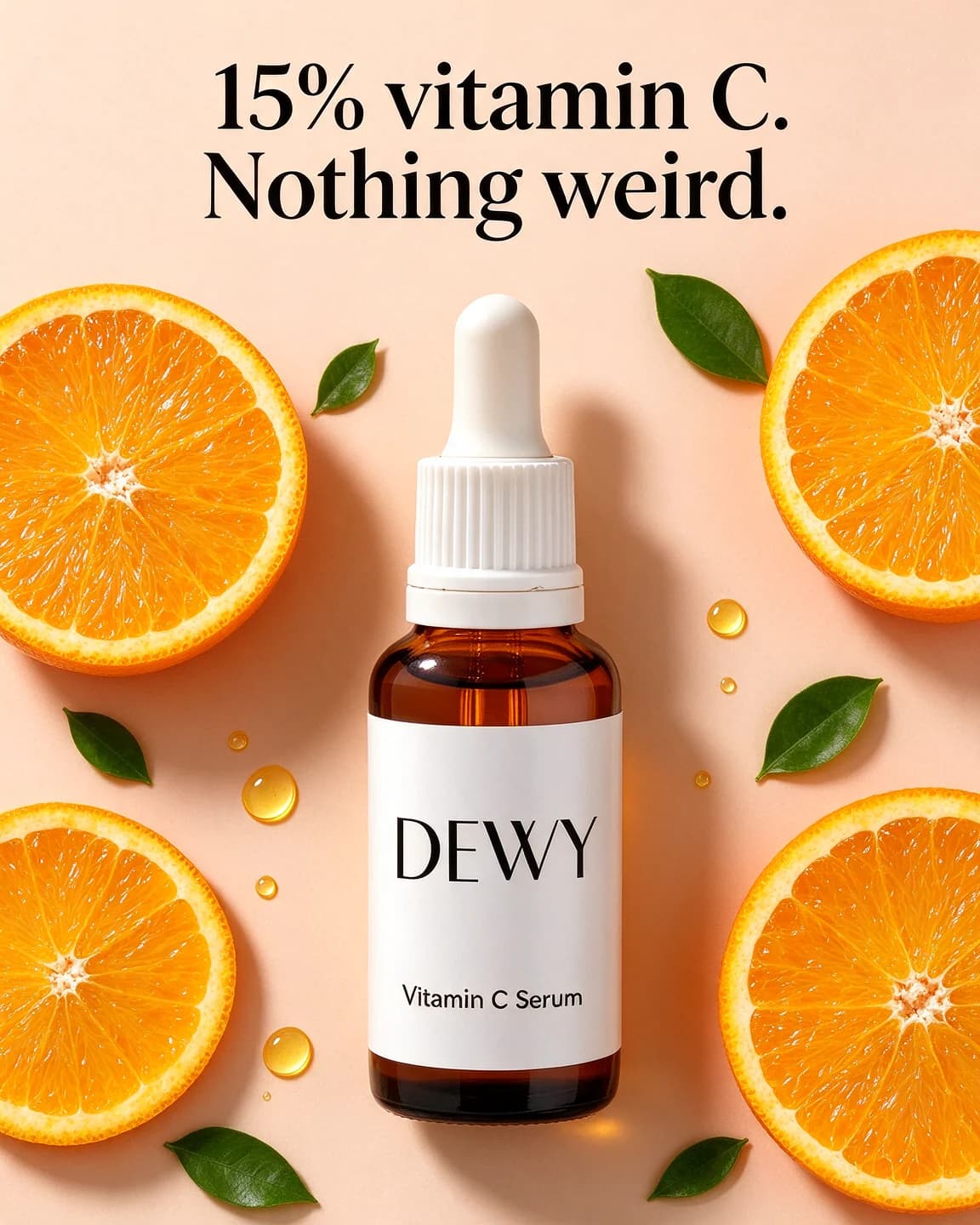
Top-down flat lay of a Dewy serum bottle surrounded by halved oranges, golden serum drops and green leaves on a pale peach surface, headline "15% vitamin C. Nothing weird."

DewyIngredient storyFeed · 4:5 image

“15% vitamin C. Nothing weird.”

Ingredient-literate buyers want the percentage, so the number goes first, and 'Nothing weird' answers their next question about what else is in the bottle. The citrus flat lay makes vitamin C visual — just make sure the ingredient list backs up 'nothing weird'.

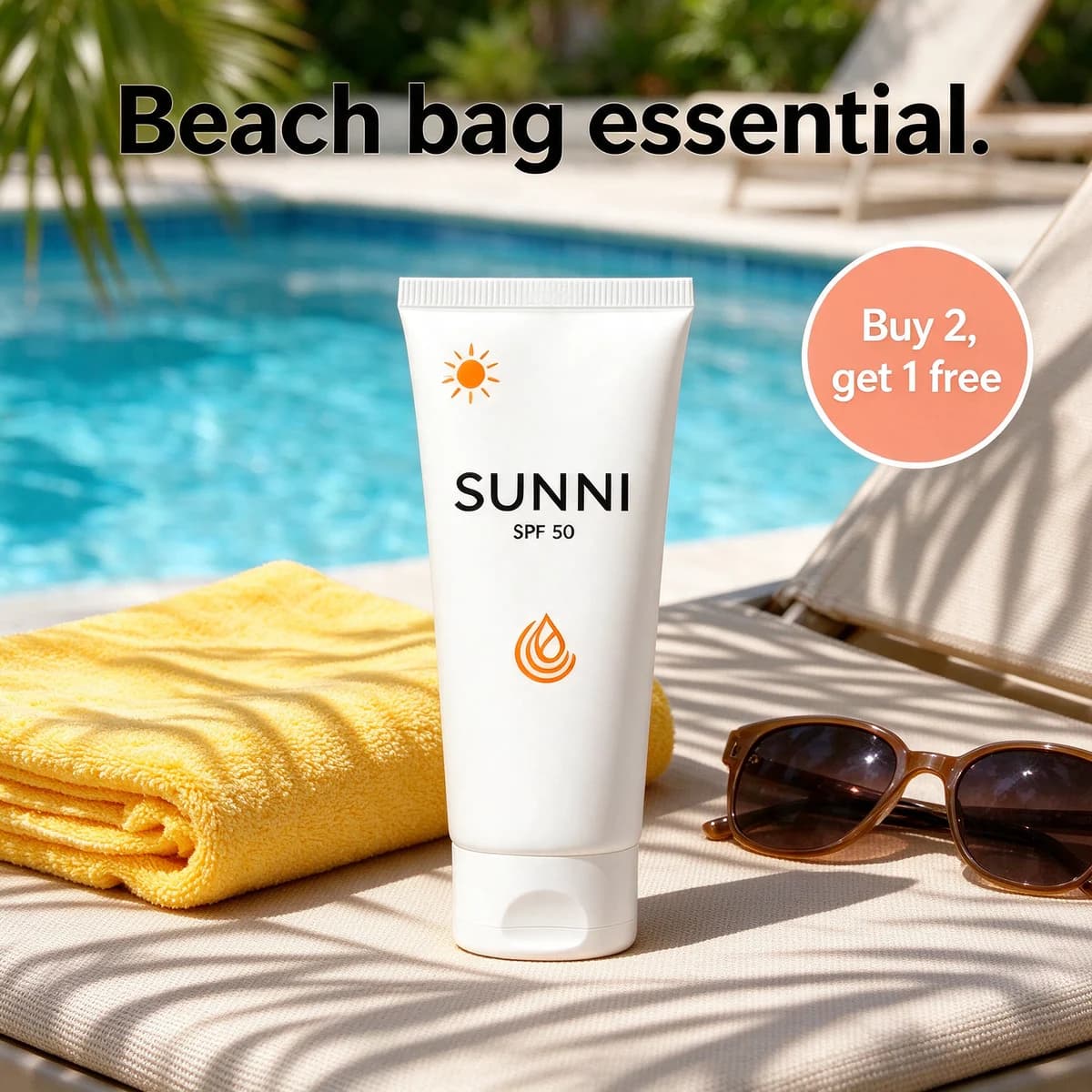
A Sunni SPF 50 tube on a poolside lounger with a yellow towel, sunglasses and palm-leaf shadows, headline "Beach bag essential." and a coral "Buy 2, get 1 free" sticker

SunniOfferFeed · 1:1 image

“Beach bag essential.”

Sunscreen gets used up and lost, so a multi-buy fits how people actually buy it: one for the bag, one for home, one to share. The poolside scene places it in the holiday-packing moment, which makes it a natural retargeting ad before summer breaks.

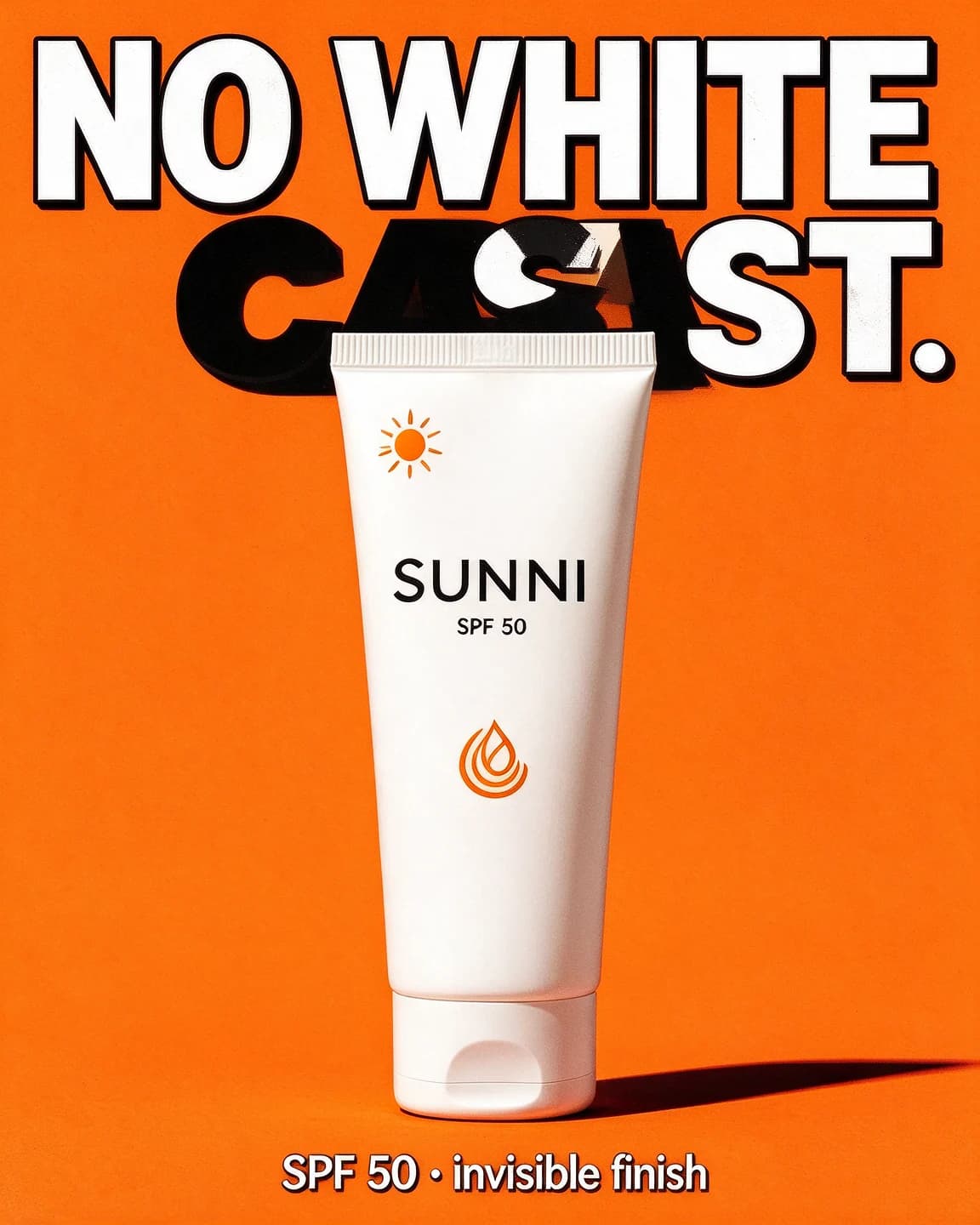
A Sunni SPF 50 tube on a flat tangerine background with a hard shadow, the giant headline "NO WHITE CAST." and the line "SPF 50 · invisible finish"

SunniBold claimFeed · 4:5 image

“No white cast.”

Three words on a flat colour block read at a glance, which matters when the claim is the whole pitch. It's the beach ad's promise in a louder costume — a useful pair for learning whether this audience responds to mood or to directness.

Two more ways to try

  • SSunniSponsored

    ★★★★★

    “No white cast in photos, no sticky feel, and it sits fine under my makeup. I actually reapply it at lunch now.”

    AAnanya R. Verified buyer · Chennai
    SUNNI
    SPF 50 sunscreenShop now

    Testimonial ad

    A review about texture and reapplying — not about skin changing — gives social proof without drifting into results claims.

    Edit this template
  • DDewySponsored

    3 things to know about vitamin C

    1. 1Use it in the morning
    2. 2Always follow with sunscreen
    3. 3Store the bottle somewhere dark
    DEWYSERUM
    Vitamin C SerumShop the serum

    Listicle ad

    Teaching something useful earns attention from ingredient-curious shoppers and makes the brand the one that explains, not just the one that sells.

    Edit this template

Angles to test first

  1. 1

    Texture and ritual

    Show the drop, the swipe, the finish in daylight — how it feels and where it fits in a routine. It's what a packshot can't show, and it doesn't promise results.

  2. 2

    Ingredient transparency

    Lead with the active and its percentage, then answer 'what else is in it?'. Ingredient-literate shoppers often compare percentages before they compare brands.

  3. 3

    Objection handling

    Name the thing that stops people using the category — white cast, stickiness, pilling under makeup — and show how yours avoids it.

  4. 4

    Routine simplifier

    'One step', 'the only serum I use', 'three-step mornings': speak to people tired of long routines, without criticising anyone's skin.

  5. 5

    Offers that match usage

    Multi-buys for products that run out or get lost, like sunscreen. First-order discounts for trial, like serums. Bundles that build a routine.

15 hooks for skincare & beauty ads

  • The one step I never skip: [product].
  • [Percentage]% [active]. Nothing weird.
  • [SPF number]. Zero [white cast].
  • Finally, a [sunscreen] that doesn't [feel sticky].
  • What one drop of [active] looks like.
  • My [morning] routine in [number] steps.
  • [Product type] for [Delhi summers], not just [beach days].
  • The [lightweight] [serum] that sits under [makeup].
  • [Beach bag] essential: [product].
  • Why our [vitamin C] comes in an [amber] bottle.
  • [Number] things to know about [active].
  • How to reapply [SPF] over [makeup].
  • No [white cast]. No [grease]. Just [SPF 50].
  • Your [morning routine], in one [bottle].
  • [Discount] off your first [serum].

Moments to plan for

  • Summer (Mar–Jun in India)

    Pitch sunscreen as an everyday commute essential, not just a beach product, with 'reapply at lunch' reminders.

  • Monsoon (Jun–Sep)

    Lightweight, non-greasy textures shown on humid, rainy-day commutes.

  • Wedding season (Nov–Feb)

    Routine bundles framed around getting ready for functions — texture and ritual, never promised results.

  • Diwali (Oct–Nov)

    Gift sets pairing a serum with a sunscreen, gift-wrapped beside diyas.

  • Holiday travel (Apr–May, Dec)

    Travel-size duos and a 'beach bag essential' multi-buy before school holidays.

  • Black Friday (Nov)

    A clear multi-buy on routine staples, with the offer on the image and the terms in the primary text.

Watch out for

  • No before-and-after photos of skin. Meta restricts before-and-after imagery that shows or implies changes to the body or skin, so show texture, application and packaging instead.
  • Don't imply you know something about the viewer's skin ('Struggling with acne?', 'Your dark spots…'). Meta's personal attributes policy doesn't allow that phrasing — talk about the product, not the person.
  • Timed results ('Glow in 7 days'), 'clinically proven' and 'dermatologist recommended' all need real evidence behind them. If you can't show the study, soften the line.
  • Only claim the SPF (and PA rating) printed on your pack, and avoid absolutes such as 'waterproof' or 'blocks all UV' — sunscreen claims are tightly regulated in many markets.
  • Avoid 'fairness' or 'whitening' framing that treats darker skin as a problem. It's widely criticised, and India's advertising self-regulator, ASCI, has specific guidance on it.

Practical pointers, not legal advice. Check Meta’s Advertising Standards and your local rules.

What makes skincare ads work

Skincare ads sell something nobody can see working in a two-second scroll. The strongest ones show what is visible — a drop falling from a pipette, a swipe on the back of a hand, a matte finish in daylight — and let an honest ingredient list do the persuading.

It's also the category where Meta is strictest. Before-and-after skin photos, promised results and copy that points at the viewer's skin are the usual reasons beauty ads get rejected. The craft is selling without overpromising, and the examples above show four ways to do it:

  • Texture and routine instead of transformation: "The one step I never skip."
  • Ingredients with numbers: "15% vitamin C. Nothing weird."
  • Objections, answered: "SPF 50. Zero white cast."
  • Offers matched to how people buy: a multi-buy for sunscreen that gets used up and lost.

One example, "Glow in 7 days.", is deliberately on the edge. A timed result is a strong hook, but it's a claim you must be able to substantiate. If you can't, swap it for a texture or routine line — you lose a little punch and a lot of risk.

Your first two weeks of skincare testing

Pick five angles and make two or three versions of each:

  1. UGC routine — a hand, a mirror, a first-person caption.
  2. Ingredient story — the active and its percentage, with its source around the bottle.
  3. Objection killer — white cast, stickiness or pilling under makeup.
  4. Bold claim — one checkable fact, huge, on a flat brand colour.
  5. First-order offer — mainly for retargeting people who've visited.

That's 10 to 15 ads for one hero product. Our guide on how many ad creatives to test covers how to scale that up or down, and the creative test calculator shows how much each ad needs to spend before you can judge it. As a worked example: at a target cost per purchase of $7.20, letting each of 12 ads spend about twice that comes to roughly $173 before the first cut.

Make every concept in 4:5 for feeds and 9:16 for Stories and Reels. Texture is where video earns its place: a slow drip, or a swipe that sinks in, says more than a still bottle. Once an image angle has proven itself, turn it into a short video ad.

Judge on purchases, not likes. Beauty ads can collect likes, saves and comments without selling anything. The real test is whether they sell at a cost you can afford.

Creative tips for beauty ads

  • Show texture, not skin changes. A drop on a fingertip, a swatch on the back of a hand, serum catching the light. All persuasive, none of them a results claim.
  • Let props explain the active. Citrus for vitamin C, aloe only if aloe is in the formula. Props that suggest ingredients you don't use are a quiet way to mislead.
  • Use real light. Bathroom mirrors, window light, a sunny poolside. Heavy retouching makes a product look less trustworthy, not more.
  • Show a range of skin tones. Hands and arms in different tones help more people picture the product on themselves, especially for sunscreen and tinted products.
  • Keep the label readable. The brand name and product type should survive a thumbnail-sized preview.
  • One claim per image. The active, the SPF or the objection — not all three.

Let the primary text carry what the image shouldn't: how and when to use the product, the key ingredients and who it's formulated for. Frame those as facts about the product ("a lightweight gel for oily and combination skin", if your testing supports it), never as a statement about the reader's skin.

Turning a winning beauty ad into variants

When an angle sells, keep it and change one thing at a time:

  • Same line, new texture shot — a drop, a swipe, a flat lay.
  • Same routine, new setting — morning bathroom, gym bag, office drawer.
  • Same angle, another product — if "the one step I never skip" works for the serum, try it for the sunscreen.
  • New size — rebuild the winner in 9:16, with the text inside the safe zone.

BulkAds builds these variants from your real packshot — see product photo ads — and flags likely Meta policy risks, such as before-and-after framing, before anything launches. If you like the before-and-after layout, use it for situations only, like a cluttered shelf versus one bottle. The before-and-after template shows how.

Questions people ask

Can skincare ads show before-and-after photos on Facebook?

Meta restricts before-and-after images that show or imply changes to skin or the body, and ads that use them can be rejected. Show texture, application and routine instead, or compare two situations — a crowded shelf versus one bottle — rather than skin.

What should a skincare ad headline say?

One concrete thing a buyer can check: the active and its percentage, the SPF, the texture or the step it replaces. Avoid promising results you can't substantiate.

Which ad format works best for serums and sunscreens?

Test both main formats: 4:5 images to compare angles quickly, and short 9:16 videos that show texture — a drop, a swipe, how it absorbs — which a still can't.

How do I make beauty ads look less like ads?

Use a UGC-style shot: a hand, a bathroom mirror, a first-person caption, with the label still readable. If the photo isn't from a real customer, don't present it as a real review.

Are Dewy and Sunni real brands?

No. Both are fictional, and every ad on this page was made with AI for illustration.

Keep going

Every brand on this page is fictional and every ad was made with AI for illustration — they’re examples, not case studies.

BulkAds AI is an independent product and is not affiliated with, endorsed or sponsored by Meta Platforms, Inc. Facebook and Instagram are trademarks of Meta Platforms, Inc.

More ad examples

Your next fifty ads are one link away.

Paste your website, meet your brand kit and see your first batch in minutes. 7 days for $9.99 — cancel anytime.

yourbrand.comMake my ads

See pricingExplore featuresBrowse the library