Ad examples

Cleaning product ad examples: 8 ideas that show the result honestly

Cleaning products are one of the few categories where the result fits in a single photo: the stain, then no stain. These eight ads for Wrenwash, a fictional refill cleaning brand, show results, refills and routines. Each comes with its hook, its angle and a note on what keeps it believable, and the page ends with the cleaning claims that need proof before they go near an image.

8 ads2 live templates15 hooks

The swipe file

Each ad with its angle, its hook and why it works. Every brand is fictional. The ads were made with AI to show the idea.

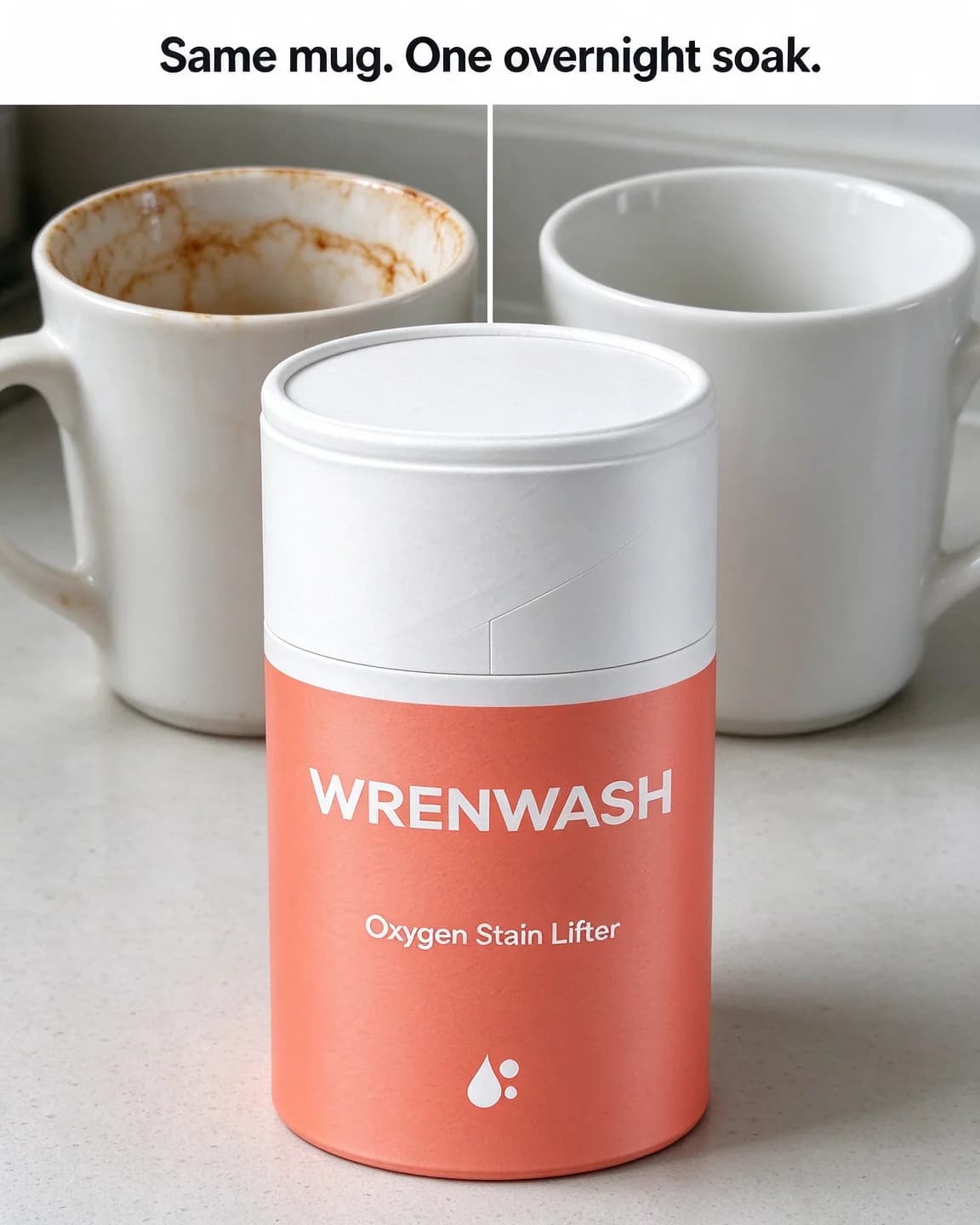
A Wrenwash Oxygen Stain Lifter canister in front of the same white mug shown twice on a pale grey counter, tea-stained on the left and clean on the right, headline "Same mug. One overnight soak."

WrenwashVisible resultFeed · 4:5 image

“Same mug. One overnight soak.”

The same mug in the same light from the same angle is the most convincing before-and-after a cleaner can show, and 'overnight' tells the buyer how long it really takes. That detail matters, because a product that needs a night shouldn't be sold as instant.

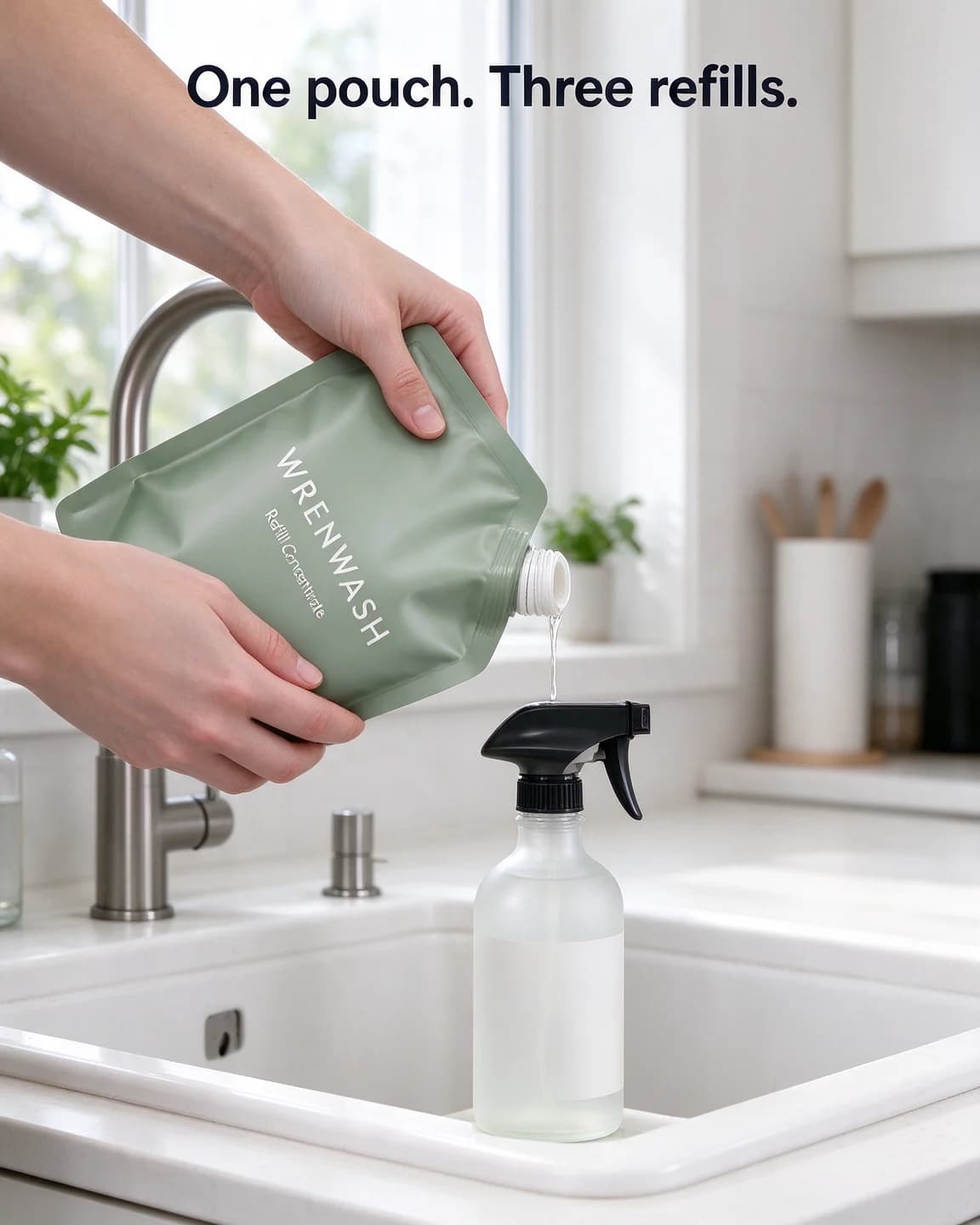
Hands pouring concentrate from a sage-green Wrenwash Refill Concentrate pouch into a frosted glass spray bottle beside a kitchen sink, headline "One pouch. Three refills."

WrenwashRefill routineFeed · 4:5 image

“One pouch. Three refills.”

It turns a sustainability idea into a plain count the buyer can check against the pack, which is far safer than calling the product eco-friendly. The pour itself shows how easy refilling is, the doubt that stops many people switching from ready-made bottles.

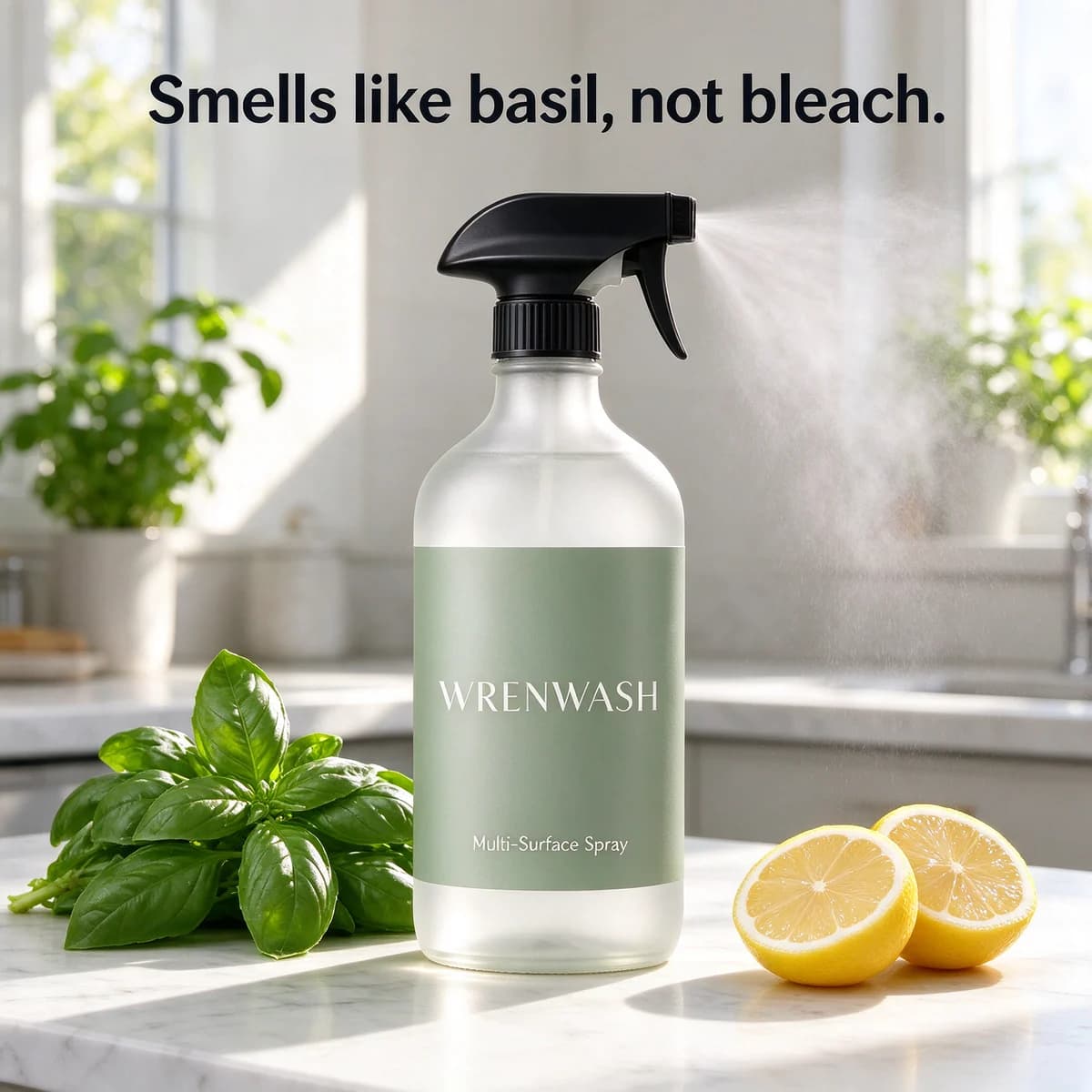
A Wrenwash Multi-Surface Spray in a frosted glass bottle on a sunny kitchen worktop beside fresh basil and halved lemons, a fine mist in the air, headline "Smells like basil, not bleach."

WrenwashScentFeed · 1:1 image

“Smells like basil, not bleach.”

Scent is part of why people stay loyal to a cleaner, and naming the smell they don't want makes the contrast without naming a rival. The basil and lemon do the smelling for the viewer, so use them only if they match the fragrance.

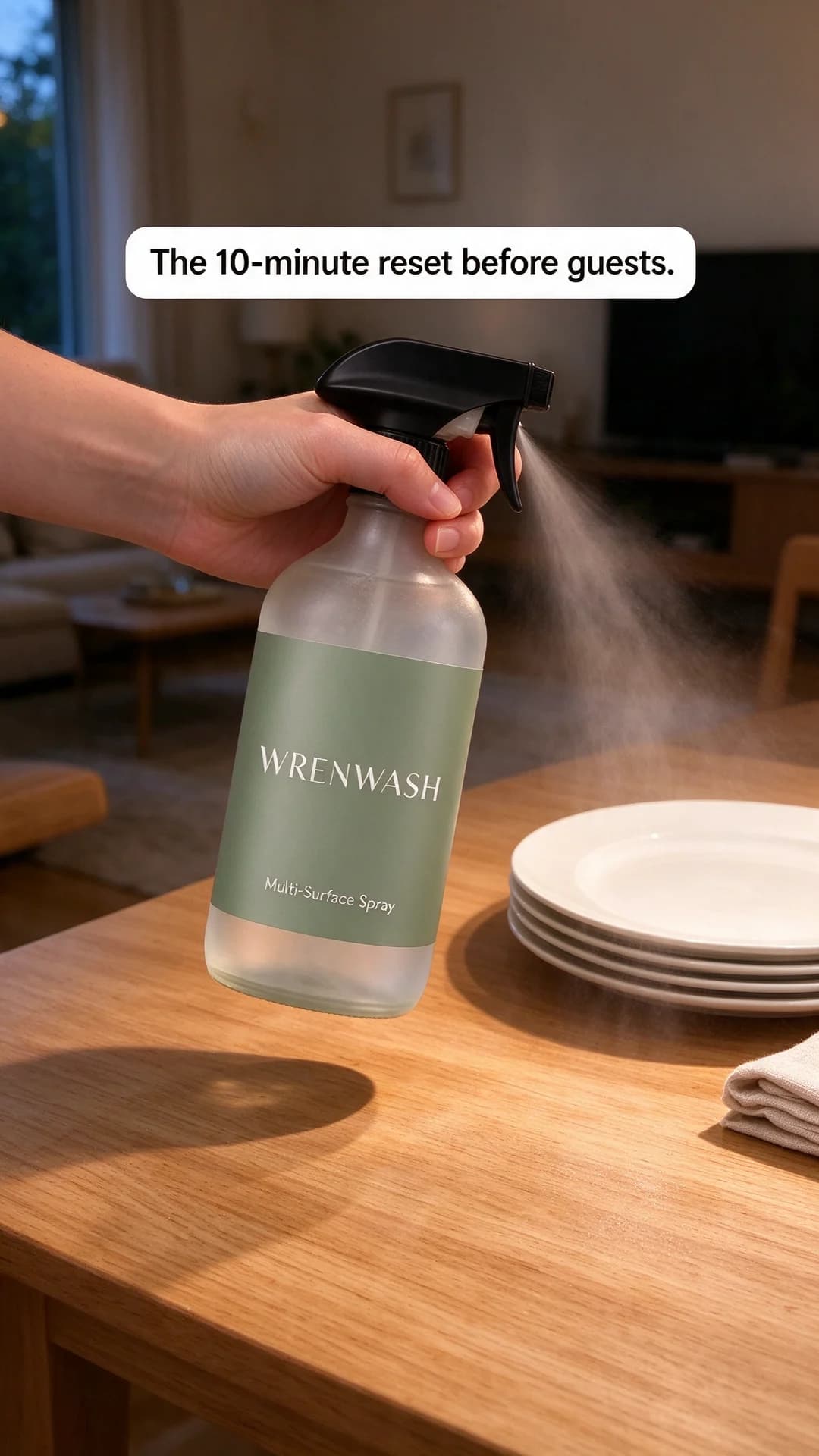
A hand spraying a dining table with a Wrenwash Multi-Surface Spray next to a stack of clean plates and a folded cloth, casual phone photo, headline "The 10-minute reset before guests."

WrenwashTime-boxed routineStories · 9:16 image

“The 10-minute reset before guests.”

A deadline everyone recognises, guests at the door, gives the spray a specific job and a reason to live on the counter instead of under the sink. The tall frame leaves room for the headline above the action and the button below it.

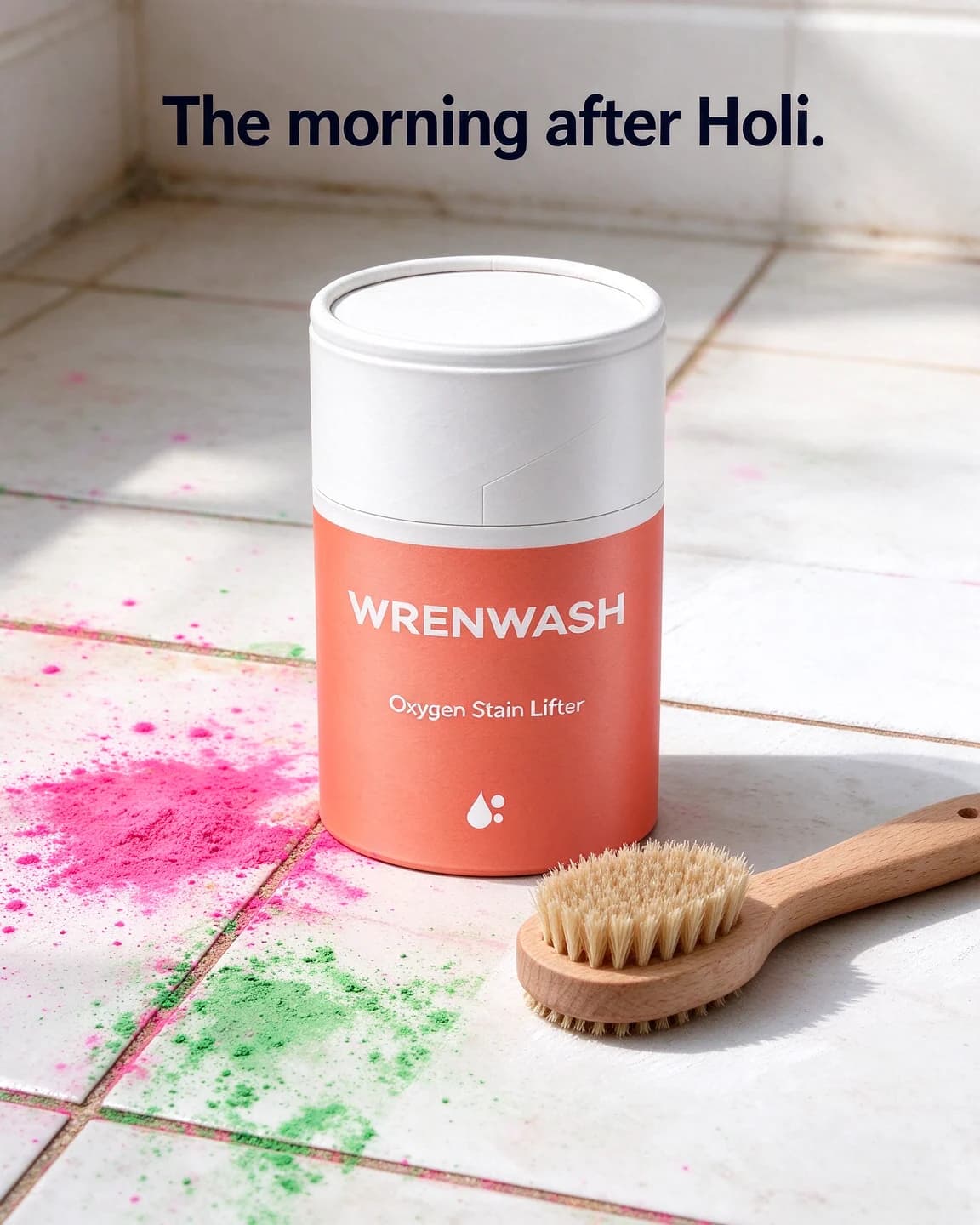
A Wrenwash Oxygen Stain Lifter canister on a white tiled floor with bright pink and green colour powder stains in the grout, a scrub brush beside it and one half of the floor already clean, headline "The morning after Holi."

WrenwashSeasonal messFeed · 4:5 image

“The morning after Holi.”

It names a mess that turns up on one known morning every year, so the ad feels timely rather than generic. Test the product on real Holi colour on your own tiles first, because some colours cling to grout harder than others and the ad shouldn't promise more than one scrub delivers.

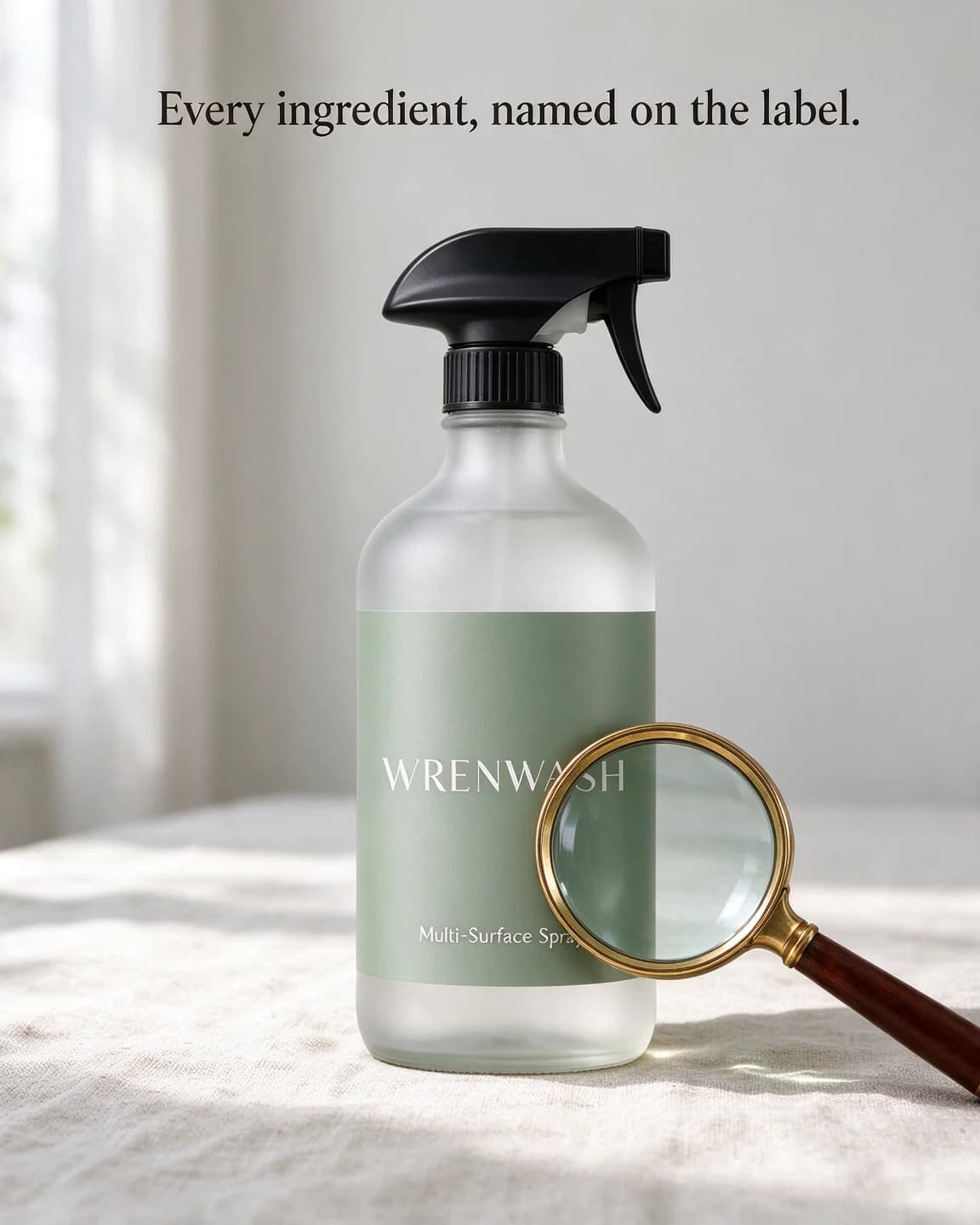
A Wrenwash Multi-Surface Spray bottle on a light linen surface with a brass magnifying glass resting beside its label, soft daylight, headline "Every ingredient, named on the label."

WrenwashLabel transparencyFeed · 4:5 image

“Every ingredient, named on the label.”

Buyers who've stopped trusting vague 'natural' claims respond to a brand that invites them to read the label, and the magnifying glass turns that invitation into a picture. It only works if the full ingredient list really is on the pack and the product page, in words people recognise.

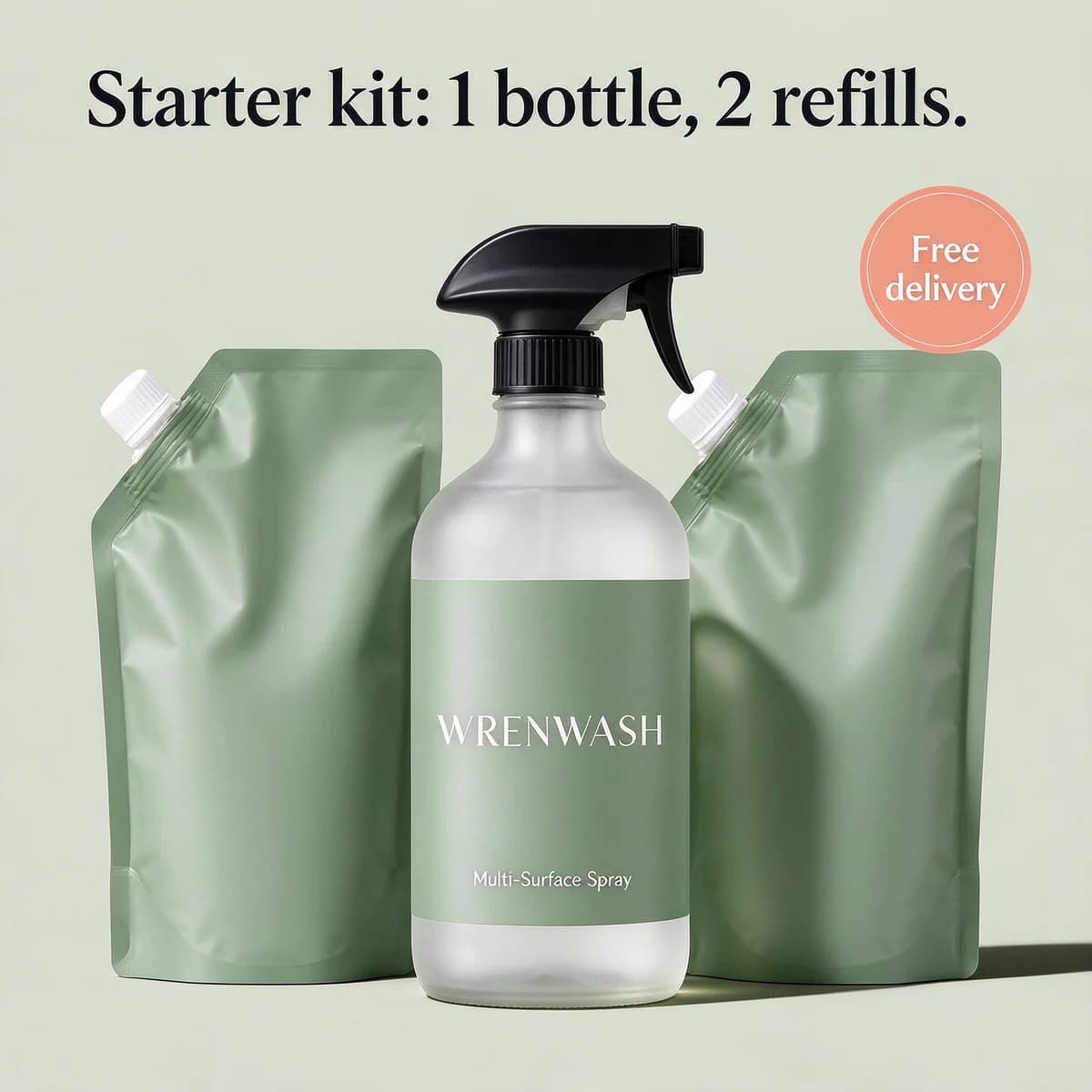
A Wrenwash Multi-Surface Spray bottle with two sage-green refill pouches beside it on a flat sage background with a hard dark shadow, headline "Starter kit: 1 bottle, 2 refills." and a round sticker reading "Free delivery"

WrenwashStarter bundleFeed · 1:1 image

“Starter kit: 1 bottle, 2 refills.”

A starter kit answers the first-time refill buyer's question, what do I actually need, in one picture, and the count on the image is something they can check on arrival. Free delivery suits a low-price household item, where shipping can feel bigger than the product.

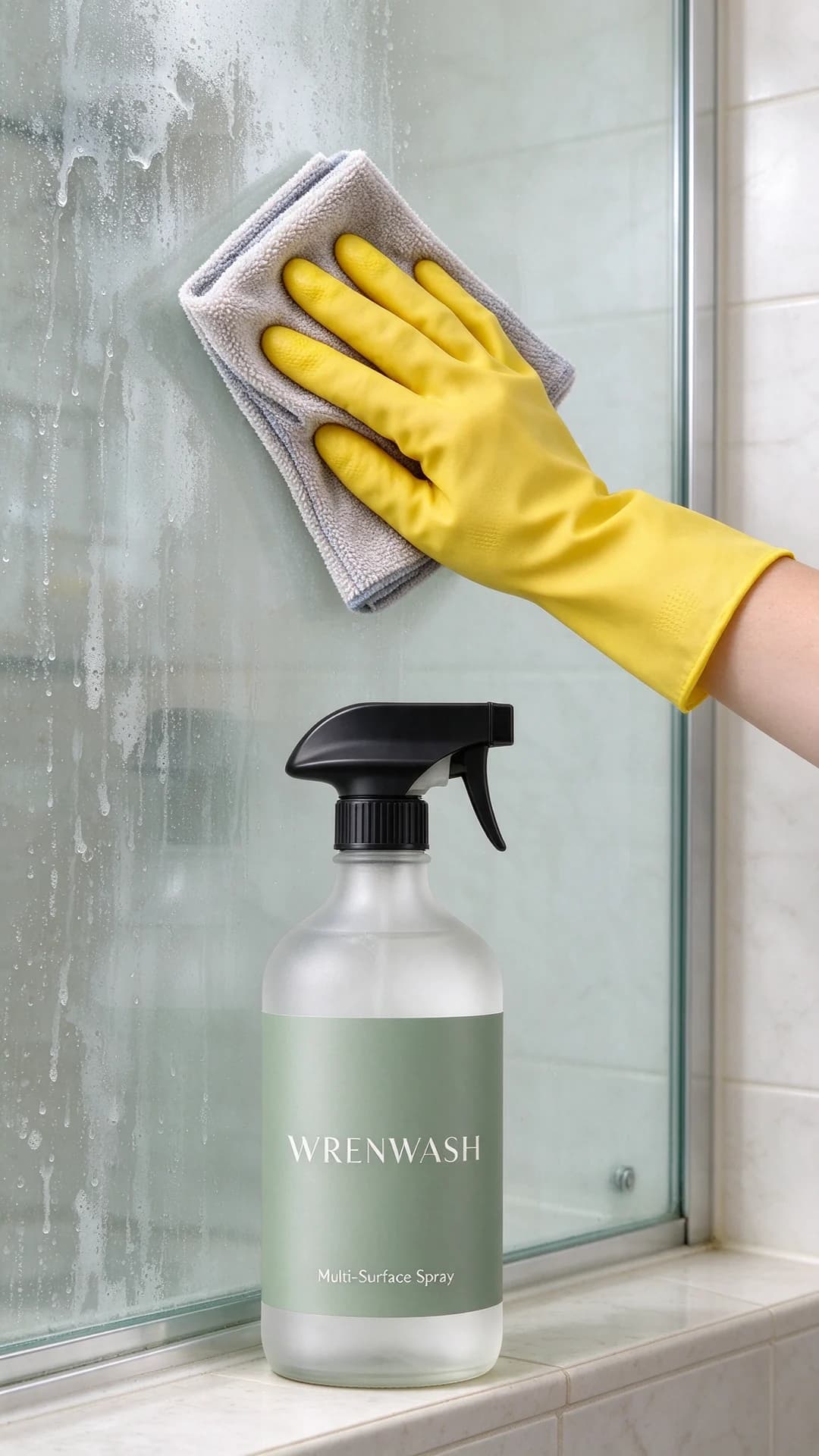
A gloved hand wiping a glass shower screen that is streaky with water marks on one half and clear on the other, a Wrenwash Multi-Surface Spray bottle on the ledge, with no text on the image

WrenwashSatisfying progressReels · 9:16 image

“Halfway through and already worth it.”

Half-clean frames are hard to scroll past, because the eye wants to see the other half finished, and they need no headline to work. The hook lives in the primary text, so the whole screen is left for the result.

Two more ways to try

  • WWrenwashSponsored

    Same mug, one overnight soak

    Before

    Tea rings

    After
    WRENWASH

    Back to white

    Oxygen stain lifterShop stain lifter

    Before & after ad

    Before-and-after is the natural layout for cleaning because the change happens to a surface rather than a person, and the two short labels keep the result specific enough to check.

    Edit this template
  • WWrenwashSponsored
    The problem

    Another spray bottle in the bin?

    The fix

    Keep the glass one. Refill it from a pouch.

    WRENWASH
    Refill concentrateShop refills

    Problem–solution ad

    The problem is a small habit everyone recognises, and the fix is a concrete action instead of a vague green promise, which keeps the ad on the right side of greenwashing rules.

    Edit this template

Angles to test first

  1. 1

    Visible result

    Same surface, same light, same angle, before and after. This is the one category where the result is a photograph, so make it a fair one.

  2. 2

    Refill routine

    Show the pour, the count and the bottle people keep. Switching to refills is a habit change, and the ad has to make the new habit look easy.

  3. 3

    Scent and feel

    Name the smell, show where it comes from and say what it isn't. Scent is part of why people reorder a cleaner, but the photo has to suggest it with props, colour and light alone.

  4. 4

    Time-boxed jobs

    The ten-minute reset, the Sunday bathroom, the wipe-down before guests. A deadline gives a cleaner a job people already have on their list.

  5. 5

    Label transparency

    Point people at the label, list ingredients in plain words and let them check. It's a stronger trust signal than 'natural' or 'non-toxic'.

  6. 6

    Seasonal messes

    Holi colour, the Diwali deep clean, monsoon damp, the kitchen after a party. Messes arrive on a calendar, so the ads can too.

15 hooks for cleaning products ads

  • Same [mug]. One overnight soak.
  • One pouch. [Three] refills.
  • Smells like [basil], not [bleach].
  • The [10]-minute reset before [guests].
  • The morning after [Holi].
  • Every ingredient, named on the label.
  • Starter kit: [1] bottle, [2] refills.
  • Halfway through and already worth it.
  • Keep the bottle. Refill the [inside].
  • For the [hob] you've been avoiding.
  • [Diwali] deep clean, room by room.
  • What [tea stains] look like after [one soak].
  • The spray that lives on the [counter], not under the sink.
  • [Grout] lines, back to [white].
  • One bottle for the [table], [tiles] and [taps].

Moments to plan for

  • Before Diwali (Sep–Oct)

    The big deep clean. Room-by-room checklists and the stain lifter for kitchens and grout, starting a few weeks before the festival.

  • Holi (usually March)

    The morning-after clean-up of colour on floors and grout, with the result tested on real colour before the ad runs.

  • Spring cleaning (Mar–Apr)

    Windows, shower screens and cupboards, shot as half-clean frames that beg to be finished.

  • Monsoon (Jun–Sep)

    Damp corners and musty cupboards. Sell wiping away the grime and airing the room, and leave 'kills mould' to registered products.

  • Moving out (year-round)

    End-of-tenancy kits for renters chasing their deposit back, with a checklist of the jobs a landlord looks at first.

  • Festive hosting (Dec–Jan)

    The ten-minute reset before guests arrive, then the kitchen on New Year's Day.

Watch out for

  • Germ claims belong to a different kind of product. The US Environmental Protection Agency registers products that sanitise or disinfect and says it regulates cleaning products only if they do (EPA, as of October 2026), so a line like 'kills 99.9% of germs' needs a registered, tested product behind it. A cleaner that cleans should say it cleans, lifts or cuts grease.
  • Vague green words need proof. The FTC's Green Guides (16 CFR 260.4, as of October 2026) say marketers shouldn't make unqualified general environmental benefit claims, and India's Central Consumer Protection Authority issued greenwashing guidelines in October 2024 that restrict terms like 'eco-friendly' without evidence. Say the specific, checkable thing, such as 'one pouch refills three bottles'.
  • 'Non-toxic', 'chemical-free' and 'safe around kids and pets' are safety claims that need evidence, and everything in the bottle is a chemical. Describe the formula and the label directions instead.
  • Show safe use in every scene: gloves when the label says gloves, no mixing of products, nothing sprayed near food, and bottles kept out of children's reach. One careless shot can undo the trust the result built.
  • Keep before-and-after shots fair: the same surface, light and angle, the product used as the label directs, the real time it took and no retouching of the 'after'. If the label rules out surfaces such as natural stone or unsealed wood, don't show them.

Practical pointers, not legal advice. Check Meta’s Advertising Standards and your local rules.

What cleaning product ads have to show

Most product ads have to suggest a result. Cleaning ads can show one. A tea-stained mug that comes back white, a shower screen half streaked and half clear, a grout line that changes colour: that's the whole pitch in a single frame, and it's why before-and-after is the natural layout for this category.

It's also why cleaning ads are judged harshly. Viewers have seen plenty of miracle wipes, so they look for the tricks: a different mug in the "after", brighter light, a stain that was never really there. The Wrenwash ads above try to stay checkable:

  • The result, with its real time: "Same mug. One overnight soak."
  • A count instead of a green claim: "One pouch. Three refills."
  • A routine with a deadline: "The 10-minute reset before guests."
  • A pointer to the label: "Every ingredient, named on the label."

Meta's rules on transformation images sit in the health and wellness section of its Advertising Standards (as of October 2026). They are written for bodies, not worktops: weight-loss and cosmetic ads must target adults aged 18 and over, and weight-loss ads that show results must say how long those results took. A tiled floor is a different case, but the time rule is a good habit to borrow. "One overnight soak" tells the viewer exactly what to expect, and it keeps the result tied to what the product really does when it's used the way the label says.

The shots that sell a cleaner

  1. The split frame. Same surface, same light, same angle, with a clean line down the middle. The before-and-after template is built for it.
  2. The half-clean wipe. A cloth mid-stroke across glass or tiles. The eye wants to see it finished, which also makes it a strong first frame for video.
  3. The soak. A mug, a pan or a bowl of whites, with the product beside it and the time in the headline.
  4. The refill pour. Concentrate going into the bottle people keep. It explains a refill system faster than any paragraph can.
  5. The counter shot. The bottle where it lives: next to the sink, the hob or the bathroom tap. For a refill brand the glass bottle is the thing the buyer keeps for years, so show it looking good enough to leave out.
  6. The label close-up. For ingredient-conscious buyers, a readable label is the proof.

Light matters more here than in most categories. Glossy tiles, steel and glass show every reflection, so soft side light keeps both the shine and the label readable. Keep the stain believable too. A real tea ring is brown and uneven, and a cartoonishly dark one makes the whole ad look staged.

Two rounds: the result, then the refill

A refill cleaning brand is really selling two things, a product that works and a habit worth switching to. Testing both at once muddles the answer, so split them.

Round one asks "does it work?" Show the result three ways: the split-frame mug and a grout line coming back to white with the stain lifter, and the half-clean shower screen with the spray. Make each in 4:5 and 9:16. That's six ads with one message, so whatever wins tells you which proof people find most convincing.

Round two asks "why switch?" Keep the winning proof shot running and test what the brand says next: the refill pour with "One pouch. Three refills.", the starter kit, the basil scent and the label close-up. Four angles in two shapes is eight more ads, so the two rounds come to fourteen ads, two small batches rather than one crowded one.

Refill brands also have a useful number to test: the price per refill. If a refill pouch sells at $3 and makes three bottles, each refill works out at $1, against $4 for a new filled bottle. Some buyers respond to "$1 a refill" more than to any percentage, so test the per-refill price against the pack price in the primary text of two otherwise identical ads.

Judge both rounds on purchases and, where you can see them, repeat orders. A satisfying wipe can rack up views without selling a single pouch, and in a category people buy again and again, the second order is where the money is.

Claims that need proof first

Cleaning copy is full of words that are regulated somewhere: disinfects, antibacterial, eco-friendly, biodegradable, non-toxic. The watch-outs above give the sources, and the rule underneath them is simple. Say what the product does in words you can show, such as lifts tea stains, cuts kitchen grease or refills three bottles. If a stronger claim is true and registered where you sell, put the evidence on the product page and keep the line on the image short.

Real results and AI scenes in BulkAds

Start with the honest trade-off. An AI-made "after" is an illustration, not evidence. It's fine for testing layouts, scenes and moods, and it's how every stain on this page was made. For the ad that says "this is what our product does", shoot the real before and after on a phone, on the same surface in the same light, and upload it with Upload ad. BulkAds keeps that photo as it is, you add the headline and primary text (BulkAds can rewrite them), and it launches next to the AI-made ads, so the real result runs in the same campaign as everything else.

Everything else starts from one clean packshot of each product on white. Product photo ads place that bottle, pouch or canister into new scenes, such as a sink, a tiled floor or a sunny worktop. The pre-flight check compares each ad with your photo for product accuracy and checks the spelling of every word on the image before you see it, which matters when the label is part of the pitch.

A few habits help:

  • Put your real proof points in the brand kit, such as "one pouch refills three bottles" or "fragrance from basil oil", so the copy repeats facts.
  • Prune the claims you can't support. The brand kit is built from what your website says, so if the site calls the spray "non-toxic", remove that line from the kit until you have the evidence. The pre-flight check also flags likely Meta policy risks before launch.
  • Brief seasonal batches in plain words, for example "the morning after Holi, white tiles, coloured powder in the grout, half scrubbed".
  • Turn a winning still into a short video ad once it has proven itself, with light moving slowly across the clean glass.

Questions people ask

Can cleaning product ads use before-and-after photos?

Yes, and it's the most natural layout for the category, because the change happens to a surface rather than a person. Keep it fair: the same surface, light and angle, the product used as directed, and the real time it took.

Can I say my cleaner kills germs?

Only if the product is registered and tested for it where you sell. In the US, as of October 2026, the EPA registers products that sanitise or disinfect. If yours is a cleaner, say what it removes, such as grease, stains or limescale.

How do I advertise a refill cleaner without greenwashing?

Use specific, checkable facts instead of general green words: how many bottles one pouch refills, what the pouch is made of, or the price per refill. Vague terms like 'eco-friendly' need evidence under the FTC's Green Guides in the US and the greenwashing guidelines India's Central Consumer Protection Authority issued in October 2024.

What makes a cleaning ad stop the scroll?

A half-clean frame. A wipe that's halfway across a streaky shower screen, or a floor that's half scrubbed, makes people want to see the rest, and it needs no headline.

Is Wrenwash a real brand?

No. Wrenwash is fictional, and every ad on this page, including the stains, was made with AI for illustration.

Keep going

Every brand on this page is fictional and every ad was made with AI for illustration — they’re examples, not case studies.

BulkAds AI is an independent product and is not affiliated with, endorsed or sponsored by Meta Platforms, Inc. Facebook and Instagram are trademarks of Meta Platforms, Inc.

More ad examples

Your next fifty ads are one link away.

Paste your website, meet your brand kit and see your first batch in minutes. 7 days for $9.99 — cancel anytime.

yourbrand.comMake my ads

See pricingExplore featuresBrowse the library