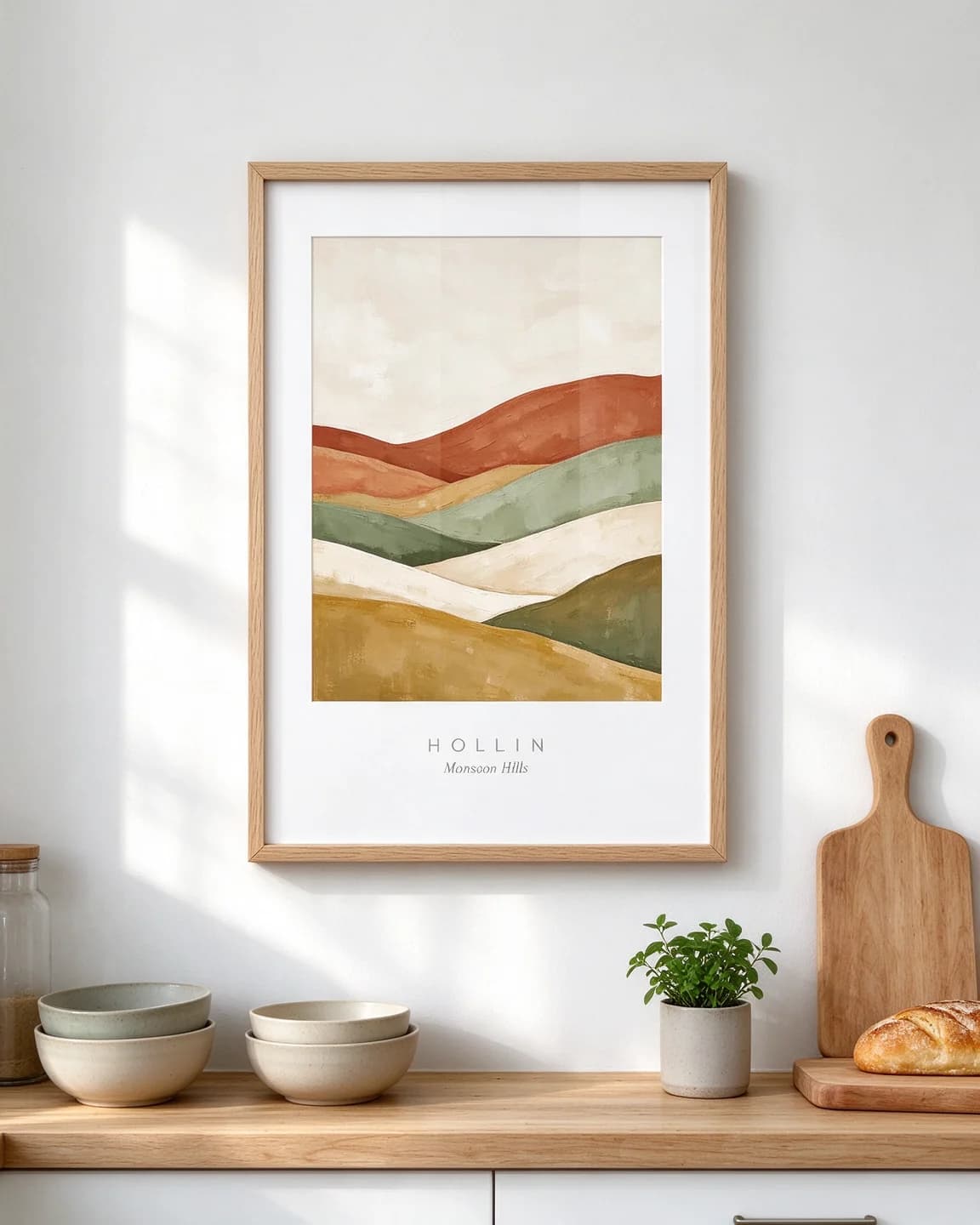
Why wall art is hard to sell in a feed
A print in a feed is a small rectangle inside another small rectangle. The buyer can't judge its size, can't see the paper and can't tell whether its terracotta will clash with their sofa. An ad that shows the artwork flat, straight from the scan, leaves the viewer to do all of that imagining alone.
Each example above removes one of those doubts:
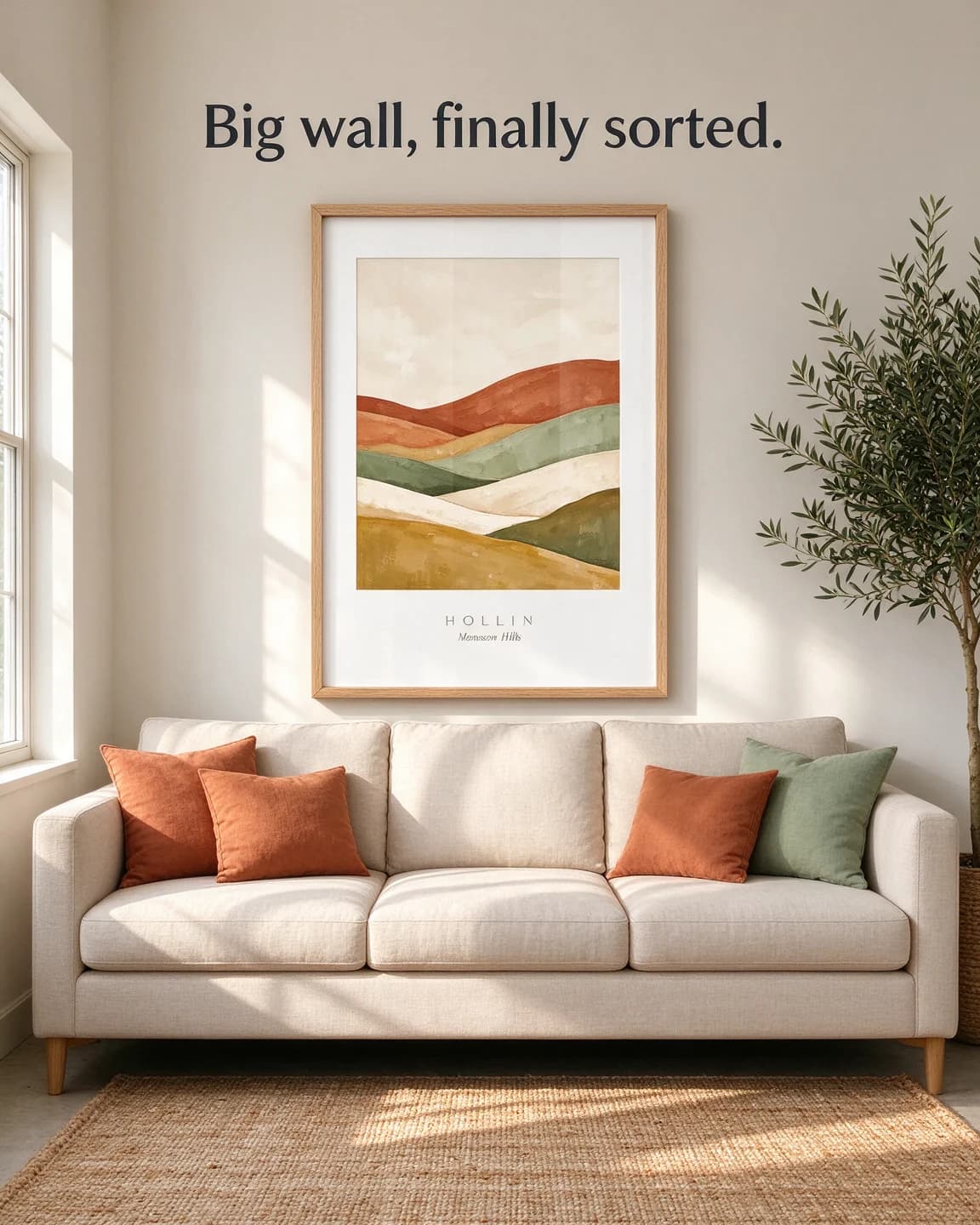
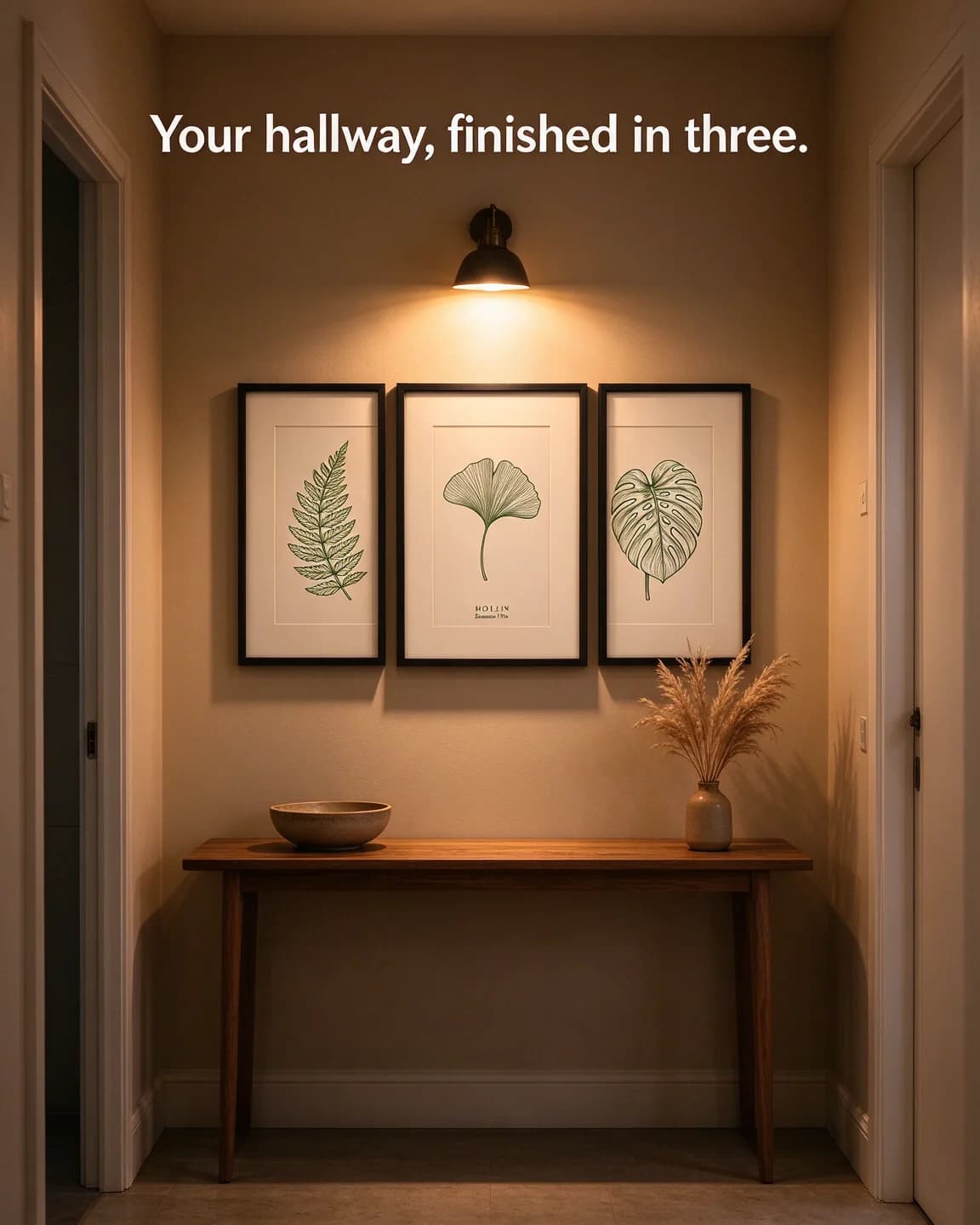
- Size: the print above a sofa, the trio along a hallway.
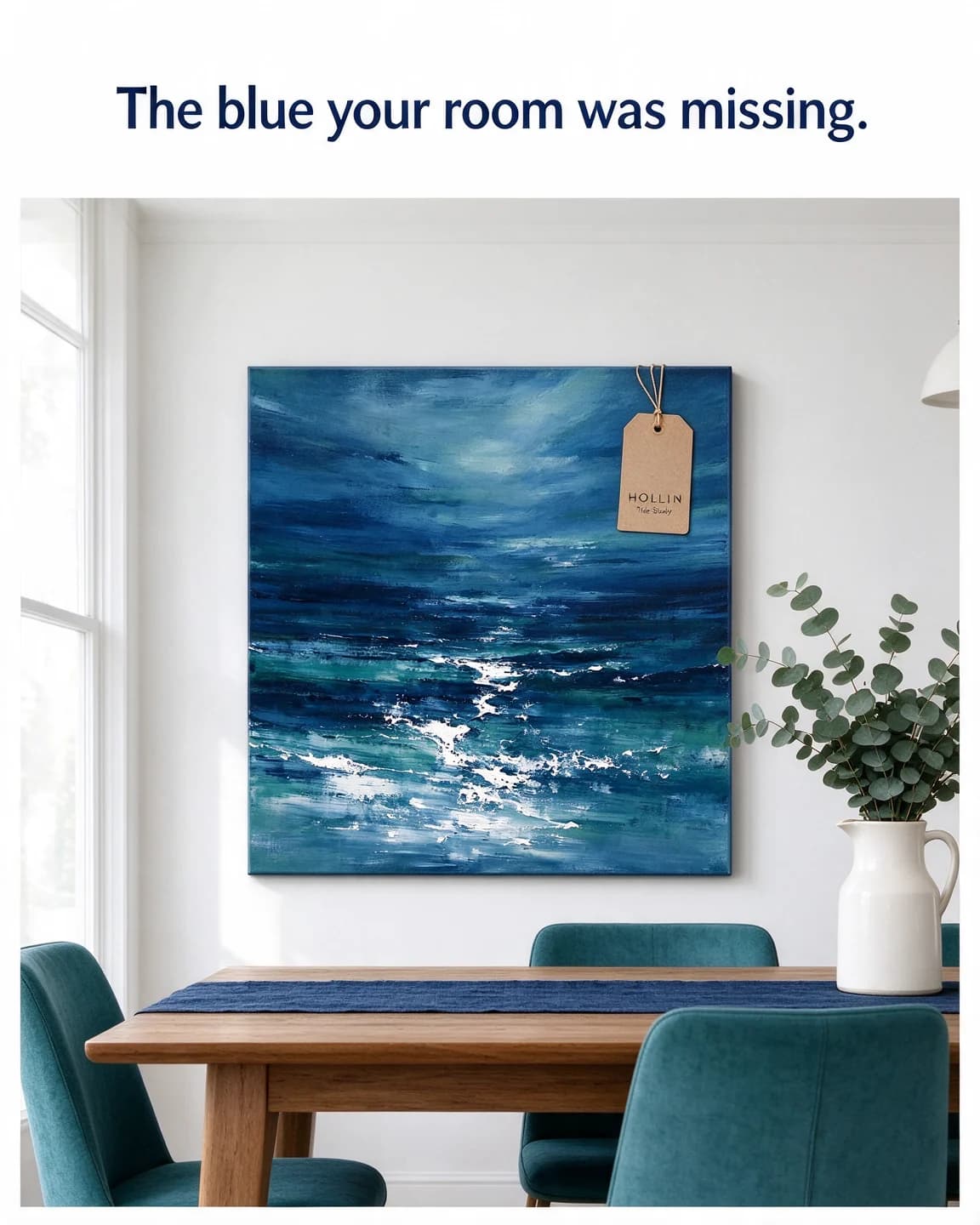
- Colour: the canvas picking up the teal of the dining chairs.
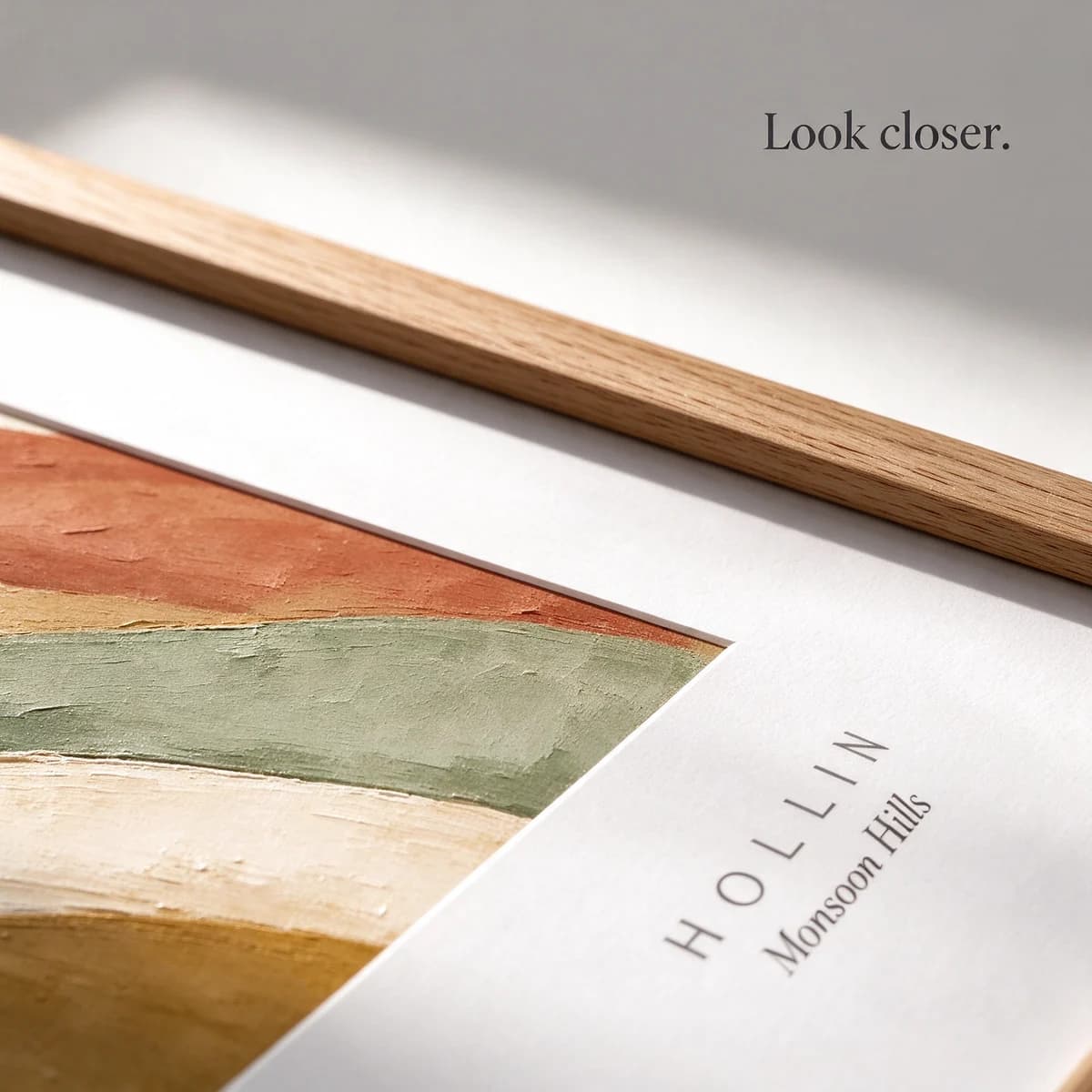
- Quality: the macro of the mitred oak corner and the paper grain.
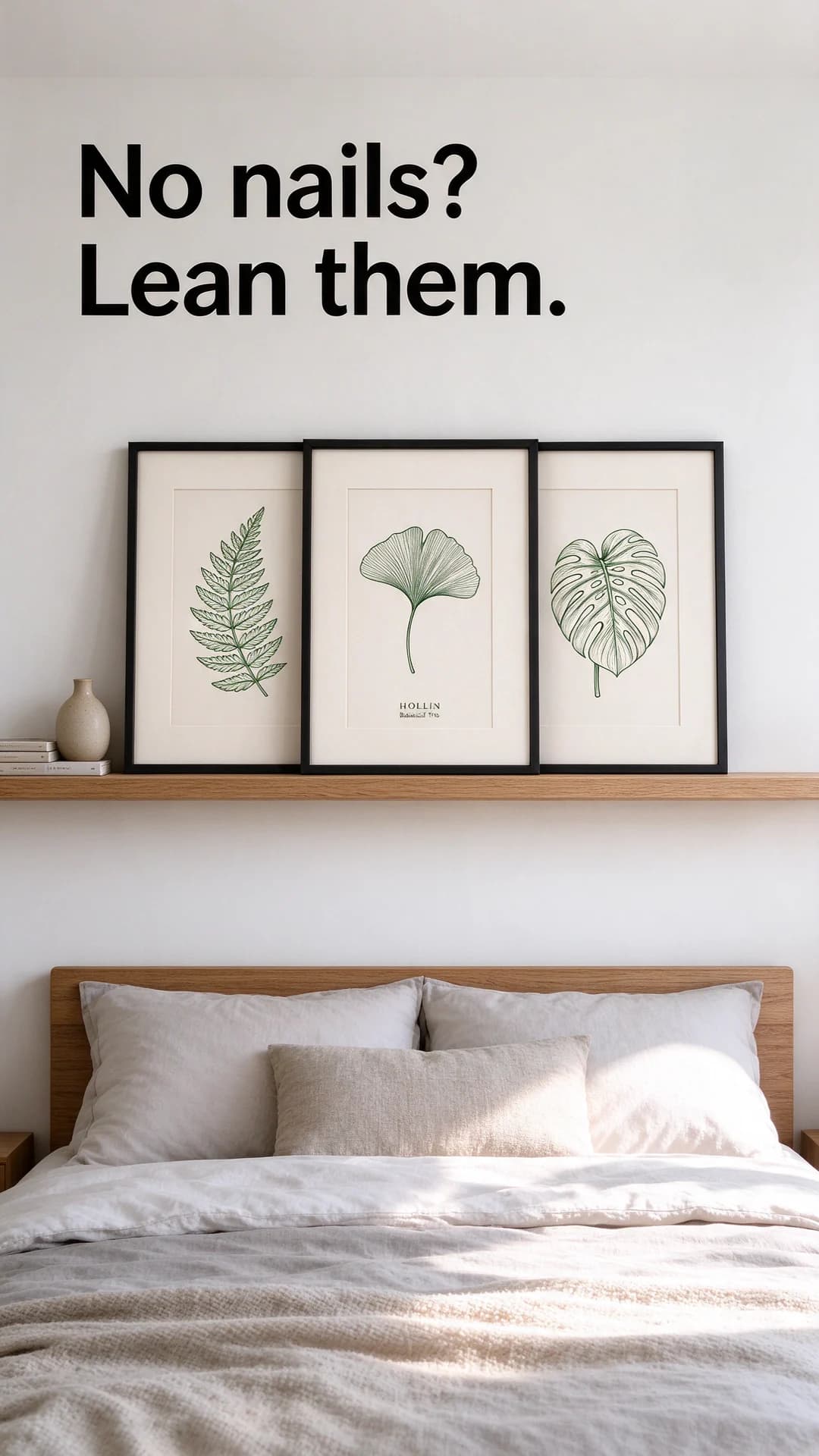
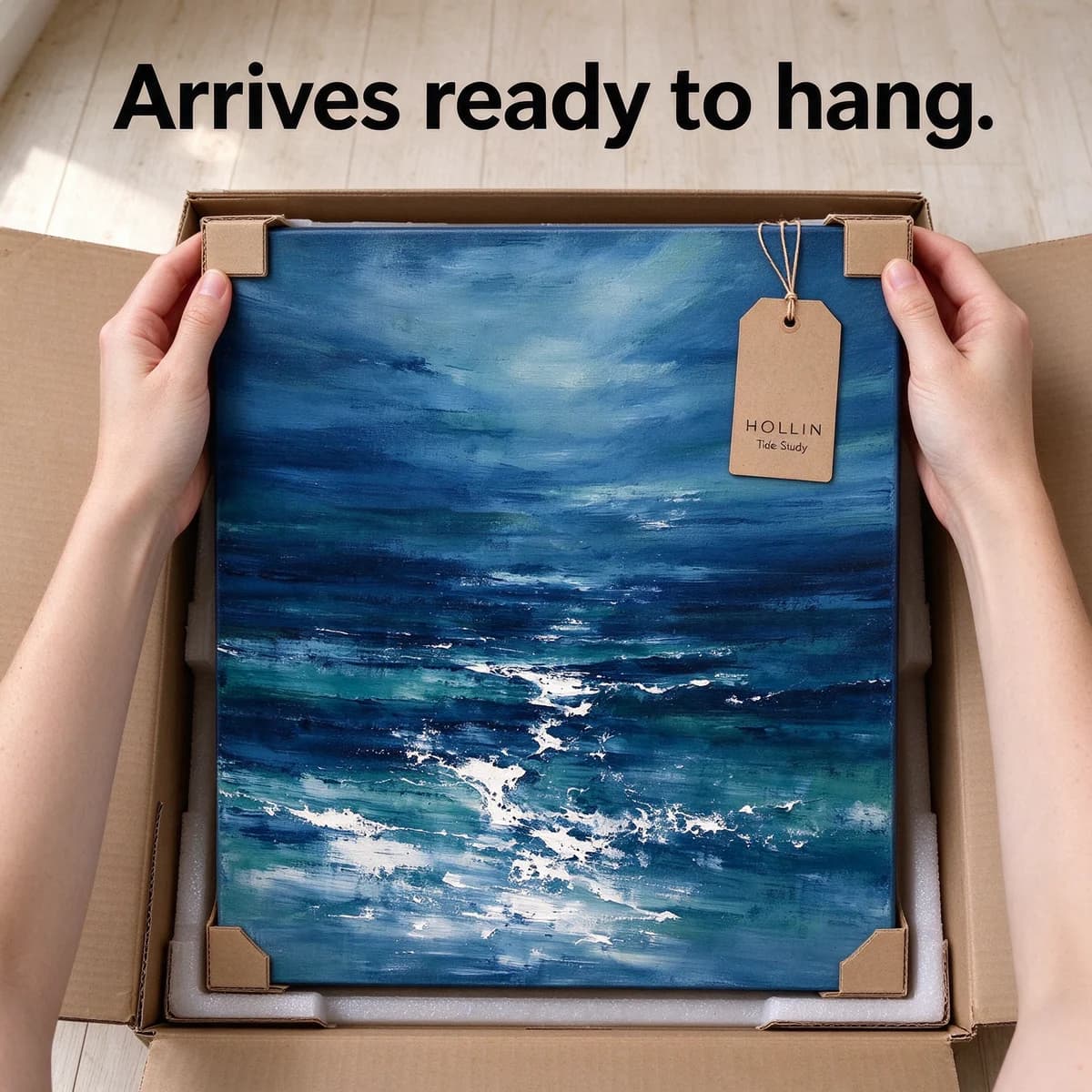
- Practicality: frames leaning on a shelf for renters, a canvas lifted cleanly out of its packaging.
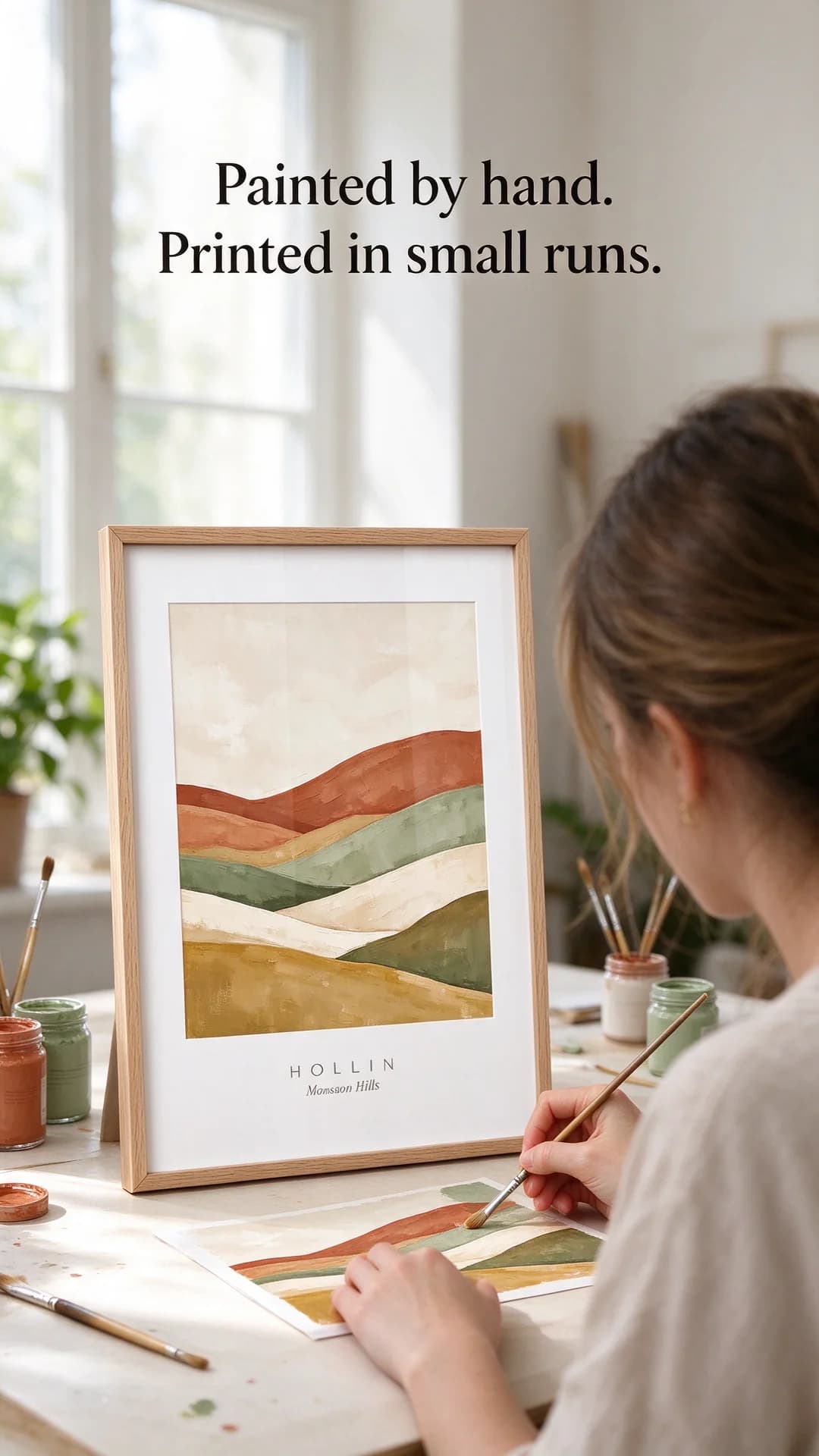
- Story: the artist's hands at the studio table.
Art is also a matter of taste. Two people can love and hate the same print, so the artwork itself is one of the biggest variables in any test. Keep that in mind before you blame an angle for a weak result.
Photos a print studio should plan
Start with a straight-on, evenly lit photo of each framed piece, with no glare on the glass and the frame square to the camera. Then plan these:
- In the room. The piece at its true size over a sofa, bed, console or desk, seen from where a person would stand. This is the lifestyle shot that does most of the selling.
- The detail. Frame corner, mat edge, paper texture or brushstrokes, very close.
- The set. Matching prints hung together, so buyers see a finished arrangement rather than single pieces.
- The no-drill option. Frames leaning on a shelf or mantel, for renters.
- The arrival. The protective packaging, corners and fixings, for big or expensive pieces.
- The maker. Hands painting, mixing colour or signing a print, seen from behind.
The art inside the frame must always be your real artwork, exactly as it is. Change the room, the light and the furniture freely. Never change the art.
Separating the artwork from the angle
Wall art tests tangle two variables together, the artwork and the angle, so separate them. Pick your two strongest artworks and run the same four angles on each:
| Angle | What it answers | Format |
|---|---|---|
| In the room | "How big is it, and will it suit my space?" | 4:5 feed |
| Craft detail | "Is it worth more than a poster?" | 1:1 feed |
| Colour match | "Will it go with what I have?" | 4:5 feed |
| Renter-friendly lean | "Can I even hang it?" | 9:16 Stories |
That's eight ads. If one artwork wins on every angle, it's the art people want, so make more ads for it. If one angle wins on both artworks, it's the message that works, so carry it across the range. The guide on how many ad creatives to test covers scaling that up.
Framing is the other early question. Suppose an unframed A2 print sells for $23 and the same print framed in oak sells for $61. The framed version makes the better picture, while the unframed one is the easier first purchase. Run ads for both, and say plainly in the primary text which version the image shows and what the other one costs.
AI room scenes and fine artwork
In BulkAds you add the framed print's photo as a product, choose up to 12 ads and a size for the batch, and the AI ad generator places that photo into new rooms, light and styling, with copy written in your brand voice. Each ad is compared with your original photo before you see it, and ads where the product drifted are flagged.
Be honest about the limits. AI image models handle rooms and furniture well and are less reliable with fine detail. Thin linework, small brushmarks and lettering inside an artwork are where a generated scene can quietly redraw things. So:
- Zoom in on every ad and compare the art with your file before approving it. Regenerate or drop any where the artwork changed.
- Use your own photo as-is for detail shots. A real macro of the frame corner beats a generated one. Upload it with Upload ad, add the headline and primary text (BulkAds can rewrite them) and launch it with the image untouched.
- Prefer bolder artworks for room scenes. Large shapes and flat colour survive placement better than delicate drawings.
Once a room ad wins, a short video ad with a slow push-in towards the frame is an easy next test for Reels, because the movement feels like walking up to look at the print. Our guide to product photos for AI ads covers how to photograph glass and frames without glare.
Colour, size and returns
Two surprises are worth designing out of every wall art ad: the piece turns up smaller than it looked, or the colour isn't what the screen showed. Both start in the ad, and both are cheap to prevent before launch.
- Name the size in the copy. Write the real dimensions in centimetres and the frame width in the primary text. Not every buyer can picture A2, while 42 by 59.4 cm is something they can measure out on their own wall.
- Match furniture to the size. An A3 print looks right above a bedside table, not above a three-seat sofa. Choose scenes that fit the real size.
- Check colour against the real piece. Hold the print beside your screen in daylight. If the ad runs warmer or cooler, regenerate before launch.
- Say what's included. Frame, mat, glass or acrylic, hanging cord or nothing at all. Ads that imply a frame on an unframed product create disappointed customers.
When a wall art ad starts selling
Build on the winner one change at a time:
- Same artwork, new room. If the sofa ad sells, try the print over a bed, a desk or a dining table.
- Same room, new artwork. Swap in a print with a similar palette, so you learn whether people respond to the room or to the art.
- New size. Rebuild a winning 4:5 room ad as a 9:16 Story, with the headline high and the frame in the middle.
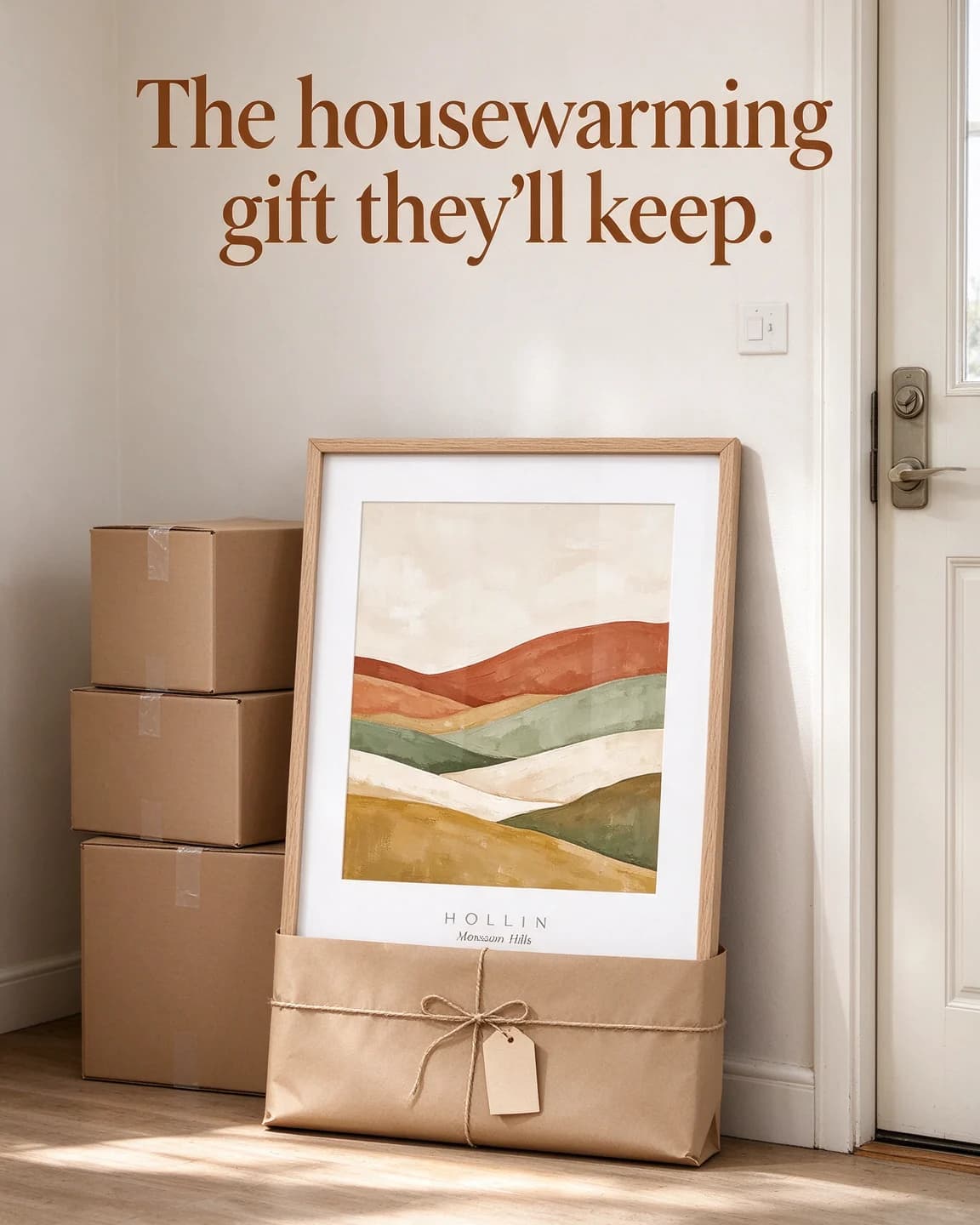
- New occasion. Rewrite the same image as a housewarming or wedding gift.
The home decor examples take the same room-first approach for candles and planters, and the Etsy sellers use case shows how small studios run this with a handful of products.
Questions people ask
What should a wall art ad show?
The piece in a real-looking room at its true size, seen from where a person would stand. Add a detail shot for quality and a set or leaning shot for practicality, and keep the artwork itself exactly as it is.
Can I use AI room mock-ups for my art prints?
Yes, as long as the art inside the frame stays your real artwork and the room matches the real size. Check every generated ad against your original file, because fine lines and small details are where AI scenes can drift.
Should I advertise framed or unframed prints?
Test both. Framed prints photograph better, while unframed prints are an easier first purchase. Say clearly in the primary text which version the image shows.
Which format suits wall art ads best?
4:5 room scenes for the feed, square detail shots, and 9:16 Stories for tall arrangements such as a shelf of leaning frames. Rebuild a winning room ad in 9:16 rather than cropping it.
Is Hollin a real print studio?
No. Hollin and its prints are fictional, and every ad on this page was made with AI for illustration.
Keep going
- Features
Product photo ads
Your real packshot, in every scene
- Use cases
BulkAds for Etsy sellers
Turn your own photos of handmade or vintage pieces into on-brand Meta ads. How Etsy sellers set up BulkAds, which angles suit makers and the honest limits.
- Guides
Product photography for ads: how to shoot it on a phone
A phone, a window and a sheet of white card are enough. How to shoot product photos that make good ads — and that AI tools can put in new scenes without mangling your label.
- Ad templates
Lifestyle ad template
Your product in the real moment someone reaches for it
- Ad templates
Social post ad template
Word of mouth, captured as an ad: a name, a few casual lines, a photo
- Ad templates
Founder story ad template
The person who made it, explaining why — in three short paragraphs
Every brand on this page is fictional and every ad was made with AI for illustration — they’re examples, not case studies.
BulkAds AI is an independent product and is not affiliated with, endorsed or sponsored by Meta Platforms, Inc. Facebook and Instagram are trademarks of Meta Platforms, Inc.