
Why UGC ads work
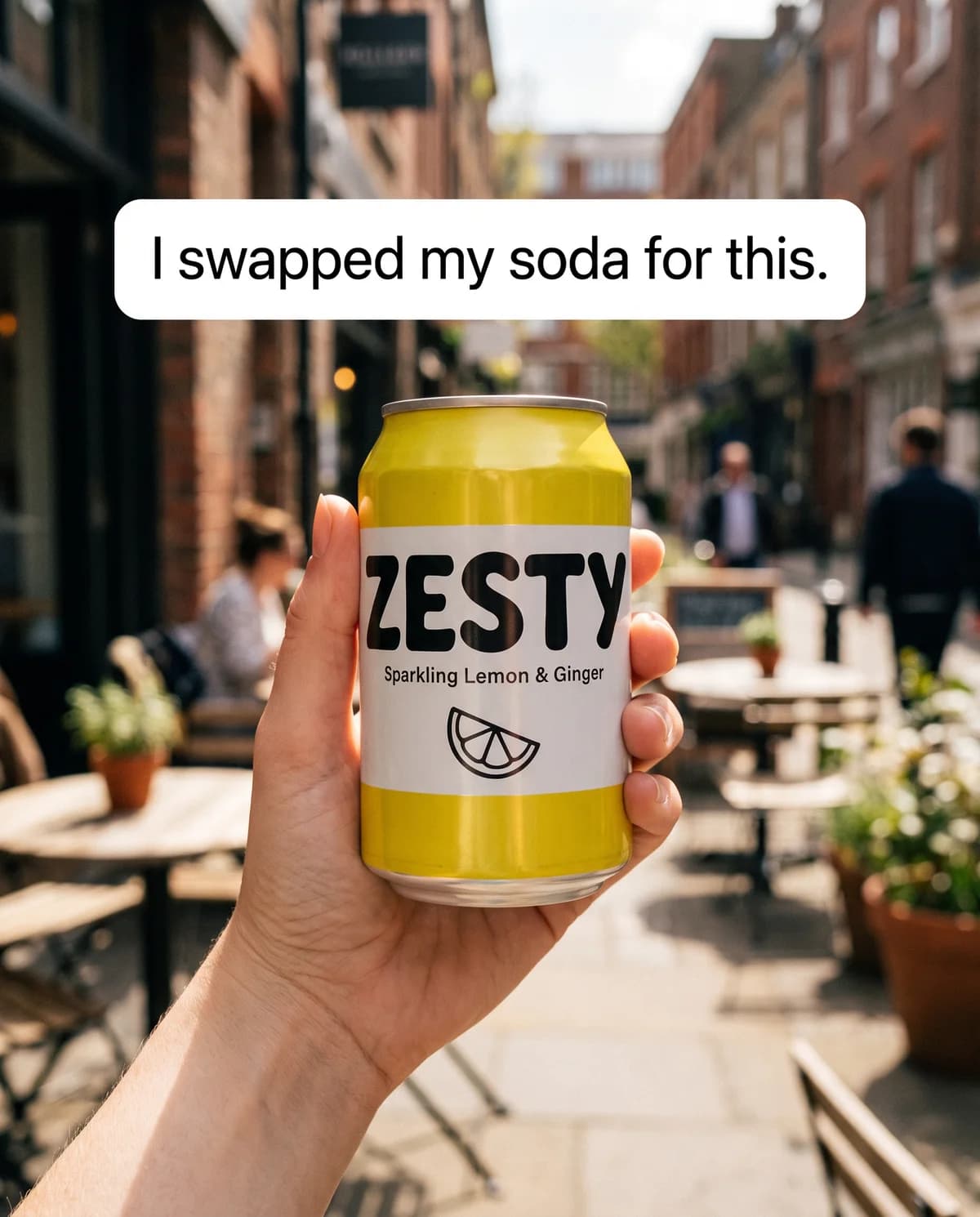
People scroll past ads because they look like ads. A UGC ad — short for user-generated content — borrows the look of the posts around it: a phone-camera photo, a real place, one line in someone's own words. For a split second it reads as a person rather than a brand, and that's often enough to earn a second look.
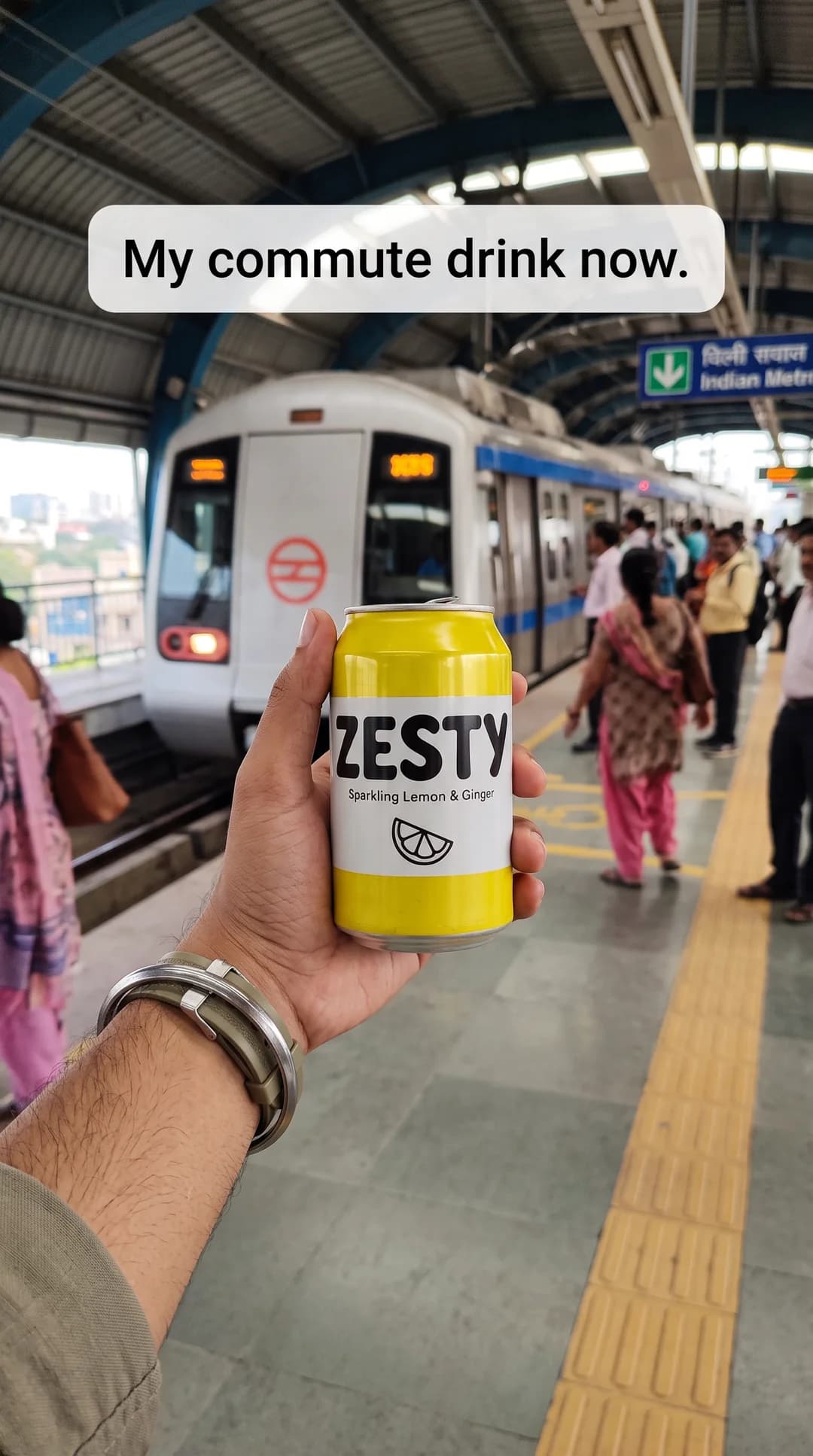
The second reason is trust. A brand saying "our soda tastes great" is expected. A commuter holding the can on a metro platform saying "my metro drink now" is social proof: someone like me chose this, in a moment like mine. The ad doesn't argue, it shows.
The third is specificity. Good UGC is anchored in a time and a place — 7am, the gym bag, the office drawer — which helps the viewer picture the product in their own day. Studio shots rarely do that.
How to make a UGC ad, step by step
- Start from what customers actually say. Read your reviews, DMs and comments. The best captions are often lifted almost word for word: "I keep a pack at my desk", "my kids steal these".
- Pick one real moment of use. Where is the product when people love it? A commute, a lunch box, a gym bag, a bedside table. One moment per ad.
- Get the photo. Ask customers for photos (with permission), send product to a few creators, or shoot it yourself on a phone in a real place: natural light, a hand in frame, some background life. You can also make a UGC-style scene from your packshot — BulkAds does this with product photo ads, keeping your real product in the shot.
- Write the caption in first person. Eight words or fewer, the way a person would type it. No brand voice, no exclamation marks, no claim a customer wouldn't make.
- Add one sticker, at most. "Day 12", "Daily swap", "Week 2". It adds context without looking designed.
- Keep the call to action soft. "Try it" or "Shop now" on the button. The caption does the selling.
- Make it vertical. UGC lives in Stories and Reels, so start at 9:16 and keep the caption clear of the top and bottom edges, where Meta's interface sits. The safe zone checker shows roughly where that is. Then make a 4:5 version for feeds.
Ten UGC variations for one test
One UGC ad tells you very little. Ten that differ in meaningful ways tell you which moment, which voice and which proof your customers respond to. Here's a spread for the Zesty example:
| # | What changes | Example |
|---|---|---|
| 1 | Moment | Metro platform: "My metro drink now" |
| 2 | Moment | Office desk at 3pm |
| 3 | Moment | After the gym, can on the bench |
| 4 | Hook | Confession: "I was so wrong about sugar-free soda" |
| 5 | Hook | Habit: "Day 12 of no cola" |
| 6 | Hook | Someone else: "My flatmate keeps stealing these" |
| 7 | Proof | A line from a real review as the caption |
| 8 | Proof | Ingredient in hand: "There's actual ginger in this" |
| 9 | Person | A different customer, age group or city |
| 10 | Offer | Same photo, sticker changed to the 24-pack deal |
The first six test different ideas, the last four test details within them. That spread matters. Practitioners report that Meta treats near-identical ads as largely the same, so ten ads with one photo and slightly reworded captions give its delivery system much less to work with than ten genuinely different moments.
The ad variation calculator shows how fast moments × hooks × captions × sizes multiply, and what testing them would cost. For more first-person openers, the hook bank has fill-in-the-blank lines grouped by type.
How to test UGC ads
Put the variations in one ad set with broad targeting, one ad per creative, and give each ad enough spend to earn a verdict. A common rule of thumb is to let an ad spend around two to three times your target cost per purchase before you judge it. Say your target is $5.15 per purchase: an ad that has spent $10–$15 with no sales is unlikely to turn around.
Judge UGC on purchases, not just clicks. Because it looks like content, UGC can pull a high click-through rate from people who were curious rather than ready to buy. Clicks and, for video, the share of people who watch past the first seconds are useful early signals of which moments stop the scroll. Cost per purchase is the verdict.
When one wins, don't just raise its budget and wait for it to wear out. Make fresh versions of the same moment — a new person, a new caption, the same idea — so replacements are ready when results start to fade. BulkAds' Autopilot handles this loop in the tests it launches itself: it stops ads that spend twice your target cost per purchase without a sale, and each winner seeds four fresh variants.
Common mistakes
- Too polished. Studio light, perfect composition and your brand font turn UGC back into a normal ad. Keep it phone-real.
- A caption no customer would say. "Experience the refreshing taste of premium ginger" is brand copy in disguise, and people can tell.
- Several messages at once. One moment, one line. If you need three benefits, a listicle is the better template.
- A person who doesn't match the buyer. If you sell to students in Pune, a creator in a New York loft is the wrong mirror.
- Calling one ad a test. UGC is a style, not a concept. Test several moments before deciding "UGC doesn't work for us".
Rights, disclosure and Meta's rules
Use customer photos and videos only with written permission, and credit or pay creators as agreed. A customer tagging your brand in a post is not permission to put it in a paid ad. When a creator is paid, the content should be disclosed as a paid partnership. Meta offers branded content labels and partnership ads for running ads from a creator's handle, though it renames these features often, so check Ads Manager for the current options.
Keep every caption honest. If the ad says "I switched from cola", a real customer should have said something like it. Don't write fake reviews into UGC-style ads, don't put health promises in a creator's mouth that you couldn't substantiate yourself, and don't use before-and-after body shots. Meta's advertising standards restrict all three, and consumer-protection rules in many markets treat invented testimonials as misleading. Use your real reviews and real numbers — they're more convincing anyway.
Questions people ask
What is a UGC ad?
A UGC ad is an ad made from, or made to look like, content a real customer or creator posted: a phone-camera photo or video with a first-person caption. It works because it reads like a post rather than an ad.
Do I need real creators to make UGC ads?
Not for a UGC-style image: a natural phone photo of your product in a real moment, with a caption drawn from real reviews, carries most of the effect. You do need a real customer or creator if the ad presents a specific person's experience.
Should UGC ads be video or image?
Both work. Video suits Reels and Stories and can show the product in use. UGC-style images are cheaper to make in volume, which makes them good for finding the winning moment and caption before you invest in video.
Can I use customer photos from Instagram in my ads?
Only with the customer's permission, ideally in writing, and credited the way you agreed. Being tagged in a post is not the same as permission to use it in paid ads.
How many UGC ads should I test at once?
Many media buyers start with six to ten genuinely different ads in one ad set, then make fresh versions of whatever wins. Different moments and hooks teach you more than ten versions of one photo.
Keep going
- Guides
How many ad creatives should you test? The number, and the maths.
A straight answer, then the simple sum that sets your real number, how many new ads to launch each week at your spend, and when to stop testing and scale.
- Guides
Static vs video ads: which to make, and when
Statics are cheap to make and quick to test, video earns its place in Reels and Stories. An honest comparison, the metrics for each and a plan that uses both.
- Ad templates
Testimonial ad template
One real review, one real name, one clear reason to buy
- Ad templates
Social post ad template
Word of mouth, captured as an ad: a name, a few casual lines, a photo
- Ad templates
Notes app ad template
A plain phone note whose last line happens to be your product
- Hook bank
The hook bank
Fill-in-the-blank opening lines, sorted by what they do.
Every brand, person and review in these mock-ups is fictional. In your own ads, use only real reviews, real numbers and claims you can back up.
BulkAds AI is an independent product and is not affiliated with, endorsed or sponsored by Meta Platforms, Inc. Facebook and Instagram are trademarks of Meta Platforms, Inc.