Ad examples

Camping gear ad examples: 8 ideas for tents, lanterns and sleeping bags

Camping gear sells a night that hasn't happened yet, so the ad has to make it feel easy, dry and warm before anyone leaves home. Below are eight ads for Fernlo, a made-up outdoor brand with a two-person tent, a rechargeable lantern and a sleeping bag, with a note on each, plus the wording that keeps waterproof and warmth claims honest.

8 ads2 live templates15 hooks

The swipe file

Each ad with its angle, its hook and why it works. Every brand is fictional. The ads were made with AI to show the idea.

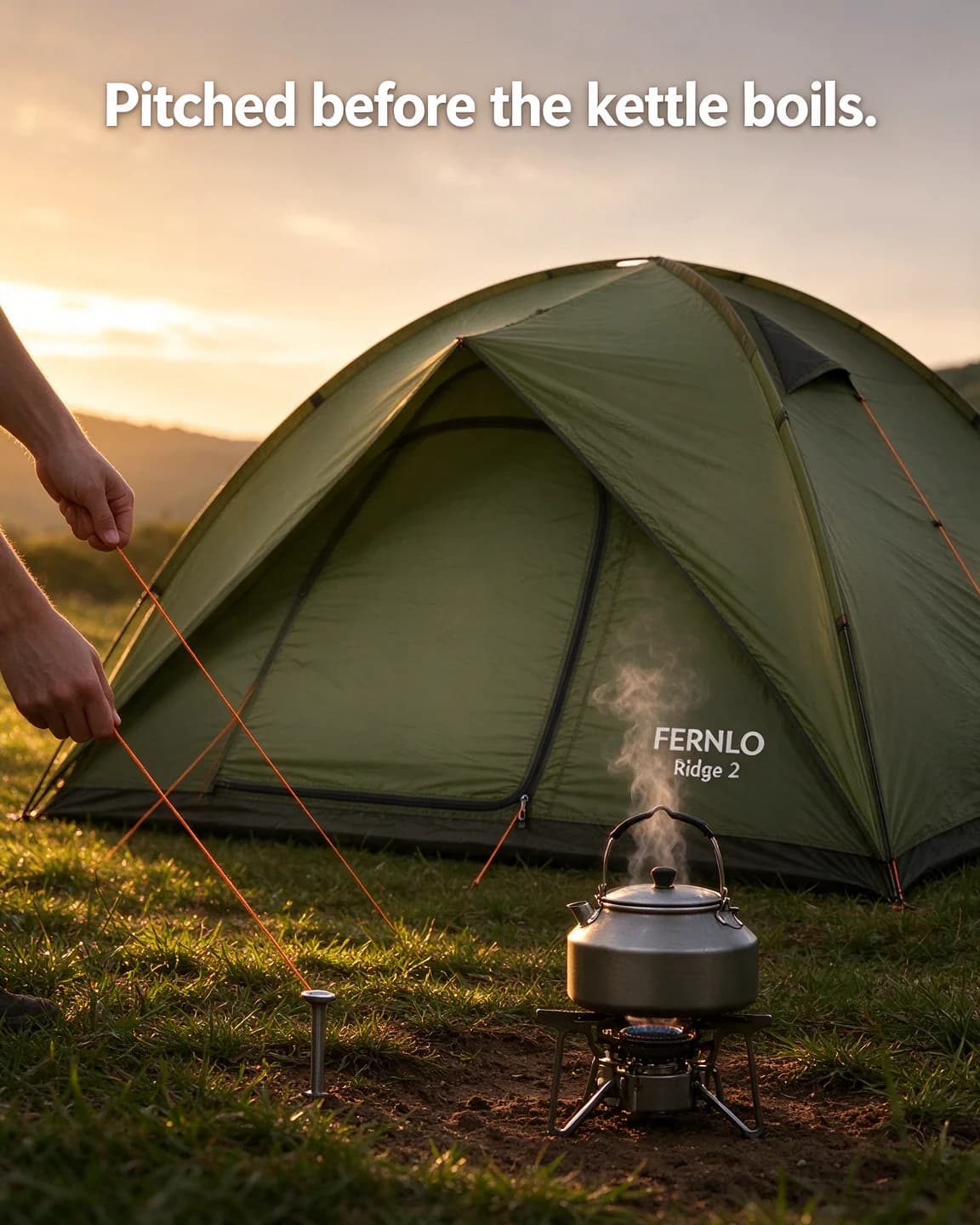
Hands pulling a guy line tight on the olive-green Fernlo Ridge 2 tent on a grassy campsite at golden hour, a camping kettle steaming a few metres away, headline "Pitched before the kettle boils."

FernloEasy pitchingFeed · 4:5 image

“Pitched before the kettle boils.”

A fiddly setup is the classic first-trip worry, and the kettle gives the speed claim a homely timer instead of a stopwatch figure. Back it up with an unedited pitching video on the product page, because experienced campers will ask how long it really takes.

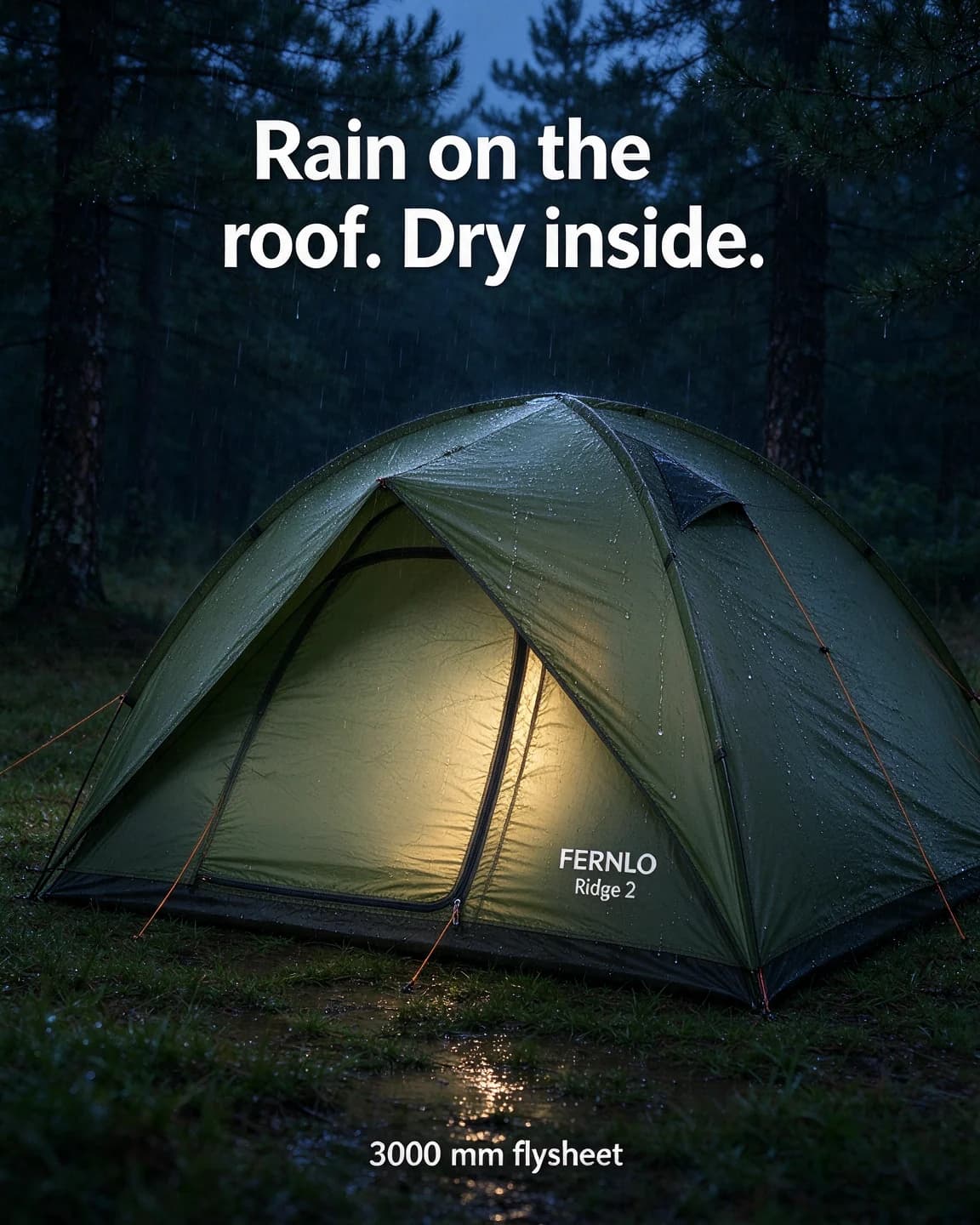
The Fernlo Ridge 2 tent pitched in light evening rain with water beading on the flysheet and a warm glow inside, headline "Rain on the roof. Dry inside." and a small line "3000 mm flysheet"

FernloWeather confidenceFeed · 4:5 image

“Rain on the roof. Dry inside.”

The rhythm of the line sells the cosy side of rain, the kind you listen to rather than sit in. The small hydrostatic head figure lets regular campers check the claim, and it must be the number from your own test report, not a hopeful one.

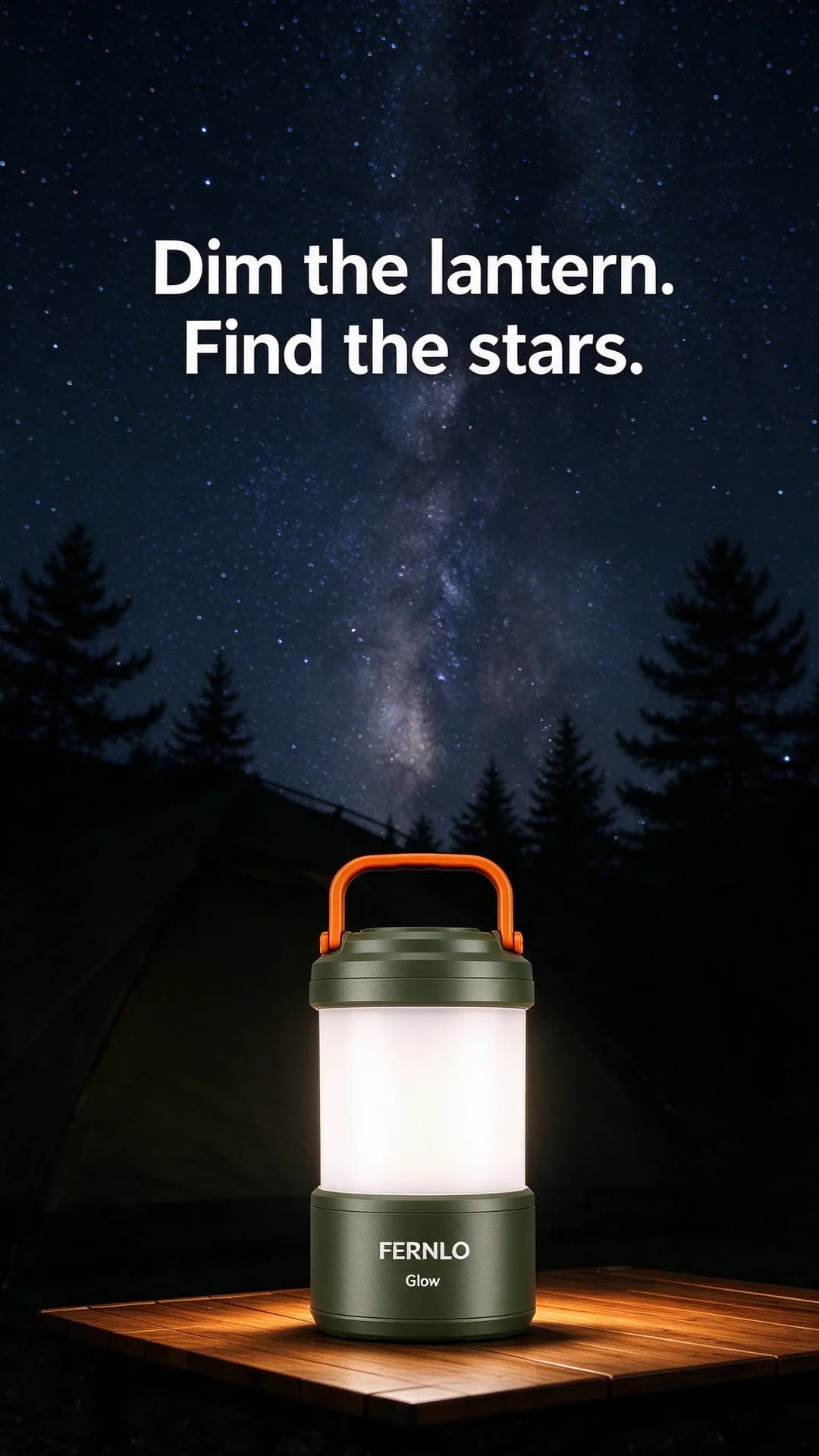
The Fernlo Glow lantern glowing softly on a camp table at night beside a dark tent under a sky full of stars, headline "Dim the lantern. Find the stars."

FernloAfter darkStories · 9:16 image

“Dim the lantern. Find the stars.”

It sells the dimmer as a feeling, the moment you turn the light down and the sky appears, instead of listing brightness modes. The tall frame gives most of the screen to the stars, with the lantern low and the headline high, clear of the reply bar.

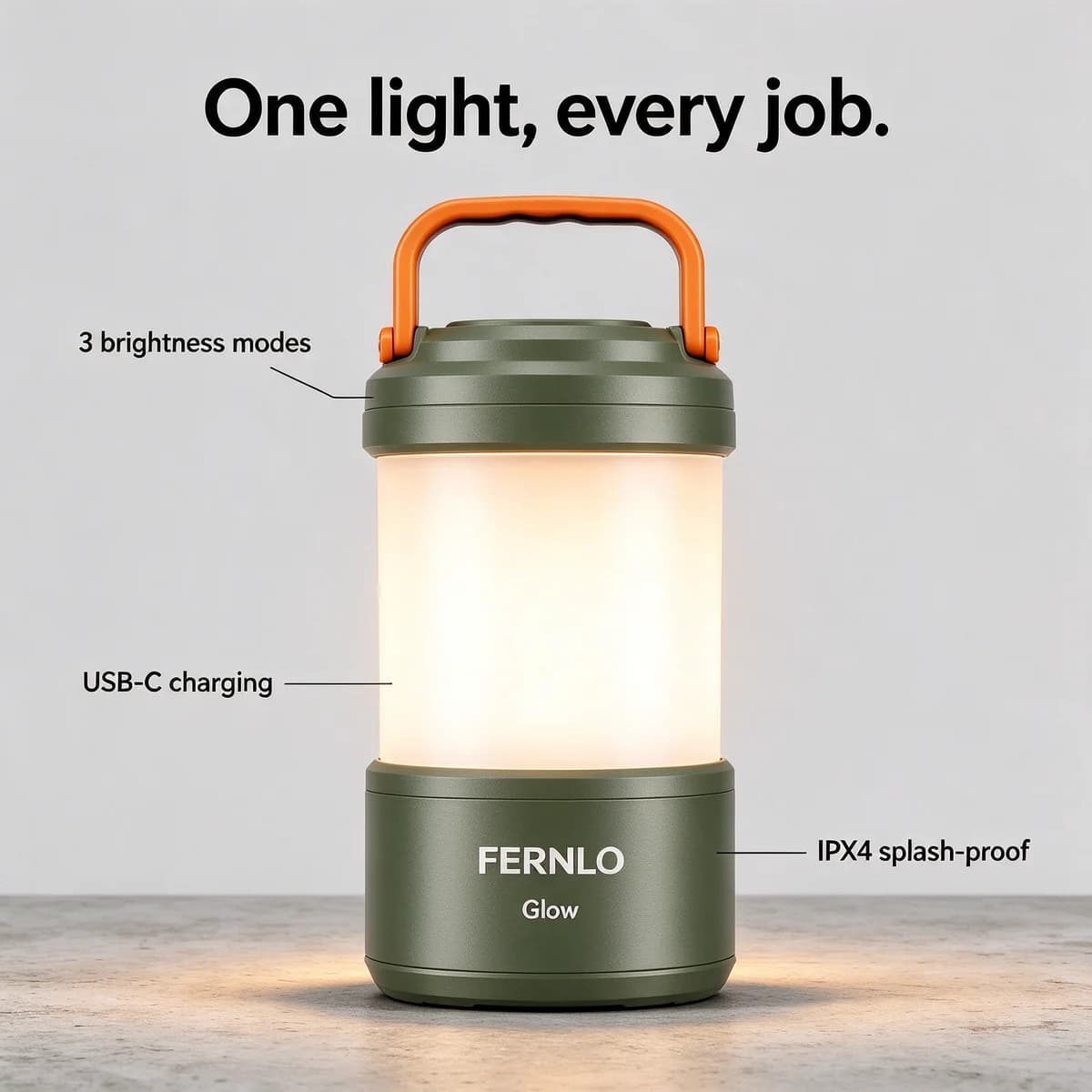
The Fernlo Glow lantern lit on a pale stone background with labels "3 brightness modes", "USB-C charging" and "IPX4 splash-proof", headline "One light, every job."

FernloFeature calloutFeed · 1:1 image

“One light, every job.”

Gear-savvy buyers compare lanterns on a handful of specs, and three labels answer them faster than a caption can. Writing 'splash-proof' next to IPX4 translates the rating honestly, where 'waterproof' would claim more than the test showed.

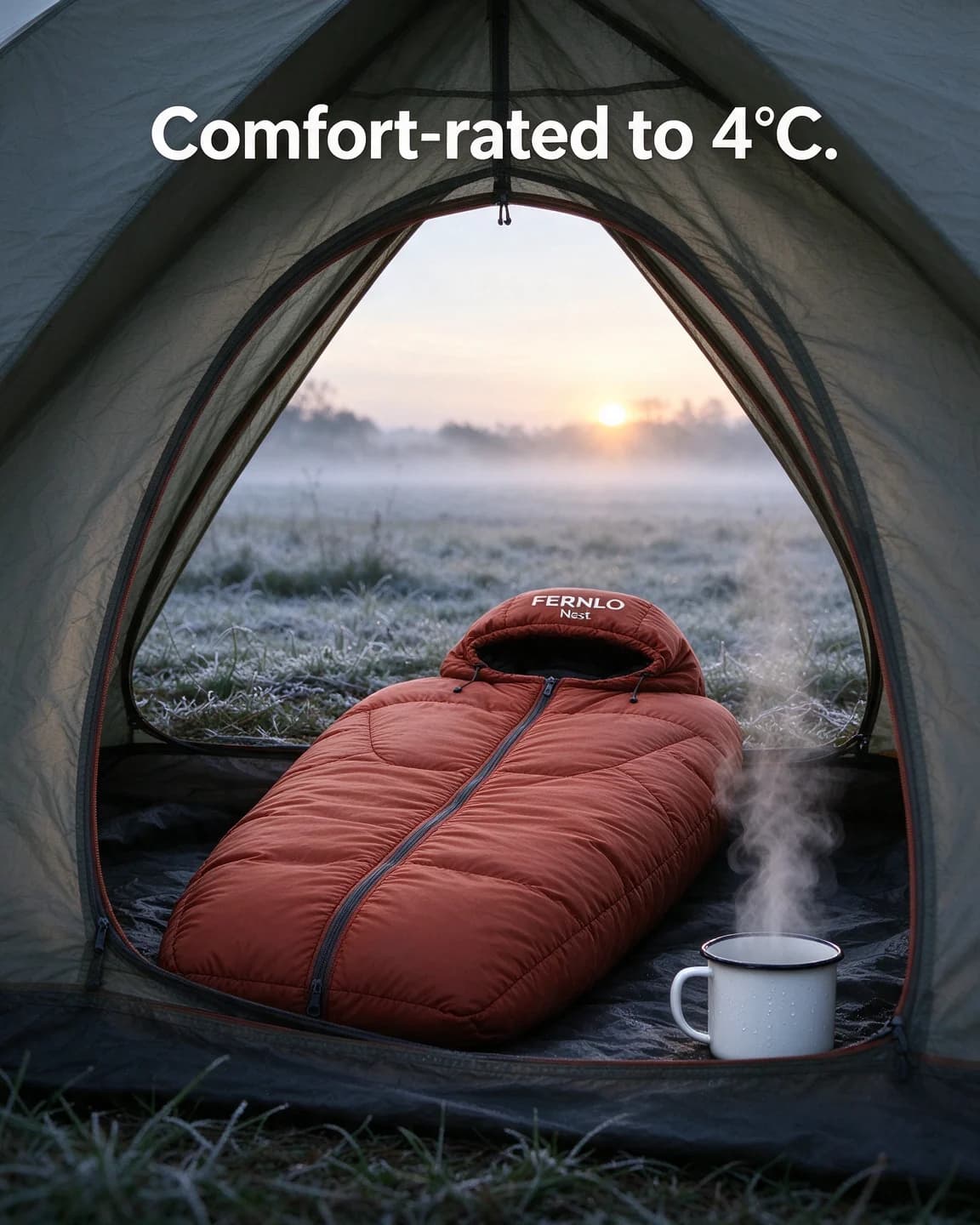
A rust-orange Fernlo Nest sleeping bag laid out in the open doorway of a tent on a frosty morning with a steaming enamel mug beside it, headline "Comfort-rated to 4°C."

FernloHonest specFeed · 4:5 image

“Comfort-rated to 4°C.”

Leading with the comfort figure, the one meant for a good night's sleep, earns trust from campers who have shivered in a bag sold on its lowest number. The frost outside and the steam from the mug make the temperature feel real without another word.

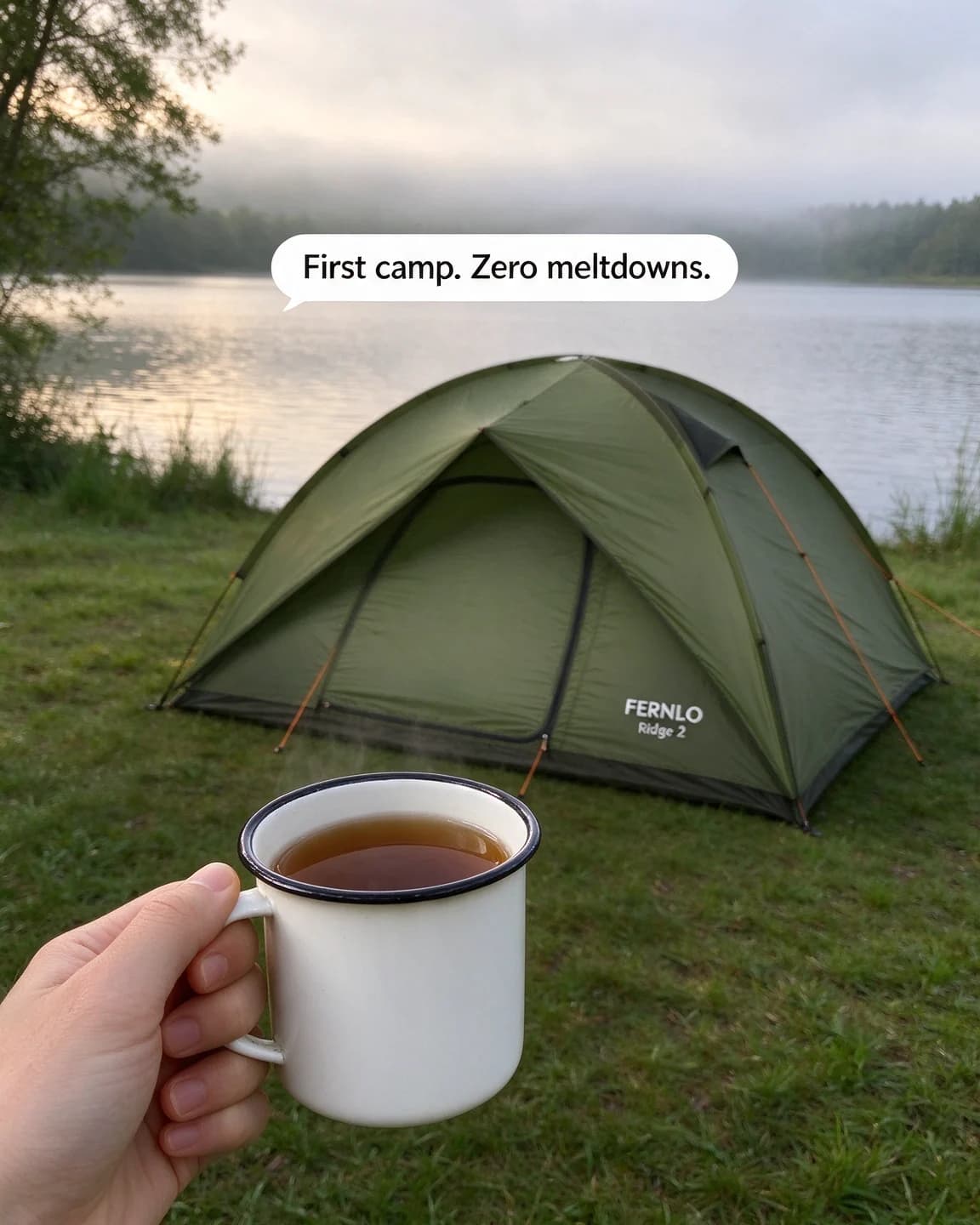
Phone photo of a hand holding an enamel mug in front of the pitched Fernlo Ridge 2 tent at a lakeside campsite, with a speech bubble reading "First camp. Zero meltdowns."

FernloFirst-trip UGCFeed · 4:5 image

“First camp. Zero meltdowns.”

It speaks straight to the beginner's fear of a trip going wrong, and the joke about meltdowns covers tents and toddlers alike. The hand-and-mug framing is how people really photograph a campsite, so it sits naturally among friends' holiday posts.

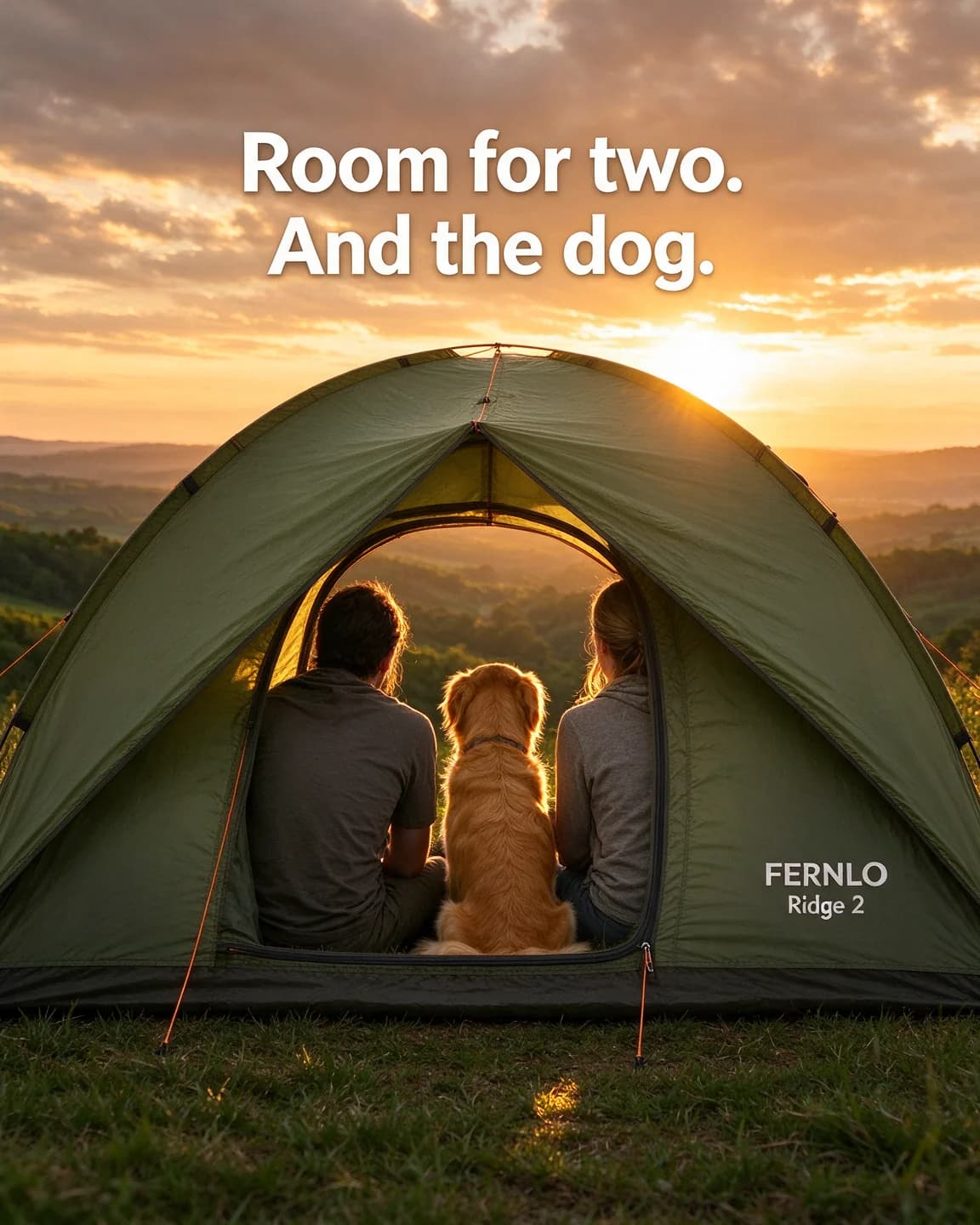
Two people seen from behind sitting in the open doorway of the Fernlo Ridge 2 tent at sunset with a dog between them, headline "Room for two. And the dog."

FernloSpace you can seeFeed · 4:5 image

“Room for two. And the dog.”

'Two-person' means little until you see two people, so the ad shows the doorway with room to spare. The dog adds warmth and answers the question dog owners will have, but only run it if the floor genuinely fits two mats and a dog.

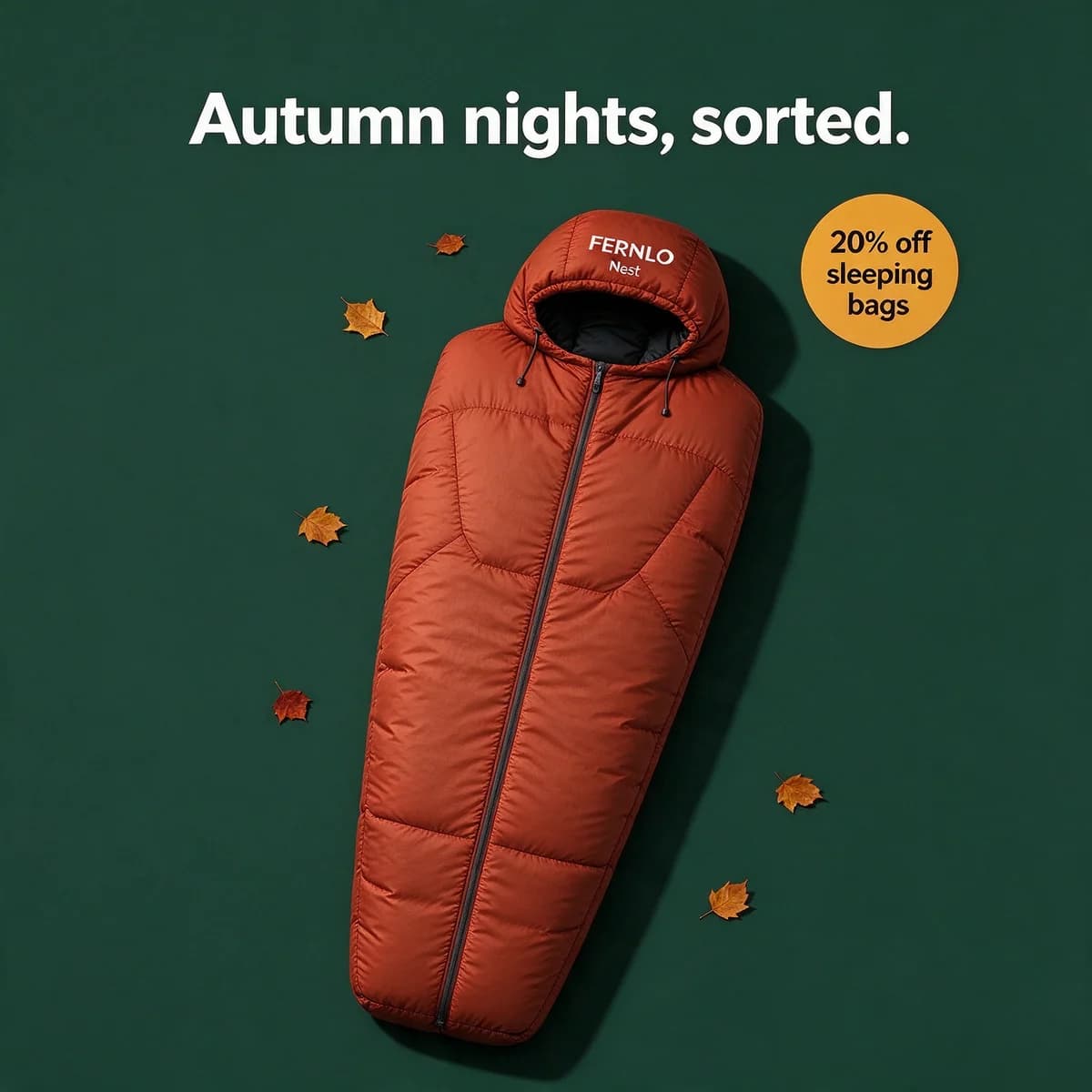
The rust-orange Fernlo Nest sleeping bag on a flat forest-green background with a hard shadow and fallen leaves, headline "Autumn nights, sorted." and a "20% off sleeping bags" sticker

FernloSeasonal offerFeed · 1:1 image

“Autumn nights, sorted.”

Cooler nights are when summer campers find out their bag isn't warm enough, so the offer lands on the moment of need. One product on a flat colour keeps the discount readable in a small square slot.

Two more ways to try

  • FFernloSponsored

    Glow vs your phone torch

    Fernlo
    FERNLO
    • Lights the whole tent
    • Hangs from the roof loop
    • Dims right down for stars
    • Your phone stays charged
    The usual
    ?
    • Lights one corner
    • Propped against a boot
    • Full blast or nothing
    • Phone flat by midnight
    Glow rechargeable lanternShop lanterns

    Us vs them ad

    Comparing with the phone torch everyone already carries, rather than a rival lantern, makes the upgrade obvious and keeps the comparison fair.

    Edit this template
  • FFernloSponsored
    ‹ Notes

    Friday, 6:40 PM

    First camping trip list

    • Tent, pegs and a mallet
    • Sleeping bag and a mat
    • Warm layer for 2am
    • Water and a small pan
    • Fernlo Glow, charged
    FERNLO
    Glow rechargeable lanternShop the lantern

    Notes app ad

    A packing list is something beginners screenshot, and the ticked last line slips the lantern in as the thing people forget. It reads like a note to self, which suits people who have looked at tents but not yet bought.

    Edit this template

Angles to test first

  1. 1

    Easy first trip

    Pitching speed, simple poles, colour-coded clips. Beginners buy confidence, so show the tent going up with two hands and no instructions in sight.

  2. 2

    Dry and warm nights

    Rain on the flysheet, frost outside a doorway. Make the weather visible and the comfort obvious, then back it with the figure from your test report.

  3. 3

    Numbers regulars trust

    Comfort rating, hydrostatic head, IP rating, packed weight. Experienced campers compare these before they compare brands, so give them the number and the standard behind it.

  4. 4

    Light after dark

    Lanterns and head torches are night products. Show them lighting a scene, and sell the low setting as much as the bright one.

  5. 5

    Space you can see

    'Two-person' and 'family-size' mean little on their own. Show people in the doorway and mats on the floor so the capacity is obvious.

  6. 6

    The place itself

    A lake at dawn, a sky full of stars, a quiet valley. Some of the strongest outdoor ads sell the escape first and let the product sit small in the frame.

15 hooks for camping gear ads

  • Pitched before the [kettle boils].
  • Rain on the roof. [Dry] inside.
  • Dim the [lantern]. Find the [stars].
  • One light, every [job].
  • Comfort-rated to [temperature].
  • First camp. Zero [meltdowns].
  • Room for [two]. And the [dog].
  • [Autumn] nights, sorted.
  • Your [phone torch] has done enough.
  • [Two nights] of kit, [one car boot].
  • What [3000 mm] means in a [downpour].
  • Rated for [real nights], not [bravado].
  • Practise in the [garden]. Pitch it at the [lake].
  • [Number] things first-time campers forget.
  • Lights on at [8pm]. Still on at [breakfast].

Moments to plan for

  • Spring gear check (March–April)

    'Practise in the garden' ads for the tent, and a checklist ad for people unpacking last year's kit.

  • Long weekends and bank holidays

    Short-break framing: one or two nights close to home, with pitching speed as the headline.

  • Summer school holidays

    Capacity scenes for families, with the tent's real floor size in the primary text.

  • Perseid meteor shower (mid-August)

    Stargazing ads for the lantern's low setting. NASA's Perseids page gives 12 to 13 August as the 2026 peak night (checked October 2026), so start the ads the week before.

  • Autumn (September–October)

    Warmer sleeping bags and lantern-lit porches for the shoulder season, with the comfort rating up front.

  • Christmas gifting (December)

    The lantern as an easy present for the outdoors person who has everything, with a clear order-by date.

Watch out for

  • Avoid a bare 'waterproof' on tents. Quote the hydrostatic head of the flysheet and the floor from your own test report, in millimetres, and say whether the seams are taped. A figure with no test behind it means little to regular campers.
  • Sleeping bag warmth has a standard. ISO 23537-1:2022, valid from March 2022, sets the tests and labelling for adult sleeping bags designed for limit temperatures of -20°C and higher (EVS listing of the standard, checked October 2026). Lead with the comfort temperature, the figure based on a standard adult woman sleeping comfortably, and never headline the extreme figure, which Wikipedia's summary of the standard calls a survival-only rating (checked October 2026).
  • Lantern and torch water ratings come from IEC 60529, the standard behind IP codes. A second digit of 4 means water splashed from any direction does no harm, and 7 means the product survives 30 minutes immersed to 1 metre (the standard's test table as given in Wikipedia's 'IP code' article, checked October 2026). So IPX4 is 'splash-proof', never 'waterproof'.
  • Never show a lit stove, barbecue or heater inside a tent or its porch, however cosy it looks. The US CDC lists fuel-burning stoves, lanterns and grills among the sources of carbon monoxide and says never to use a portable gas camp stove indoors (CDC, 'Carbon Monoxide Poisoning Basics', checked October 2026). Viewers copy what ads make look normal, so show cooking and campfires outside, well away from the tent, and only where fires are allowed.
  • Leave knives and blades out of kit shots unless you've checked the policy for that item. Meta's advertising standards list non-culinary knives and blades among the weapons ads can't promote (Meta Transparency Center, 'Weapons, ammunition or explosives', checked October 2026), so a camp knife in a flat lay can sink an ad that is really about a tent.

Practical pointers, not legal advice. Check Meta’s Advertising Standards and your local rules.

What camping gear ads have to sell

Camping gear is bought for a night that hasn't happened yet. The buyer is picturing it, and often picturing what could go wrong: a tent that won't go up in the wind, a 2am chill, a campsite so dark nobody can find the zip. The ads that work replace each of those worries with a picture of the night going right.

There are two kinds of buyer in this category, and they want different things from an ad:

Buyer What they need to see Ads above that speak to them
First-timers That it's easy and it'll be fine "Pitched before the kettle boils.", "First camp. Zero meltdowns."
Regular campers Numbers they can compare "Comfort-rated to 4°C.", "One light, every job."
Both The place and the feeling "Dim the lantern. Find the stars.", "Room for two. And the dog."

Write separate ads for each group rather than one ad that tries to please everyone. A beginner skims past a hydrostatic head figure, and a regular scrolls past "it's so easy" when there's no number behind it.

Shots that work for tents, lanterns and sleeping bags

Tents

Show the tent pitched, from a three-quarter angle, door open and guy lines tight. Straight from the front, a tent hides its depth, and a packed tent tells nobody anything except its size. Put people in the doorway, seen from behind, to show capacity, and show the inside with two sleeping mats side by side when you claim it sleeps two. Pack size reads best beside an object everyone knows, such as a boot, a bottle or a day pack.

Lanterns

A lantern ad lives or dies on light. In daylight a lantern is a plastic cylinder. At blue hour or at night it's the warm centre of the campsite. Show what it lights, a tent interior, a table, the path back to the car, and keep at least one ad with the lantern turned low, because "it dims" is a feature people only appreciate in the dark.

Sleeping bags

Warmth is invisible, so context does the work: frost on the grass, breath in the air, a mug steaming beside the bag. Lay the bag in a tent doorway or on a mat rather than flat on white, and make the hood and zip visible, since those are the details buyers check.

Wording outdoor specs without stretching them

Campers read the numbers, and three kinds of claim need the most care in this category: waterproofing, warmth and water resistance for anything electric. The watch-outs above name the standards and where to check them. The working rule is short:

  1. Put the number on the image. "3000 mm flysheet", "Comfort-rated to 4°C", "IPX4".
  2. Put the test on the product page. How the figure was measured, and by whom.
  3. Translate the number into plain words that don't stretch it. "Splash-proof" for IPX4, "warm on a frosty night" only for a comfort rating that covers one, "dry through steady rain" only if the tent has been tested in it.

The rain ad above follows that pattern: the feeling in the headline, the checkable figure in small type underneath.

A first batch for an outdoor brand

Pick a hero product, usually the tent, and make two ads each for four worries: setup, weather, space and first-trip nerves. Then add two ads that sell the escape itself, the lake or the stars, with the product smaller in the frame. That's ten ads, enough to show whether your buyers respond to reassurance, to numbers or to the place. If ten feels like too many for one tent, how many ad creatives to test explains how to size a batch to the sales you expect.

Bundles suit this category, because a tent alone doesn't make a trip. As a worked example, if the Ridge 2 sells for $98 and the Glow lantern for $19, a tent-and-lantern bundle at $108 saves the buyer $8.25. That's a clear enough saving to lead an ad for people who have already viewed the tent, and it answers "what else do I need?" before they go looking elsewhere.

Timing matters a lot here. Interest in camping gear follows the weather, the school calendar and the long weekends, so start testing a few weeks before your first busy weekend and have the winners ready when people start planning, not when they're already packing. The setup and weather ads belong in 4:5 for feeds. Night scenes earn the 9:16 frame, where a dark sky fills the screen, and the safe zone checker shows where a headline won't be covered by the app's buttons.

Making outdoor scenes from one packshot

Location shoots are the expensive part of outdoor marketing: travel, a crew, a campsite, and weather that rarely follows the shot list. BulkAds starts from one clean packshot of your tent, lantern or sleeping bag on a plain background and builds the scene around it, whether that's a lakeside at golden hour, rain on the flysheet, a frosty doorway or a sky full of stars. Each ad is compared with your original photo, so one where the tent gained an extra door or lost its logo is flagged before it reaches you. The guide to product photos for AI ads explains how to shoot that first packshot.

Rain, frost and starlight are hard to schedule and easy to describe. Keep them honest, though. If your tent has never been tested in heavy rain, don't generate a storm for it. Add your real figures to the brand kit as proof points, the hydrostatic head, the comfort rating and the IP rating, because the copy for every ad is told to use those and not to invent new numbers.

When an image wins, turn it into a short video ad, with rain running down the flysheet or a lantern glowing brighter as the light fades. Each image ad uses 2 credits, so the ten-ad plan above comes to 20 credits. Launch it paused with the bulk ad launcher, or let Autopilot launch it as its own test, stop the losers and draft new variants of the winners as the season moves on.

Questions people ask

What makes a good tent ad?

The tent pitched from a three-quarter angle with the door open, in a scene that answers one worry: setup, rain, space or a first trip. Put the checkable number, such as the hydrostatic head, in small type and the test details on the product page.

Can I call a tent waterproof in an ad?

Only with care. Quote the hydrostatic head of the flysheet and floor from your own test report and say whether the seams are taped. A bare 'waterproof' with no figure behind it invites complaints and returns.

How should a lantern be shown in an ad?

At blue hour or at night, lighting something such as a tent, a table or a path. A lantern photographed in daylight looks like a plastic cylinder. Include one ad with it dimmed, since that's a feature people only value in the dark.

Which sleeping bag temperature should an ad use?

The comfort temperature from testing to ISO 23537-1, the standard for labelling adult sleeping bags. Never headline the extreme figure, which is a survival rating, not a comfortable night.

Is Fernlo a real brand?

No. Fernlo is fictional, and all eight ads on this page were made with AI for illustration.

Keep going

Every brand on this page is fictional and every ad was made with AI for illustration — they’re examples, not case studies.

BulkAds AI is an independent product and is not affiliated with, endorsed or sponsored by Meta Platforms, Inc. Facebook and Instagram are trademarks of Meta Platforms, Inc.

More ad examples

Your next fifty ads are one link away.

Paste your website, meet your brand kit and see your first batch in minutes. 7 days for $9.99 — cancel anytime.

yourbrand.comMake my ads

See pricingExplore featuresBrowse the library