Why feature callout ads work
A feature callout ad puts the product in the middle and points at what matters: short labels around a clear packshot, each tied to a part of the product or a fact about it. It answers a careful buyer's questions in the order their eyes move — what is it, what's special, what's in it — without a paragraph of copy.
The format works because it's concrete. Instead of telling people the product is good, it shows them where the good parts are: the mesh upper, the reservoir, the 20 g of protein. Labels placed on or around the product feel like evidence rather than adjectives, which makes them easier to believe.
It also fits how people shop on a phone. Nobody reads a spec sheet in a feed, but most people will take in three or four words at a time. A callout ad turns the spec sheet into a picture.
Labels also slow the scroll in a useful way. A labelled product invites the eye to travel from one label to the next, which buys a few extra seconds of attention — time a plain packshot rarely gets.
Features vs benefits: what the labels should say
Marketers are often told to "sell benefits, not features". On a callout ad the best labels do both: a feature short enough to point at, phrased so the benefit is obvious.
| Plain feature | Callout label | What the buyer hears |
|---|---|---|
| Weight: 212 g | 212 g light | Less to lift, every stride |
| Water reservoir in the base | Self-watering reservoir | Fewer thirsty plants |
| 20 g protein per bar | 20 g protein | A snack that counts |
| Contains real ginger juice | Real ginger juice | A taste you can actually notice |
The fuller benefit usually goes in the primary text, where there's room for a sentence. The label's job is to be short, specific and true.
How to make one, step by step
- Start with a great product photo. Callouts point at details, so the details have to be visible: sharp, well lit, the whole product in frame. Our guide to product photos for AI ads covers phone set-ups that work.
- List every feature buyers ask about. Check reviews, product-page questions and support emails. The features people ask about are the ones worth labelling.
- Pick three or four. Choose ones that are important and visible — or important and invisible, like a reservoir, where the label does what the photo can't.
- Write each label in three words or fewer. Numbers and nouns beat adjectives: "212 g light" beats "super lightweight".
- Place each label next to what it describes. A label about the sole goes near the sole. Floating labels with no connection to the product lose most of their power.
- Add a short headline. "What's inside every can" or "Built for the long run" frames the labels in six words or fewer.
- Keep the background plain. The product and labels need all the attention. Busy scenes make callouts hard to read.
Because every label points at a real detail, the product in the ad has to match the product in the box exactly. BulkAds' product photo ads start from your real photo and check each ad against it, so labels don't end up pointing at details that drifted.
Ten variations for one test
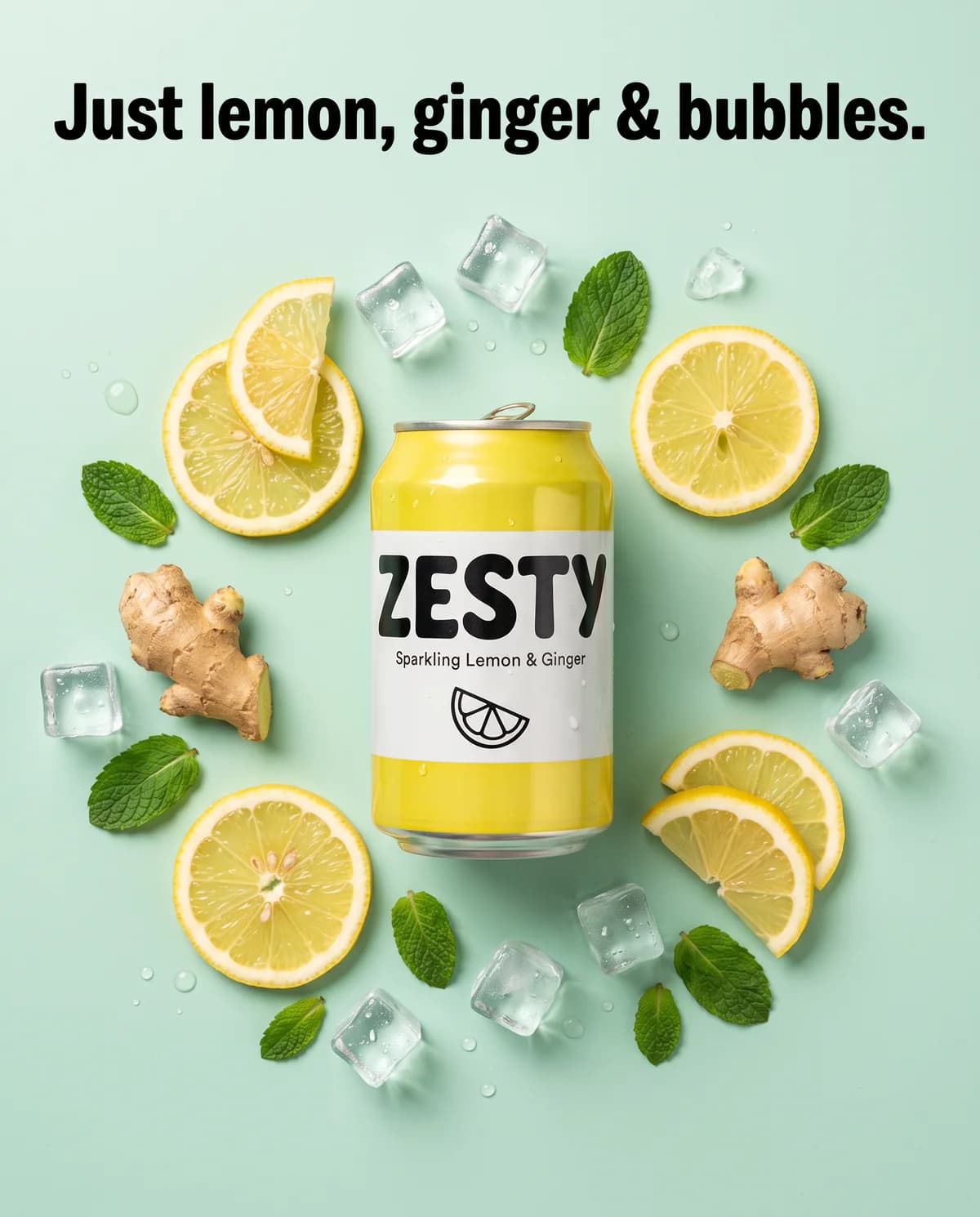
For callouts, the biggest lever is which features lead, the framing comes second. For the Zesty example:
- Ingredients: 0 g sugar, real ginger juice, vegan
- Taste: sharp lemon, gentle heat, crisp fizz
- Moments: desk drawer, gym bag, party fridge
- Pack: 330 ml can, 24-pack, free delivery on 24-packs
- Contrast: each label answering "unlike regular soda"
- The winning set with four labels instead of three
- The winning set with the product much larger
- The winning set on a lifestyle background instead of flat colour
- The winning set rebuilt at 9:16, labels kept clear of the top and bottom edges
- The winning set with a line from a real review as one of the labels
Sets 1–5 test which features your buyers care about, 6–10 test the layout. The ad variation calculator shows how feature sets × layouts × sizes multiply, and what testing them would cost. If the headline is the weak spot, the hook bank has fill-in-the-blank openers.
How to test feature callouts
Launch the feature sets together in one ad set, one ad per creative, and give each enough spend to reach a verdict — a couple of times your target cost per purchase is a common rule of thumb. Judge on cost per purchase, with click-through rate as the early signal.
Callout ads suit people who are already weighing up the product, so they often shine in retargeting and with warm audiences. If they struggle with cold audiences, don't write the format off. Turn the winning feature into a bold claim or a listicle for new audiences, and keep the callouts for people who've already visited.
Read the winner for what it says about your buyers, too. If the taste set beats the ingredients set, people already trust what's in the can and want to know how it tastes — a message worth carrying into every other template you run next.
Common mistakes
- Too many labels. Past four, it's a spec sheet. Save the rest for the product page.
- Jargon. "TPU heel counter" means nothing to most buyers. Use the words your customers use.
- Adjectives instead of facts. "Premium", "amazing" and "ultra-comfortable" aren't callouts. Numbers, materials and parts are.
- Labels far from the product. If people can't tell what a label points at, it's decoration.
- Labels that repeat the headline. If the headline already says "zero sugar", a "0 g sugar" label wastes one of your few slots.
- Details you can't stand behind. Every label is a claim. Use only real specs from your product data, and keep health or performance promises out unless you can substantiate them.
Questions people ask
What is a feature callout ad?
A feature callout ad shows the product in the centre with short labels pointing to its key features — materials, specs, ingredients — so buyers take in the important details at a glance.
How many callouts should an ad have?
Three or four. Fewer can look thin, and more turns the ad into a spec sheet nobody reads on a phone.
Should callouts be features or benefits?
Short features phrased so the benefit is obvious, like “212 g light”. Put the fuller benefit in the primary text, where there's room for a sentence.
Do feature callout ads work for cold audiences?
They can, but they often do best with people already considering the product. If they struggle cold, turn the strongest callout into a bold claim for new audiences and keep callouts for retargeting.
Keep going
- Features
Product photo ads
Your real packshot, in every scene
- Guides
Product photography for ads: how to shoot it on a phone
A phone, a window and a sheet of white card are enough. How to shoot product photos that make good ads — and that AI tools can put in new scenes without mangling your label.
- Ad templates
Bold claim ad template
One provable fact in giant type, on one flat colour
- Ad templates
Listicle ad template
A numbered headline and three to five reasons, strongest first
- Ad templates
Us vs them ad template
Two matched columns, one obvious choice — against a category
- Hook bank
The hook bank
Fill-in-the-blank opening lines, sorted by what they do.
Every brand, person and review in these mock-ups is fictional. In your own ads, use only real reviews, real numbers and claims you can back up.
BulkAds AI is an independent product and is not affiliated with, endorsed or sponsored by Meta Platforms, Inc. Facebook and Instagram are trademarks of Meta Platforms, Inc.