
Ad ideas

Black Friday ad ideas: 6 sale ads that still look like your brand

Black Friday falls on 27 November 2026, the Friday after US Thanksgiving. Every feed turns black and red that week, so the ads that sell make one honest offer readable at a glance and still look like the brand behind it. Here are six sale ads for fictional brands, each with its angle and why it works, plus hooks, offers and the pricing rules to check first.

Late November (27 Nov 2026)6 ads15 hooks5 offer ideas

When to start

Late November (27 Nov 2026)

Write the brief in mid-October and start testing angles in the first week of November, at full price or as early-access ads, so you know which ideas earn attention before the sale opens. Lock the final sale versions by 20 November 2026 and keep a Cyber Monday set ready for 30 November.

Creative checklist

  • Put the offer in the first line of on-image text, in five words or fewer
  • Keep the product label readable at thumbnail size
  • Use black as a backdrop with one accent colour from your brand kit
  • Make every concept in 4:5 for feeds and 9:16 for Stories and Reels
  • Match every number on the image to the landing page
  • Write the end date in the primary text, not only on the image
  • Save a copy of each winner with "Cyber Monday" in place of "Black Friday"

The swipe file

Each ad with its angle, its hook and why it works. Every brand is fictional. The ads were made with AI to show the idea.

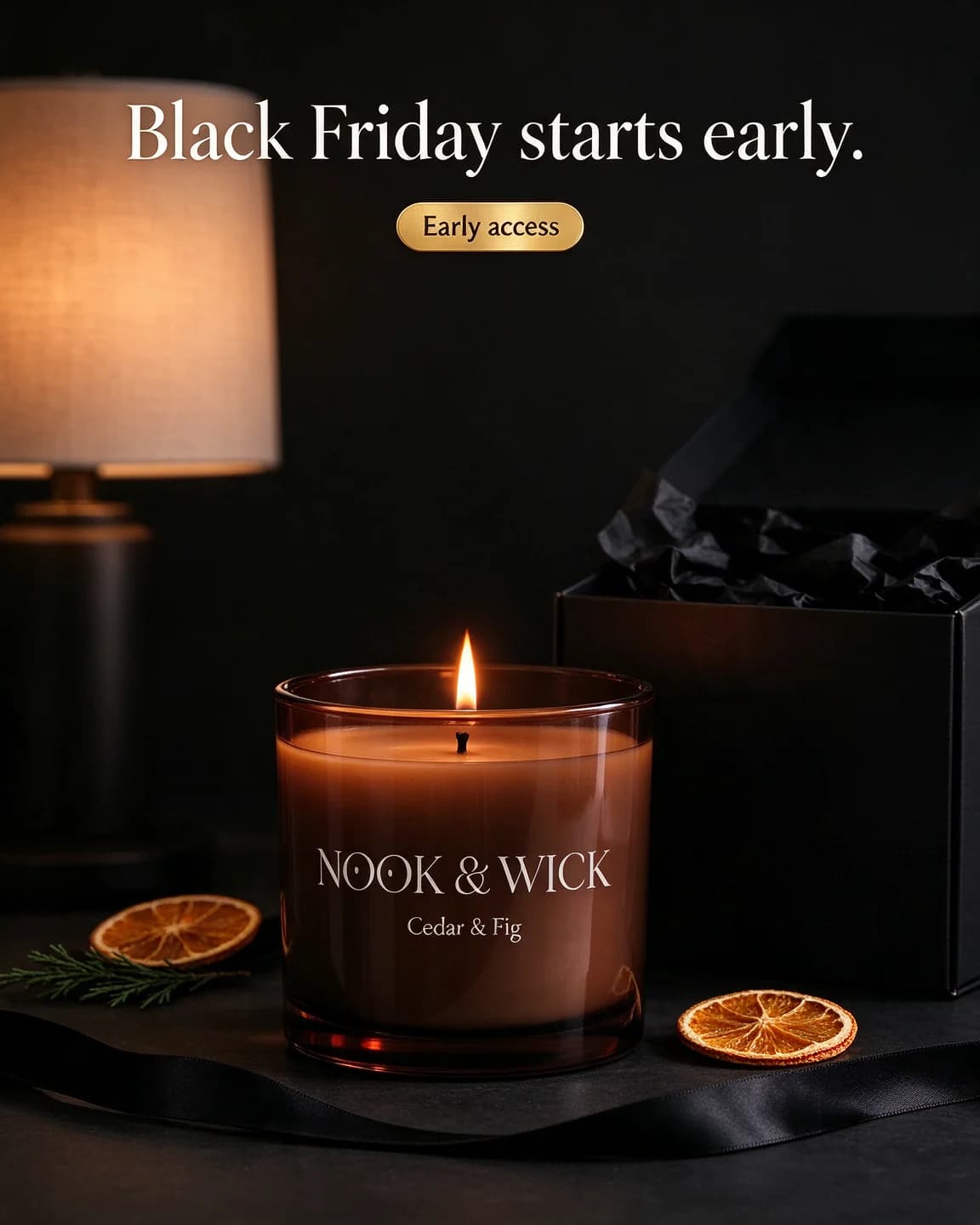
A lit Nook & Wick Cedar & Fig candle beside an open black gift box with black tissue and a satin ribbon, headline "Black Friday starts early." and a gold "Early access" sticker

Nook & WickEarly accessFeed · 4:5 image

“Black Friday starts early.”

Gift buyers start browsing before the day itself, and an early-access ad reaches them while feeds are still quiet. The black box and ribbon say Black Friday without a single red sticker, so the candle keeps its premium look. Run it only if the head start is real, with the opening date in the primary text.

A white and electric-blue Pacer running shoe on a flat black background with a hard white offset shadow, headline "Our one sale this year." and a yellow "30% off" sticker

PacerRare saleFeed · 1:1 image

“Our one sale this year.”

A brand that rarely discounts has a reason to buy now that permanent-sale brands can't copy. One shoe, one number and a black poster read at a glance, even as a thumbnail. The line has to be true, so skip it if you also ran a summer sale or a festive one.

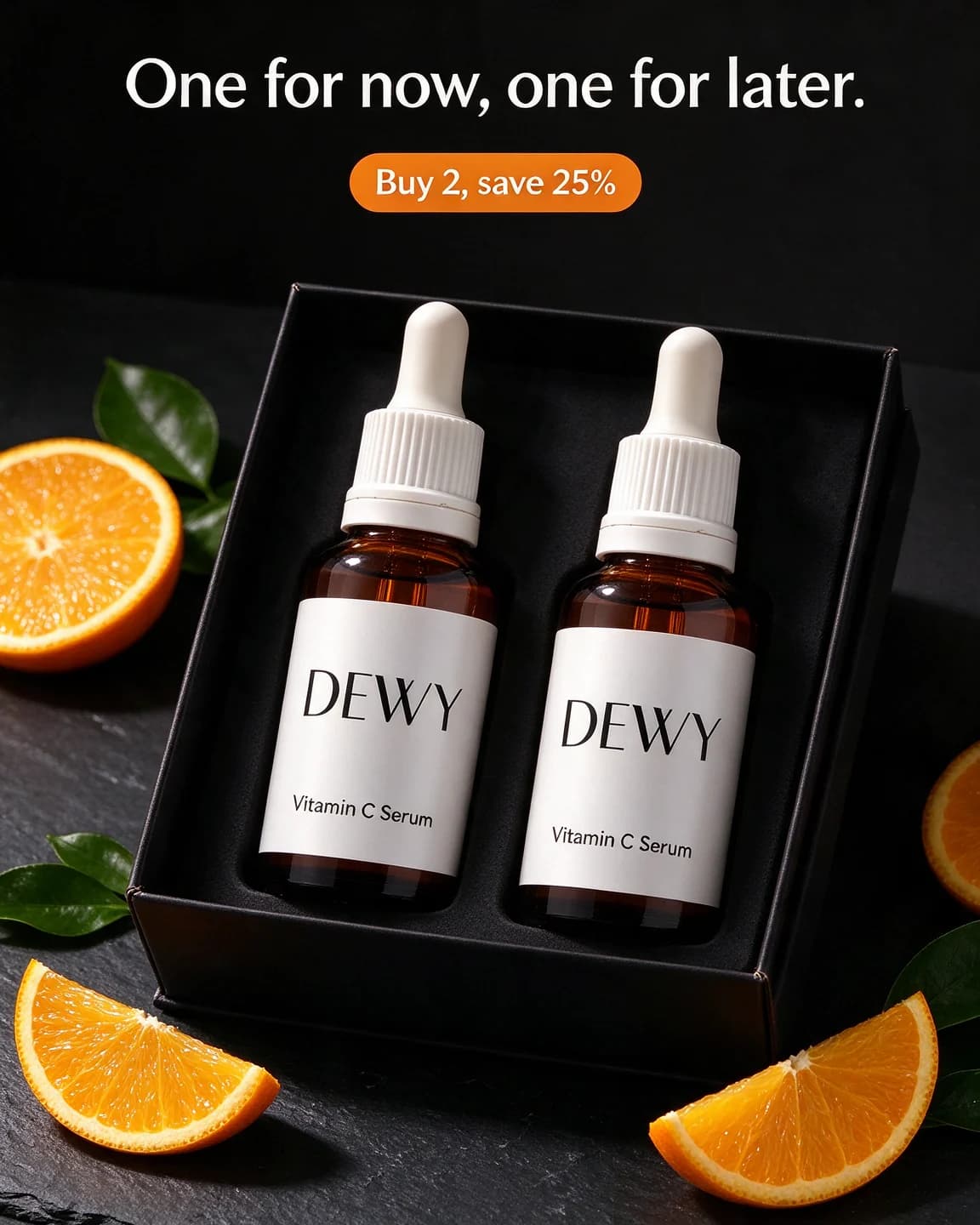
Two identical Dewy Vitamin C Serum bottles in an open black gift box on dark slate with orange slices, headline "One for now, one for later." and an orange "Buy 2, save 25%" sticker

DewyStock-up bundleFeed · 4:5 image

“One for now, one for later.”

Serum runs out, so a two-bottle deal matches how people already buy it and lifts the order without a deeper cut on one bottle. The headline gives a reason to take two, which a bare percentage never does. Work the saving out from the real price of two single bottles.

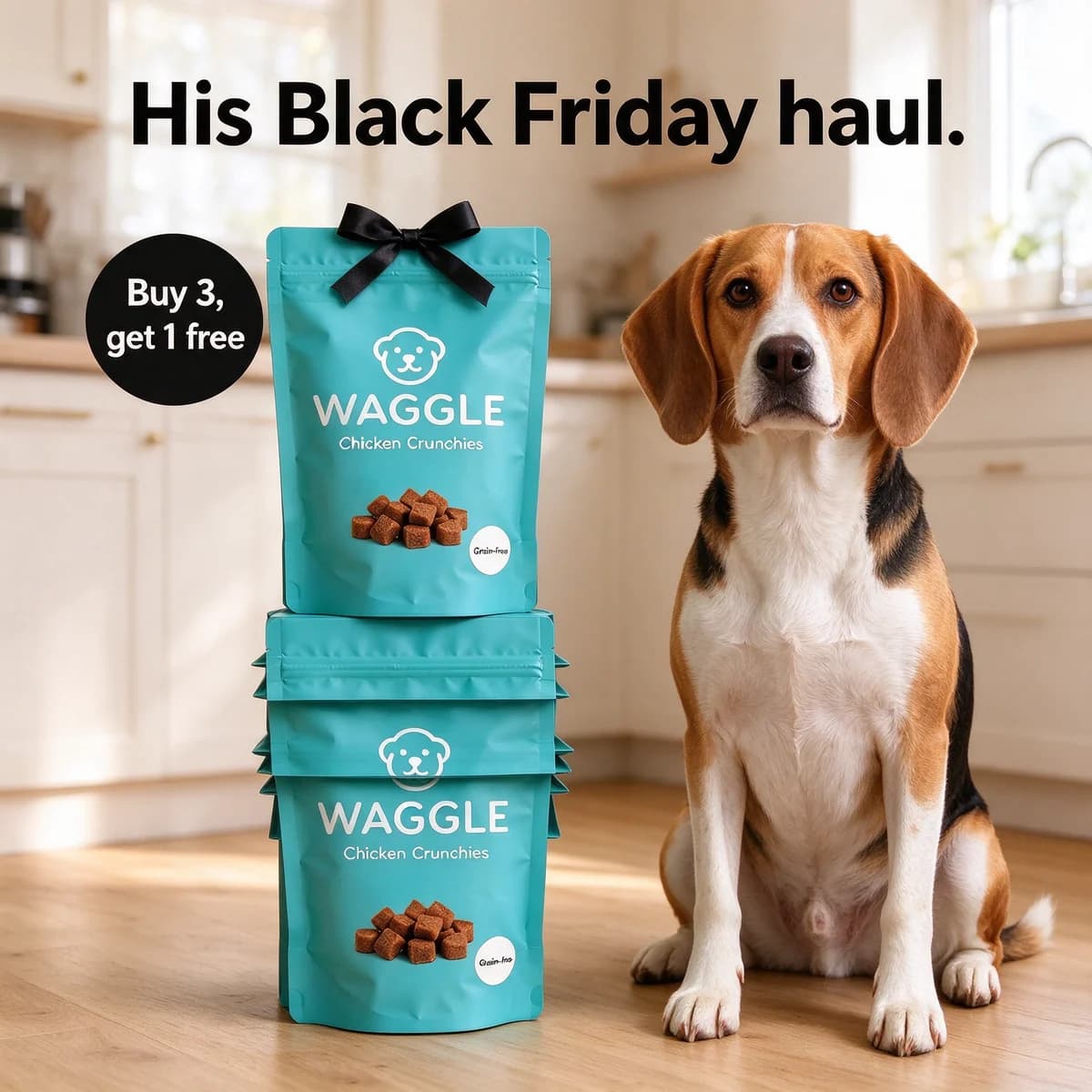
A beagle sitting proudly beside a tall stack of teal Waggle Chicken Crunchies pouches, the top one tied with a black bow, headline "His Black Friday haul." and a "Buy 3, get 1 free" sticker

WaggleHumour and stock-upFeed · 1:1 image

“His Black Friday haul.”

A dog guarding a pile of treats is funny before it is an offer, which buys the second look a sale ad needs. Treats get eaten every week, so a multi-buy is a deal owners actually want. The bow on the top pouch quietly turns it into a gift idea for friends with dogs.

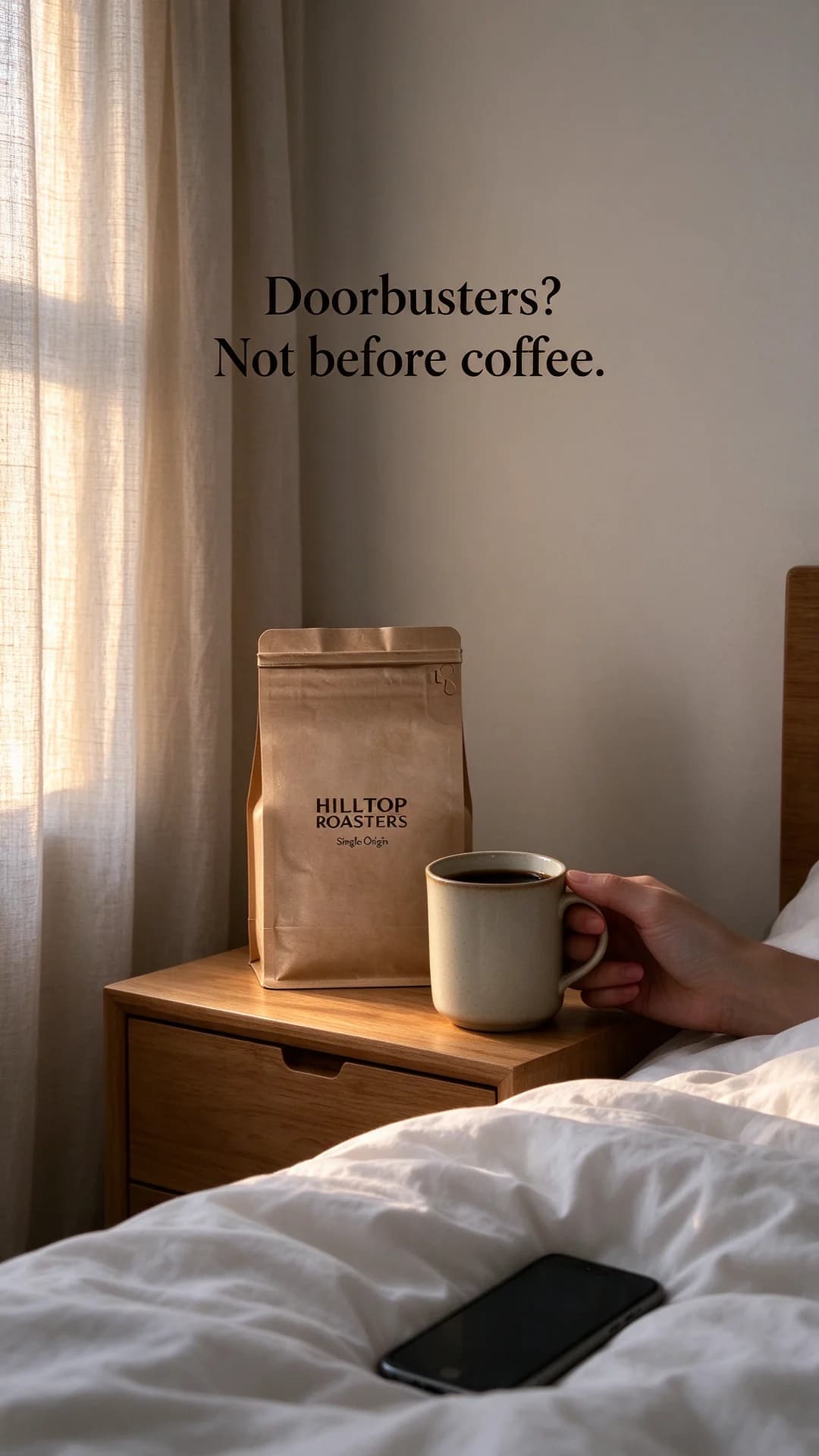
A hand holding a mug of black coffee beside a Hilltop Roasters Single Origin bag on a bedside table at dawn, a phone lying face down on the duvet, headline "Doorbusters? Not before coffee."

Hilltop RoastersShop from homeStories · 9:16 image

“Doorbusters? Not before coffee.”

It sells the opposite of queues and panic: a slow morning in bed with the sale on a phone. That contrast stands out in a week of shouting and fits a roaster's calm voice. The vertical frame puts the headline in the upper third and the bag in the middle, leaving the bottom strip, where Stories shows its reply bar, to the duvet.

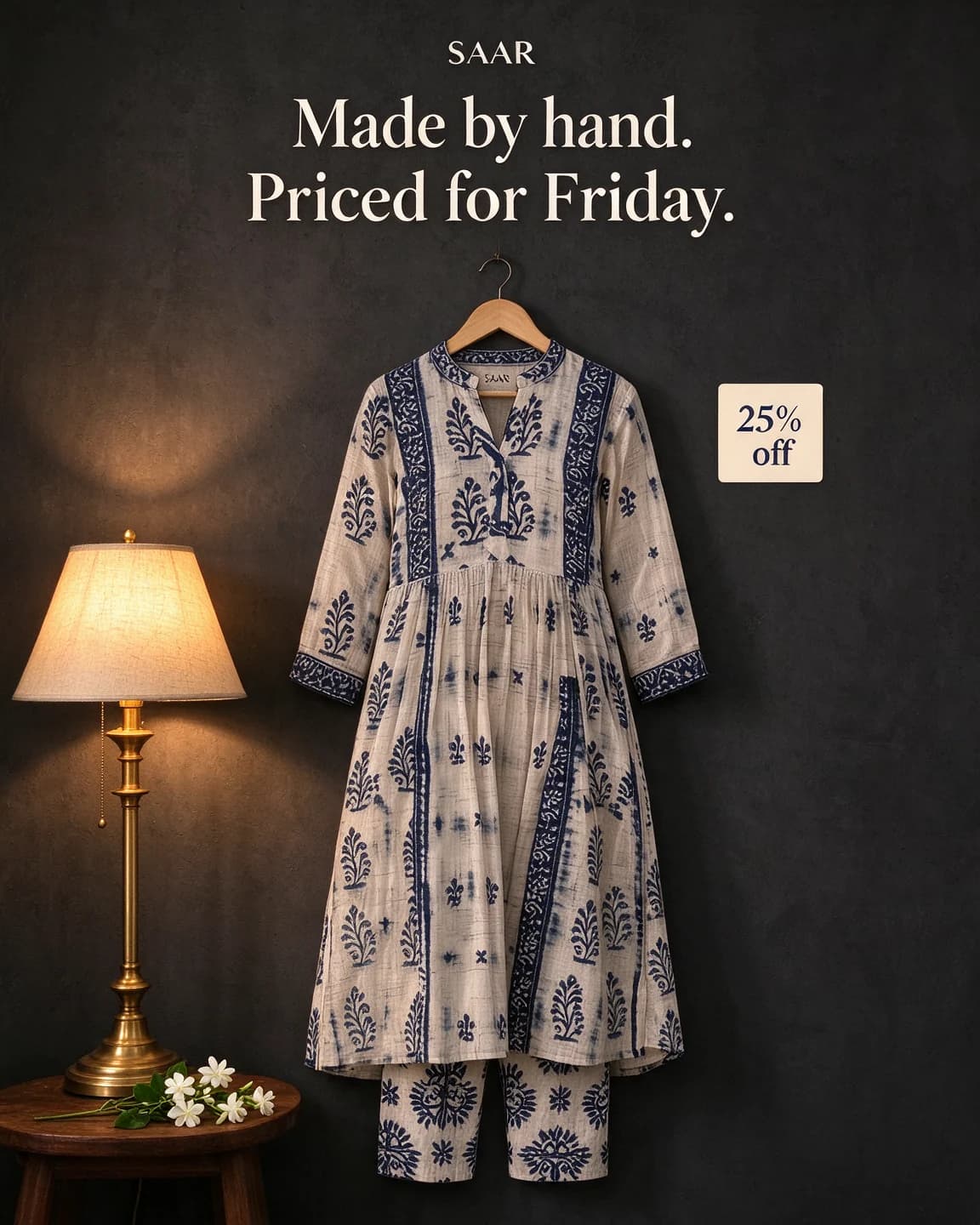
A white-and-indigo hand-block-printed Saar linen kurta on a wooden hanger against a deep charcoal wall in warm lamp light, headline "Made by hand. Priced for Friday." and a "25% off" tag

SaarCraft valueFeed · 4:5 image

“Made by hand. Priced for Friday.”

Makers of handmade goods worry that a discount cheapens the work. This line puts the craft first and the price second, so the sale reads as a rare chance rather than a clearance. For brands selling in India, late November also sits in the winter wedding season, which makes a festive kurta timely.

Angles to test first

  1. 1

    Early access

    Give subscribers and past buyers a head start. It rewards loyalty, spreads orders over more days and gets your ad seen before feeds fill up with red stickers.

  2. 2

    The rare sale

    If you discount once a year, say so plainly. Scarcity of sales is a reason to act now that a brand on permanent discount can't borrow.

  3. 3

    Stock up

    For anything people use up, such as coffee, treats or serum, a multi-buy beats a deeper single-item cut. Show the pile, not just the percentage.

  4. 4

    The early gift

    Black Friday lands four weeks before Christmas, so some of what sells is presents bought early. Show the product boxed, wrapped or tagged, and name who it's for.

  5. 5

    Calm, not chaos

    Shopping from bed, a quiet kitchen, no queue in sight. It stands out precisely because almost nobody else shows it.

  6. 6

    The price, made plain

    One product, the old price, the new price and nothing else. It looks simple, and it answers the only question a sale shopper has.

15 hooks for Black Friday ads

  • Black Friday starts early at [brand].
  • Our one sale this year: [discount] off [product].
  • One for now, one for [later moment].
  • Doorbusters? Not before [morning ritual].
  • Stock up on [product] for the whole [season].
  • [Number] [products], one Black Friday price.
  • Gift [recipient] something they'll use every day: [product].
  • Was [old price]. Now [new price]. Until [day].
  • Skip the queue. [Product] ships [delivery promise].
  • The [product] we never put on sale. Until [date].
  • [Pet name]'s Black Friday haul.
  • Made by hand. Priced for [day].
  • Early access for [list name] opens [day and time].
  • Our [bestseller] is [discount] off for [number] days only.
  • No codes, no catches: [discount] off [range].

Offer ideas

  • Early access for your list

    Open the sale a day or two early for email or SMS subscribers. In the week before, the ad sells the head start, and the sign-up is the real conversion.

  • Multi-buy on things that run out

    Buy 3, get 1 free on treats, coffee or skincare. Worked example: four pouches at $3.10 each cost $12, and paying for three makes it $9.30, a 25% saving that never touches the single-pouch price.

  • Gift sets at one round price

    Bundle two or three products into a ready-made present, such as a serum and a cleanser for $15 instead of $18 bought separately. It's easier to buy as a gift and protects the price of each item.

  • Gift with purchase

    A free mini, tote or engraving above a spend threshold. The headline price stays intact, which suits premium brands that don't want a big percentage on the image.

  • Price lock for new subscribers

    People who subscribe over the weekend keep the Black Friday price for a set period, such as their next three deliveries. Put the period in the ad, or it reads like a trick.

Watch out for

  • A "was" price has to be real. The US FTC's Guides Against Deceptive Pricing (16 CFR 233.1) treat a former price as a fair comparison only if it was the actual, bona fide price the item was offered at, on a regular basis, for a reasonably substantial period. A price raised for a week before the sale doesn't count.
  • In the EU, Article 6a of the Price Indication Directive (98/6/EC) says a price reduction is measured from the lowest price you charged in the 30 days before it, and the EU Court of Justice confirmed in September 2024 (Aldi Süd, C-330/23) that the percentage off must be worked out from that price.
  • As of October 2026, Meta's Advertising Standards list deceptive pricing among its prohibited commercial practices. The price, discount and end date on the image should be exactly what the landing page shows when someone taps.
  • Countdowns and "only 3 left" badges must be true. The guidelines on dark patterns that India's Central Consumer Protection Authority issued on 30 November 2023 list false urgency as one of them.
  • An ad that says "today only" must stop when the day does. Put the end time in your calendar and pause or swap the sale ads yourself the moment the offer closes.

Practical pointers, not legal advice. Check Meta’s Advertising Standards and your local rules.

What a Black Friday ad has to do

Black Friday is the Friday after US Thanksgiving, which puts it on 27 November 2026 and on 26 November 2027 (Thanksgiving dates from the US Office of Personnel Management's holiday calendar). Most shoppers already expect a discount, so the ad isn't there to announce that sales exist. It has three jobs: show which product is on offer, say how good the deal is, and still look like your brand when every feed turns black and red.

That last job is the hard one. In a week when most ads share the same colours, the same SALE type and the same percentages, your real product photo and your own voice are what make an ad recognisable. Each of the six ads above keeps one thing only that brand could say: a candle maker's early access, a running brand's single yearly sale, a roaster's slow morning.

The scale explains the noise. Adobe's analytics release of 2 December 2025 put US online spending on Black Friday 2025 at $11.8 billion, up 9.1% on the year before. With that much selling packed into one day, an offer that takes more than a moment to read gets scrolled past.

Choose the offer before the picture

Most weak sale ads are weak because the offer was settled last. Decide it first, because it decides the scene:

  • A percentage off one product wants a plain poster: the product, the number, nothing else. The price drop template shows the layout.
  • A multi-buy wants the pile, several identical packs, so the deal is visible before anyone reads a word. See the bundle template.
  • A gift set wants a box, wrapping or a tag, because the buyer is shopping for someone else.
  • Early access wants a date and a reason to sign up, and often no discount on the image at all.

A Black Friday timeline that leaves room to test

  1. Mid-October: brief. Pick the hero products, the offer for each and three or four angles. A short creative brief keeps a rushed team honest.
  2. Early November: test the angles. Run the ideas at full price, or as early-access ads, for about two weeks. You're learning which angle and which picture earn attention, not whether a discount sells.
  3. By 20 November 2026: make the sale versions. Rebuild the winning angles with the offer on the image, in 4:5 and 9:16, and get them signed off.
  4. 27 to 30 November: run the winners. Friday to Cyber Monday is four days. There's no time to learn from scratch, so spend the weekend on ideas that already proved themselves.
  5. 1 December: switch. Pause the sale ads and move the best angles into gift and Christmas creative.

How many variants to make depends on how many angles, hooks and formats you want to compare. The ad variation calculator shows how quickly those multiply.

Making the Black Friday batch in BulkAds

BulkAds builds batches of up to 12 ads from your real product photo, so a full sale set can come together in an afternoon:

  • Write the brief as instructions. For example: "Black Friday, black backdrop, gold accents, lead with buy 2 save 25%, gift box in some ads". Each ad in the batch takes its own angle on it.
  • Keep the claims honest at the source. Ads draw on the proof points in your brand kit and the instructions you write, so put the real discount and end date in the instructions and leave nothing for the AI to guess.
  • Check before launch. The pre-flight check reads every word on the image and flags likely Meta policy risks, which matters when the image carries a price.
  • Fix one part. If an ad is right but the sticker shows the wrong number, regenerate that element instead of the whole ad.
  • Launch paused. The bulk ad launcher puts the set into your own ad account paused, so nothing goes live before the sale opens.

One honest trade-off: Autopilot waits 48 hours before it calls a winner, which is half the Black Friday weekend (clear losers are stopped sooner, as soon as they cross your stop line). Let it launch and judge the early November tests, where it has time, and run the proven ads yourself on the day.

After the weekend

The angles that won on Black Friday are your best guess for December. Keep the idea and change the occasion: the gift box becomes a Christmas gift box, the price lock becomes a New Year offer. The Cyber Monday ideas cover the last day of the weekend, and the Christmas ad ideas take over from there. For ways to stretch a winner without starting again, read iterating on a winning ad.

Questions people ask

When is Black Friday in 2026?

Friday 27 November 2026, the day after US Thanksgiving on 26 November. In 2027 it falls on 26 November. Many brands now run offers for the whole week, or through to Cyber Monday on 30 November 2026.

How early should I start making Black Friday ads?

Start testing ideas in early November and have the final sale versions approved about a week before. Early-access or teaser ads can run from mid-November, and the sale ads themselves start the day the offer opens.

Should a Black Friday ad show the discount on the image?

Usually, if the discount is the reason to buy. Keep it to one number or one deal, readable at thumbnail size. Premium brands that don't want a big percentage on the image can lead with a gift set or a gift with purchase instead.

How do I stand out when every Black Friday ad is black and red?

Through the product photo and your own voice. Use black as a backdrop if you like, then add one colour from your brand and a line only you could write, such as a rare sale or a slow morning at home.

Are Nook & Wick, Pacer and the other brands real?

No. Every brand on this page is fictional, and the ads were made with AI to show the idea.

Keep going

Every brand on this page is fictional and every ad was made with AI for illustration. Dates shift from year to year, so check this year’s date before you plan.

BulkAds AI is an independent product and is not affiliated with, endorsed or sponsored by Meta Platforms, Inc. Facebook and Instagram are trademarks of Meta Platforms, Inc.

Your next fifty ads are one link away.

Paste your website, meet your brand kit and see your first batch in minutes. 7 days for $9.99 — cancel anytime.

yourbrand.comMake my ads

See pricingExplore featuresBrowse the library